The FT has shut AI out of its newsroom. So we ran one of its flagship features through ours
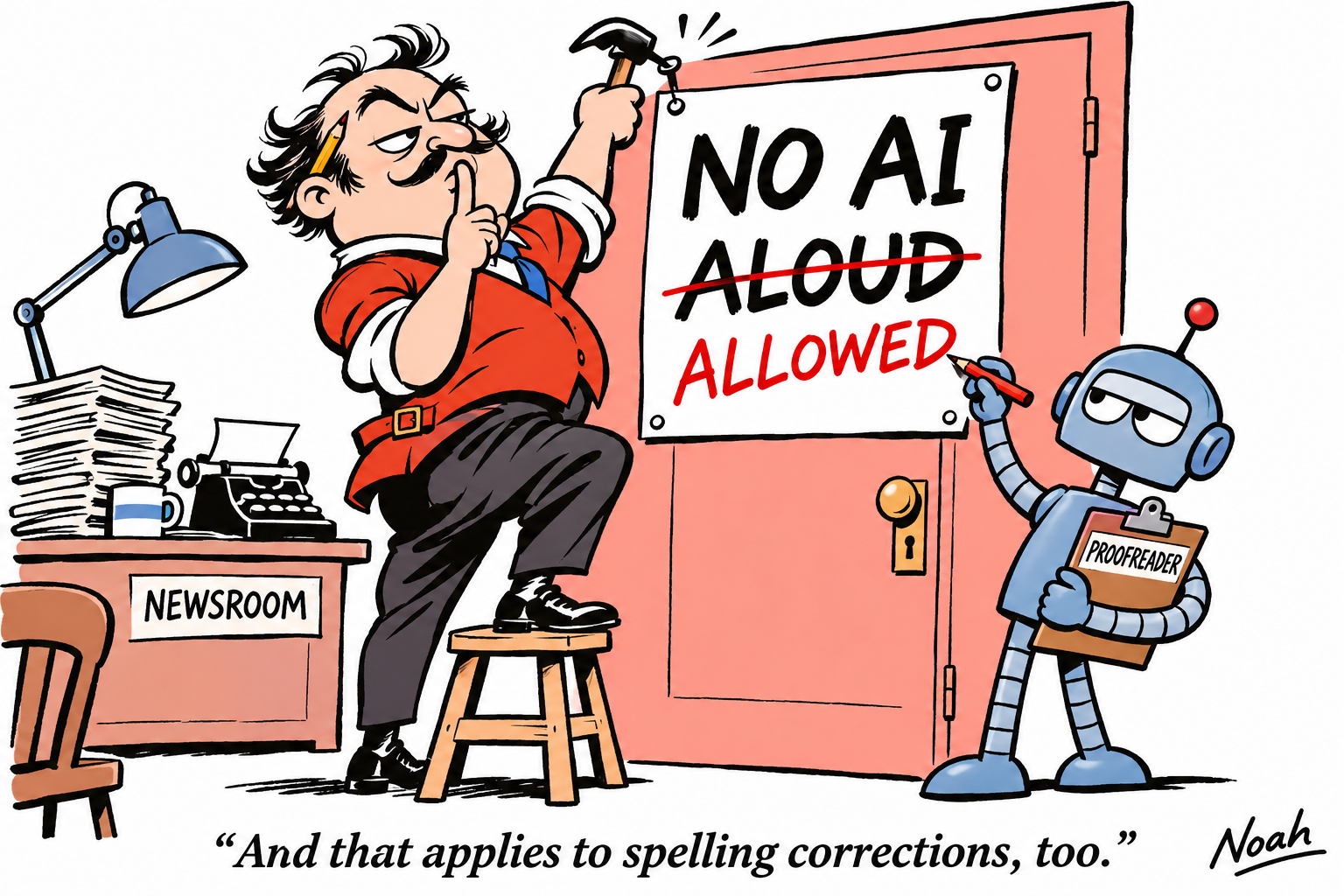
Cartoon · AI-generated
The paper's big weekend read asked whether we will soon cure cancer. An AI-assisted check found three slips that would have made headlines had a machine committed them, and a better story sitting in the public record.
The Financial Times has doubled down. Under chief executive Jon Slade and editor Roula Khalaf, AI is being kept out of the newsroom. Not just out of the writing: there is to be no AI checking copy before it is published, and certainly none going off to find the data. I think that is a mistake. [S28, S52--S53]
It is also great fun to watch, and a little sad. This is the paper that helped invent the FTSE 100. In January 1984 it launched the index with the London Stock Exchange, replacing a figure worked out once a day with one that moved as the market did. It did not report on the new instrument. It built it. [S54--S55]
Four decades on, the same organisation has looked at the most powerful research instrument to arrive in a generation and decided it would rather not. The group will happily offer readers a generative AI product, Ask FT. The machine may serve the customers. It may not check the copy. Meanwhile the weekend paper grows ever more handsome, well travelled and pleased with itself, and it is becoming hard to tell where the FT ends and Monocle begins. [S35]
So we ran a test. We picked one of this weekend's flagship pieces at random: "Will we soon cure cancer?" by Michael Peel and Sarah Neville. We put it through Noah, our research system, and asked two questions. Was it accurate? And did it find the evidence one would expect the FT, of all papers, to find? [S1]
The short answers are "mostly" and "no". The check turned up three simple errors of exactly the sort that, had an AI made them, might have found their way on to the FT's own front page as fresh proof that machines hallucinate. It also turned up a better story than the one that was printed.
A confession. The test was hijacked by its subject. Whether AI is curing cancer is a question that anyone nearing sixty, and I declare an interest, would very much like answered. So this became less a review than a companion piece. Anyone who wants the answer will need to read the two side by side.
Three slips a machine would have caught
First, the feature lists CAR-T among measures that prevent cancer. It does not prevent anything. CAR-T is a treatment for people who already have the disease. [S9]
Second, it describes a pill for pancreatic cancer as "potential". The pill has a name, daraxonrasib, and American regulators approved it on 26 August, eleven weeks before the article appeared. It is on sale in the United States. In a newspaper that makes its living from knowing when a product has reached the market, that is quite a thing to miss. [S38--S40]
Third, it says cancer among younger British adults has risen 24% since the early 1990s. The Cancer Research UK figure of 24% covers 1995 to 2019. The version that starts in the early 1990s is 22%. Nobody will lose sleep over two percentage points, but it is the wrong number attached to the wrong years. [S7]
None of this sinks the piece, which is a good one. Karen Vousden of the Crick Institute, describing tumours as "part of an ecosystem of the entire organism", is worth the cover price alone. People have always made small mistakes and always will. The point is narrower and more awkward. All three were caught in the time it takes to make a cup of tea, by a tool the FT has decided not to own.
The evidence that was sitting there
The larger finding concerns what the feature did not find.
Take its treatment of AI. Readers are given a technology grandee's ambition to solve disease in general, and an anecdote about AI researchers taking up smoking because they expect a cure to arrive in time. The FT notes, fairly, that no evidence was offered for the smoking story. It ran it anyway.
What it did not run was the best evidence anyone has. A Swedish trial called MASAI put 105,934 women through breast screening, with AI helping to read the scans for half of them. More cancers were found. The workload of reading the scans fell by 44%. A follow-up looked at cancers that surface between screenings, the ones a reader missed, and found the AI group did no worse: 1.55 per 1,000 women against 1.76. That is not a cure. It is a machine doing a dull job well and freeing scarce specialists for other work. [S19--S20]
The feature even supplies the reason this matters. Mark Lawler of Queen's University Belfast tells the authors: "If you don't have pathology, you don't have precision oncology." Quite so. The article identifies the staffing shortage and then walks past the trial that addresses it.
Then there is the most cheering result of the year, which has nothing to do with AI at all. The OPTIMA trial followed 4,429 women with a common type of early breast cancer. Half had chemotherapy as usual. For the other half, a genetic test on the tumour decided who needed it. Five years on, 90.4% of the tested group were free of invasive breast cancer against 91.5% of the rest, close enough to meet the trial's standard for "no worse". For eligible women, mainly those aged 40 and over whose tumours score low on the test, that means being spared chemotherapy altogether. [S41--S42]
A feature about curing cancer that tells readers about new weapons might also have mentioned that one of the big advances is knowing when not to fire.
The vaccine section could have been firmer too. "Promising" is the word such articles reach for. By publication day there were hard numbers. In 1,137 patients who had had high-risk melanoma removed, 82.2% of those given a personalised mRNA vaccine alongside standard immunotherapy were free of recurrence at two years, against 70.0% of those given the standard drug alone. These were people who had already had cancer, so this is about stopping it coming back, not stopping it starting. It is still the first large trial of its kind to succeed. [S10--S11, S34]
The pancreatic pill likewise: patients whose cancer had spread, and who had already been through treatment, lived a median of 13.2 months on it against 6.7 on chemotherapy. [S6, S38]
When more information does not help
The data was not all good news, and that is rather the point of looking.
The NHS trial of Galleri, a blood test meant to catch a dozen cancers early, failed its main goal. After three rounds of screening it had not reduced the number of cancers found at a late stage. A second trial, in colon cancer, showed that a blood test could correctly predict who was at higher risk of relapse, and that changing their treatment in response did not improve the outcome. [S30--S31, S49]
Knowing more is only useful if it changes a decision for the better. That applies to cancer tests. It also applies to newsrooms deciding what to do about AI, and to companies like mine selling it to them.
So is AI curing cancer?
No. It is reading mammograms, competently, in Sweden. It is helping match patients to trials a little more accurately. In the laboratory it is doing interesting things that have yet to be tested on patients. The real gains of 2026 came from a genetic test, a vaccine and a pill, and from researchers working out who needs treating and who can be left alone. [S19--S22]
That is a less thrilling answer than "soon", and a more useful one. It is also the story.
Putting dates on it
A feature can describe a new frontier indefinitely. We thought we would give a few of these possibilities deadlines, so that readers can come back and see whether we were right. [F1--F5]
• American approval of a personalised mRNA vaccine to prevent melanoma returning after surgery: a 35% chance by mid-May 2027 and 60% by mid-November 2027.
• At least one NHS breast-screening service in England routinely using AI in place of one of its two human readers within a year: 28%.
• American approval within a year of a blood test to guide chemotherapy decisions after bowel-cancer surgery: 30%.
• NHS England funding a routine blood test that screens healthy adults for several cancers within a year: 14%.
These are Noah's estimates of regulatory and service decisions, not of anyone's chances with the disease. They will move as events do, and they can be marked against what happens.
A confession of our own
Our machine is not infallible either. On its first pass through the cancer feature, Noah returned a number of matches it labelled as direct. They included Samsung smartwatch software and an American broadcasting audit. We threw them out, ran a tighter search and checked what remained against the original trials and regulators' records.
Which is the whole case. AI needs editors and editors, it turns out, could use the AI. The FT has plenty of the first and has declined the second.
In The Leopard, Tancredi tells his uncle: "If we want everything to stay as it is, everything will have to change." He meant something more cynical than a publishing strategy, but the line fits. The FT wants to keep its authority. It earned that authority by building the instruments through which people understood a changing world, not by standing apart from them. [S56]
A paper that gave investors a live measure of the market ought to be curious about a live measure of the evidence. Until it is, the rest of us will have to check its homework.
Sources
Source: Tomorrow’s Publisher