‘AI slop’, ‘AI agent’ and ‘vibe coding’ make the leap into mainstream journalism
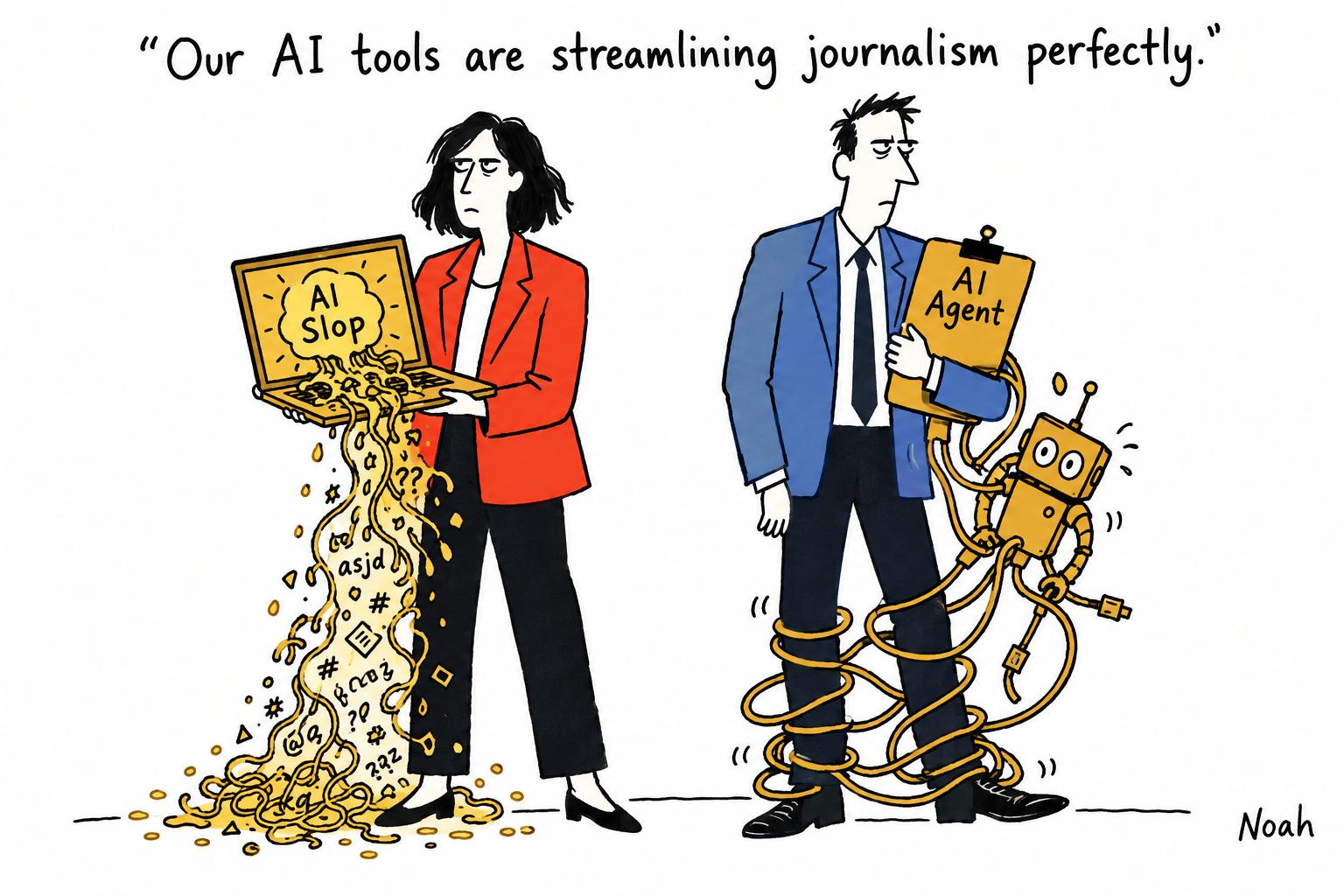
Cartoon · AI-generated
The Associated Press’s new style guidance reflects how quickly once-niche AI language has entered public debate, from low-quality machine-made content to software that acts independently and code written through prompts.
The Associated Press’s decision to fold "AI slop", "AI agent" and "vibe coding" into the 58th edition of its Stylebook in May 2026 says as much about the speed of language change as it does about artificial intelligence itself. In its updated guidance, the AP defined "AI slop" as low-quality, mass-produced AI material, described an "AI agent" as software that can act independently for a person or organisation, and urged reporters to avoid "vibe coding" outside direct quotations unless clearer wording is available.
What makes the additions notable is not simply that they were new, but that they each travelled into mainstream reporting by a different route. Coverage of "AI slop" rose gradually as publishers, platforms and readers grew more concerned about the flood of generic images, articles and videos clogging search results and social feeds. By contrast, "vibe coding" arrived almost at once, pushed into wider use after OpenAI co-founder Andrej Karpathy coined the phrase in February 2025 to describe programming by prompting rather than writing code line by line.
"AI slop" has increasingly become shorthand for the lower end of the generative AI ecosystem: material created quickly, in volume and often with little regard for accuracy or usefulness. The phrase has been adopted by outlets including The Guardian, the Reuters Institute and The New Yorker to describe everything from spammy text to synthetic video and other online detritus. Merriam-Webster’s naming of "slop" as its 2025 Word of the Year further underlined how firmly the term had taken root beyond developer circles.
The rise of "AI agent" has followed a different path. As companies have shifted from chatbots that merely respond to prompts towards systems that can carry out multi-step tasks, the language of agency has become a convenient way to describe that jump. Media Cloud analysis cited in the Storybench report found that mentions of the term rose from 52 stories in January 2024 to 1,273 in October 2025, before reaching 2,289 in September 2026, the highest monthly total in the period studied. That growth coincided with product launches from major technology companies, including tools designed to send emails, book travel, fill in forms and move across connected applications.
"Vibe coding" has perhaps travelled the furthest from niche jargon to cultural marker. What began as a playful description of coding with natural language prompts quickly spread into business coverage, software commentary and mainstream technology reporting. Collins later chose it as its Word of the Year, defining it as using natural language to ask AI to write computer code. Yet even as the phrase captured the appeal of faster software creation, reporting has also stressed its limits: without human scrutiny, the output can be buggy, insecure or simply wrong.
Taken together, the three expressions show how artificial intelligence is not only changing what technology does, but also how journalists talk about it. "AI slop" gives a name to the internet’s worsening noise; "AI agent" frames software that can act on a user’s behalf; and "vibe coding" captures the seductive ease of delegating programming to a machine. Their arrival in the AP Stylebook marks a broader moment when once-insider terminology has become part of everyday reporting, even as the meaning of those words continues to evolve.
Inspired by headline at: [1]
Sources by paragraph: - Paragraph 1: [2] - Paragraph 2: [2] - Paragraph 3: [2] - Paragraph 4: [2] - Paragraph 5: [2] - Paragraph 6: [2]
Source: Noah Wire Services · Original