WSJ uses AI to hear beyond the election horse race
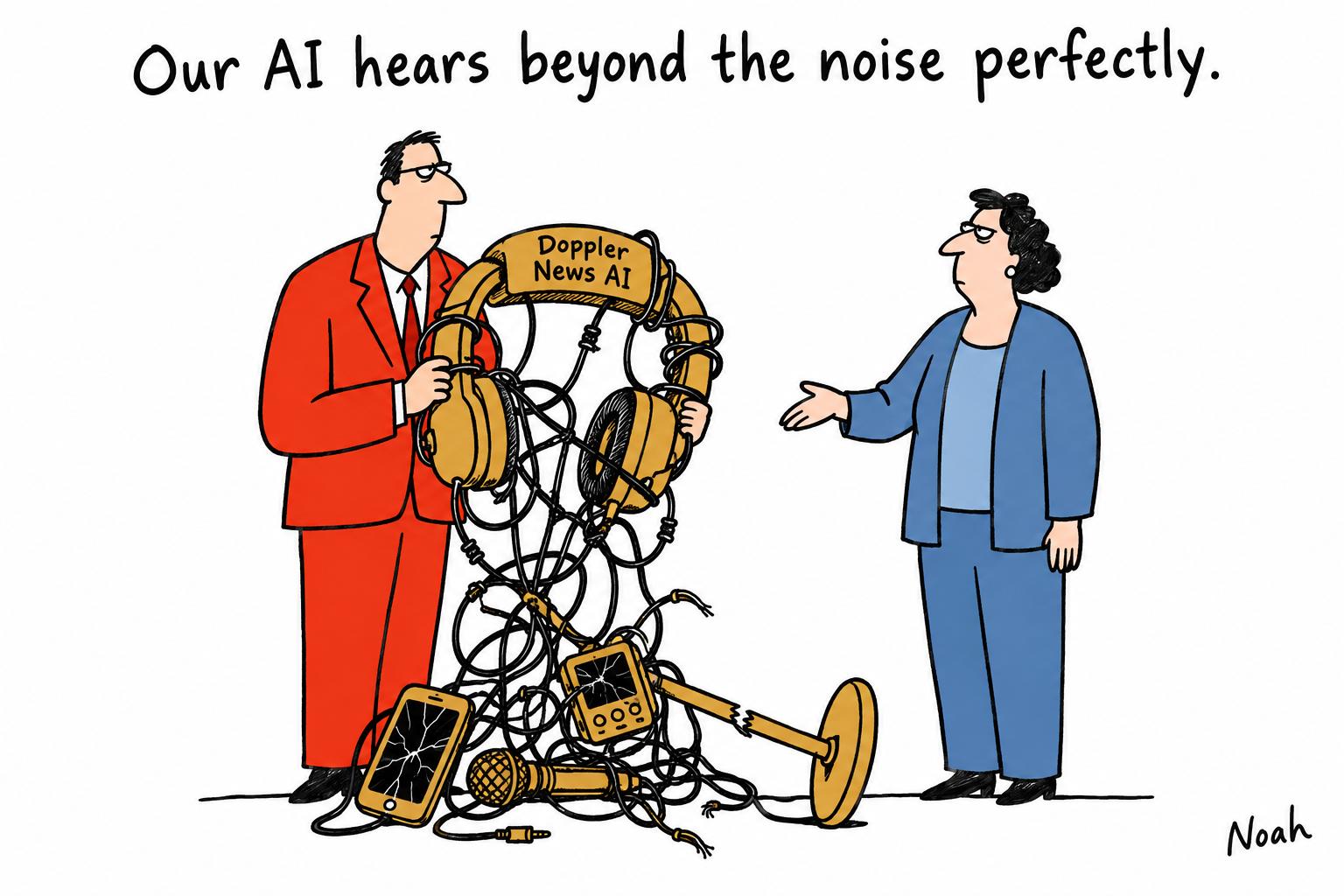
Cartoon · AI-generated
The Wall Street Journal is analysing millions of TikTok videos and podcast episodes with its Doppler News AI system to uncover the issues and anxieties shaping voters’ conversations ahead of the 2026 midterms.
The Wall Street Journal is leaning on a custom artificial intelligence system, known as Doppler News AI, to broaden its 2026 midterm election coverage beyond the familiar terrain of polls, ballot tests and horse-race reporting. According to Nieman Lab, the project is designed to sift through huge volumes of online material, including more than 25 million TikTok videos and roughly 500,000 podcast episodes, in an effort to identify the issues, moods and anxieties shaping voter conversations ahead of November’s vote.
The Journal has framed the tool as a way of listening more closely to the wider public conversation rather than trying to forecast the result. Aja Whitaker-Moore, the deputy editor-in-chief, told Nieman Lab that the newsroom wanted to capture how politics is experienced through everyday life - through culture, work, money, family and community - and to turn those signals into statistically grounded reporting. The paper has made clear, both in its own election guidance and in reporting on the project, that the system is meant to supplement journalism, not replace it.
That distinction matters because Doppler goes beyond the kinds of AI “visibility tools” other newsrooms have used to help with transcription or summarisation. The Journal is using it to conduct large-scale analysis and then publishing the findings as reported stories. The tool has already helped produce four major pieces of midterm coverage, with more expected before election day, and each story has required close collaboration between engineers, data journalists and the political team to test assumptions, refine methods and check the results.
Among the stories generated so far, one published on 8 October examined more than 30,000 hours of podcasts and found that right-leaning podcasters had recently been discussing affordability as often as their left-leaning counterparts, even after Donald Trump described the affordability crisis as a “hoax”. Another, on 1 October, used millions of TikTok videos and thousands of hours of podcasts to explore anti-AI sentiment, including opposition to Flock surveillance cameras. The analysis suggested that people posting anti-Flock views disagreed on other political questions at a rate far higher than average, making the issue unusually unifying among otherwise divided creators.
A further story on 15 October used the same database to assess online sentiment around Democratic politicians, finding that Angie Nixon, the progressive Florida Senate candidate, drew the most favourable TikTok commentary among the group studied, while Georgia Senator Jon Ossoff followed behind her and Senate Minority Leader Chuck Schumer ranked at the bottom. According to the Journal’s reporting, the newsroom is also testing how the system might be adapted beyond election coverage, with Whitaker-Moore saying the technology could outlive the midterms and be useful across other desks.
The mechanics of Doppler reflect both the scale and the limits of the Journal’s approach. The team relies on vectorisation and embedding models to sort ideas into clusters, allowing reporters to spot patterns emerging across social media and podcasting data. It is not, however, a fully automated newsroom substitute. Rob Barry, who leads the Journal’s data journalism team, told Nieman Lab that there is “almost always going to be some level of error and uncertainty and blur around the edges”, and said human judgement remains essential to deciding which questions to ask and how to interpret the findings. That caution is built into the paper’s disclosures, which accompany each story and explain both the method and its limitations.
Inspired by headline at: [1]
Sources by paragraph: - Paragraph 1: [2] - Paragraph 2: [1], [3] - Paragraph 3: [1], [2] - Paragraph 4: [1], [2] - Paragraph 5: [1], [2]
Source: Noah Wire Services · Original