WSJ’s Doppler AI listens beyond the polls for the issues shaping the 2026 midterms
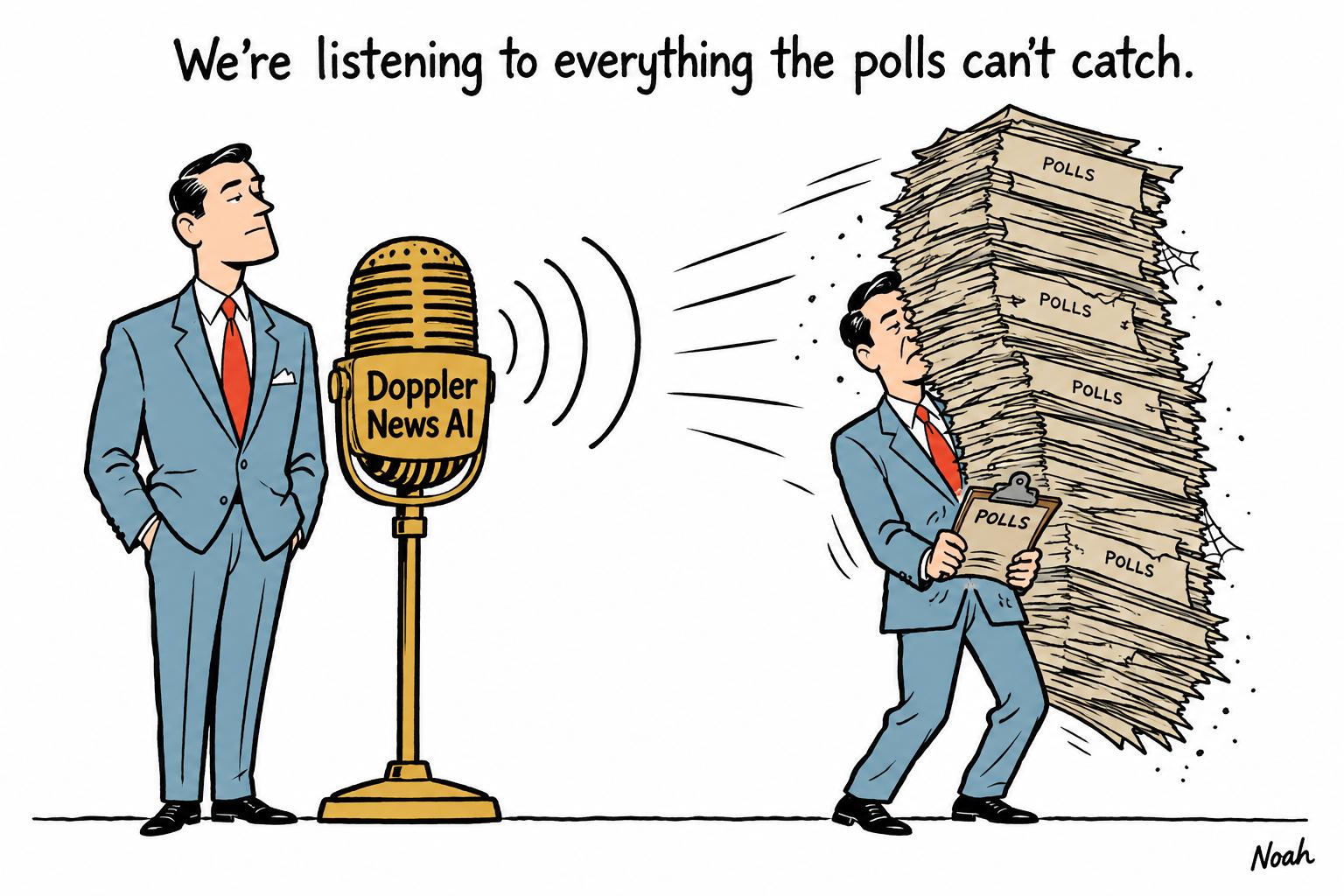
Cartoon · AI-generated
The Wall Street Journal is using Doppler News AI to analyse millions of videos, podcasts and news clips, seeking political undercurrents that conventional polling may miss.
The Wall Street Journal is testing whether a custom artificial intelligence system can do for political reporting what conventional polling has long struggled to provide: a clearer view of what voters are actually talking about. More than 100 million people are expected to vote in the 2026 US midterm elections, and the Journal’s new tool, Doppler News AI, is being used to scan huge swathes of online conversation in search of the issues, anxieties and cultural cues shaping the race.
In practice, that means the newsroom is pulling together material from across the internet rather than relying solely on surveys or campaign messaging. According to the Journal, Doppler has already absorbed more than 25 million TikTok videos, about 500,000 podcast episodes, and thousands of Instagram clips and cable news segments. The aim is not to forecast the outcome of the election, but to identify the themes that are gaining traction among voters and to broaden coverage beyond the traditional horse-race framework.
Aja Whitaker-Moore, the Journal’s deputy editor-in-chief, said the project grew out of a recognition that political opinion is often expressed in places polling does not fully capture. “We’re not trying to predict the election, but people encounter politics through a lot of different lanes: culture, work, money, family, community. We wanted to tap into that and listen in on those conversations,” she told the paper. The Journal says the tool is designed to translate that mass of content into statistically grounded findings about what people are discussing and where those conversations are happening.
The newsroom has already used Doppler to produce several major stories. One article on October 8 examined more than 30,000 hours of podcasts and found that right-leaning hosts had begun discussing “affordability” as often as left-leaning voices, despite President Trump dismissing the affordability crisis as a “hoax”. Another, published on October 1, focused on anti-AI sentiment and opposition to Flock surveillance cameras, drawing on more than four million TikTok videos and thousands of hours of podcasts. A third story, on October 15, analysed the online treatment of 67 Democratic politicians and found that Florida progressive Angie Nixon attracted the most favourable TikTok commentary, while Senate Minority Leader Chuck Schumer ranked lowest.
The project reflects a broader newsroom effort to build AI tools for reporting rather than for content generation. Whitaker-Moore said the idea came from discussions with Washington bureau chief Damian Paletta and politics editor Christopher Matthews, who felt the 2024 election coverage had missed important undercurrents that never showed up in polling. Rob Barry, who leads the Journal’s data journalism team, was asked to create something that could, in Whitaker-Moore’s words, “eat the internet and then feed it back to us”. The Journal had already built Orca, a podcast transcription and summarisation system, and its earlier TikTok investigations made the platform a natural source of material for Doppler.
Behind the scenes, the system combines different AI models, including large language models and embedding models that convert text and images into numerical vectors, allowing reporters to see where ideas cluster and how themes emerge. Barry said the database is expanding continuously and that the tool still depends on human judgement. “There’s a lot of human judgment in this,” he said, adding that the newsroom does not want the system to generate publishable material without editorial oversight. Each Doppler-assisted story carries a methodology note explaining how the analysis was done and where the limits lie. Even with spot checks, Barry acknowledged that there will always be some uncertainty around the edges.
The Journal is also treating Doppler as more than a midterms experiment. Whitaker-Moore said the team believes it could eventually be used on other desks, since the data it collects is not inherently political. That wider ambition comes at a moment when AI is already becoming more entangled with election coverage and electioneering. Earlier this year, The Wall Street Journal reported that thousands of lobbyists were devoting attention to AI-related political activity and that AI companies had pledged roughly $265 million to super PACs and related groups ahead of 2026. At the same time, other Journal reporting has underscored the structural forces shaping American politics, from gerrymandering to the difficulty both parties face in winning independents. Doppler, by contrast, is an attempt to hear the public mood directly, however messy and fragmented that conversation may be.
Inspired by headline at: [1]
Sources by paragraph: - Paragraph 1: [2] - Paragraph 2: [2] - Paragraph 3: [2] - Paragraph 4: [2] - Paragraph 5: [2] - Paragraph 6: [3], [4], [5], [6], [7]
Source: Noah Wire Services · Original