Who’s laughing now? Google loses half a trillion dollars as its AI answers earn less
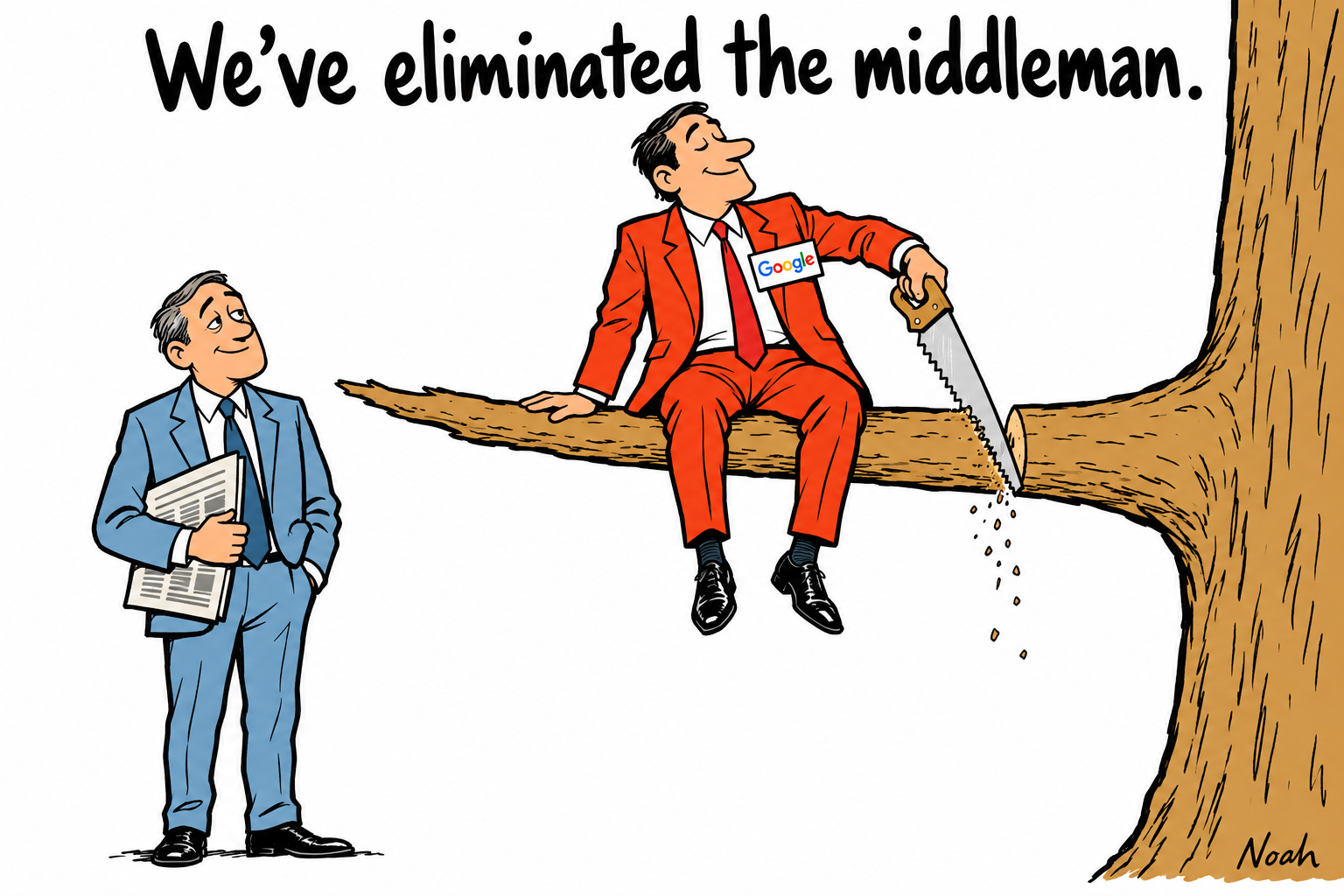
Cartoon · AI-generated
Imagine the head of audience at a British publisher. For eighteen months, the same quarterly meeting: fewer readers arriving from Google, more of the newsroom’s work appearing in AI answers, another revenue target to revise. This is an illustrative scene, but the commercial problem is documented. Publishers have been asked to adapt to a future whose terms somebody else controls.
On Thursday, Google’s shareholders got a taste of that uncertainty. Alphabet shares fell about 13% in early US trading after Wednesday’s results. Moneycontrol reported roughly $511bn erased from its market value at 9.35am in New York. That is a snapshot of a moving market, not a closing loss. Yahoo Finance put the company on course for its largest one-day dollar decline; Nvidia’s January 2025 loss remained the larger US-company record.
Publishers can be forgiven a moment of satisfaction. Google has acknowledged that its fast-growing AI Mode earns less from advertising, contributing to slower search revenue growth. The company that rewrote the bargain between search and the open web is now confronting an awkward question of its own: what happens when the new answer is less valuable than the old journey?
The sell-off does not prove that AI answers caused every lost dollar, or that publishers will recover theirs. It does puncture the comforting idea that rising AI usage automatically means healthier economics. Publishers recognised that distinction long before Wall Street sent this bill.
Google’s numbers have caught up with the argument
Google Search & other revenue rose 12% to $63.35bn in the third quarter. It was still growing, but more slowly than the 19% reported in the first quarter and 17% in the second. Meanwhile, Sundar Pichai said the year-on-year growth rate in search queries was the highest in five years. More activity was not producing the acceleration investors wanted.
Chief business officer Philipp Schindler named lower monetisation in AI Mode as one contributor. He also identified currency as the largest driver of the slowdown from the previous quarter, alongside changes in advertiser spending. Those distinctions matter. The results are evidence of an AI monetisation problem, not a controlled experiment proving that all search weakness comes from AI.
For publishers, the admission is consequential enough without exaggeration. AI Mode is Google’s conversational search experience; AI Overviews are summaries within search results. Both change the route between a reader and a source. When an answer satisfies the reader on Google, a citation alone cannot guarantee the visit that funds reporting or starts a subscription.
Alphabet’s spending added to investors’ concerns. Quarterly capital expenditure reached about $51.4bn and free cash flow was negative $9.1bn. Free cash flow is the money left from operations after capital expenditure; it is not the same as an operating loss. Alphabet’s total revenue grew 25% and Cloud revenue more than doubled. This is a powerful business being challenged over the return on its investment, not a company running out of customers.
The reassurance that did not protect publishers
On its third-quarter call in 2025, Google said AI Overviews monetised at “approximately the same rate” as conventional search. The qualification is important: that statement concerned AI Overviews, while AI Mode advertising was still being tested. It would be wrong to present the latest admission as a reversal of an identical promise about the same product.
But publishers were never entitled to assume that Google’s successful monetisation meant successful monetisation for them. Google can sell an advertisement around an answer while the publication that supplied the underlying reporting receives no visit. Even a thriving search business would not settle that complaint.
Now the incentives are more complicated. Google has to fund a costly transition while learning how to sell the new experience. Publishers should stop accepting aggregate query growth as an answer to a question about their own income. The relevant questions are who supplies the value, who captures it and what reaches the newsroom.
The missing click has a cost
Chartbeat’s research found that Google Search pageviews across its network fell 34% between December 2024 and December 2025. Its wider analysis also found much steeper search-referral declines for small publishers than for large ones. These are findings from an analytics network, not a measurement of every publisher or proof that AI alone caused the decline.
Ahrefs has separately reported a 58% reduction in click-through rate for the top organic result associated with AI Overviews in its updated study. A click-through rate measures the share of search appearances that become clicks. It is not a 58% fall in all traffic or revenue, but it shows why a good ranking can become a weaker commercial asset.
The practical loss extends beyond one advertising impression. A reader who never arrives cannot discover the publication’s newsletter, compare its expertise with a rival’s or decide to subscribe. A publisher can become more useful to an answer engine while becoming less visible as a business.
There is a useful counterpoint in Chartbeat’s work: overall traffic held up much better than search traffic. Direct relationships and other routes can cushion the damage. That is a reason to invest in them, not to pretend that every displaced search visit has been replaced or that smaller publishers can absorb the transition equally.
Google was already opening its wallet
Google announced on 15 October that more than 400 publications were participating in its News AI pilot. New names included Axios, CNN, the Financial Times and Forbes. Google says it pays for enhanced content used to develop AI features, including article overviews and audio briefings on Google News.
That programme is separate from the AI contribution pilot covering content that helps generate responses in Gemini, AI Overviews and AI Mode. Mixing them together makes Google’s payments look simpler and more comprehensive than the evidence supports.
Reporting by The Information, summarised by Search Engine Journal, describes sharply uneven payments in the contribution pilot: one early participant earning more than $1m a year, some smaller sites receiving less than $1,000 over several months, and several small and midsized sites receiving less than 0.1% of their advertising revenue. Those figures concern different publishers over different periods; they are not a published rate card.
The problem is the bargain. A payment whose calculation cannot be inspected is difficult to forecast, challenge or improve. Publishers should ask what counts as a contribution, which uses qualify and how a change in product design changes what they earn. A cheque establishes that payment is possible. It does not establish that the price is fair.
Turn the moment into negotiating power
The CMA’s publisher conduct requirement, imposed on 3 June, strengthens that discussion in the UK. It gives publishers controls over the use of content in Google’s search AI features and requires clearer attribution and links. The regulator explicitly presents the measures as a way to improve publishers’ bargaining position.
That creates a stronger starting point, not an automatic licence fee. Withholding content can carry costs; the value of any deal depends on the rights granted and the return received. Publishers need to know what they are supplying before trading it for an opaque promise of exposure.
Three demands should frame the next negotiation. First, an intelligible payment formula and reporting that lets a publisher check how its journalism contributed. Second, visible, usable routes back to the source, measured by valuable visits rather than a count of citations. Third, clear controls over permitted uses, corrections and withdrawal. Reader choice about AI answers should remain part of the wider regulatory argument.
The risk is a market in which the strongest brands negotiate substantial fees while smaller suppliers accept terms they cannot interrogate. That is a scenario to resist, not an inevitable settlement. Distinctive reporting, evidence of its use and collective licensing options can all improve a publisher’s position.
Enjoy the moment. Then send the terms.
Google is not about to abandon AI search because of one earnings reaction. Management’s response includes expanding advertising in AI Mode. That might improve Google’s returns without restoring a single publisher’s lost visit. A recovery in the share price would not resolve the argument either.
The publishers’ strongest case has always been more serious than protecting an old layout of blue links. Reporting costs money. If platforms substitute answers for visits, the economic relationship must change with the product. Expecting the supplier to keep funding the work while surrendering the customer is not a durable bargain.
Google’s shareholders have now been reminded that usage and value are different things. Publishers have lived with that distinction for much longer. They can enjoy the irony. The useful next move is to put a price—and enforceable terms—on what they provide.
Sources
- Alphabet third-quarter 2026 results — SEC filing
- Alphabet Q3 2026 earnings call — transcript
- Reuters: Search slowdown and cash burn — 29 October 2026
- Moneycontrol: early-trading market-value loss — 29 October 2026
- Yahoo Finance: Alphabet heads for its largest dollar decline
- Alphabet Q3 2025 earnings call — AI Overviews and AI Mode distinction
- Chartbeat: Pageviews are down, but AI’s impact is complicated
- Ahrefs: Updated AI Overviews click-through findings
- Google: More than 400 publications in the News AI pilot
- Search Engine Journal: AI contribution pilot payments, citing The Information
- CMA: Publisher conduct requirement — 3 June 2026
Source: Tomorrow’s Publisher