The Guardian gets carbon removal wrong. Why aren't tier one papers using tier one data?
Think Negative challenged us to check the Guardian's reporting from COP31. We found carbon stored in fizzy drinks, a headline number attached to the wrong technology, and a question that applies to every publisher.
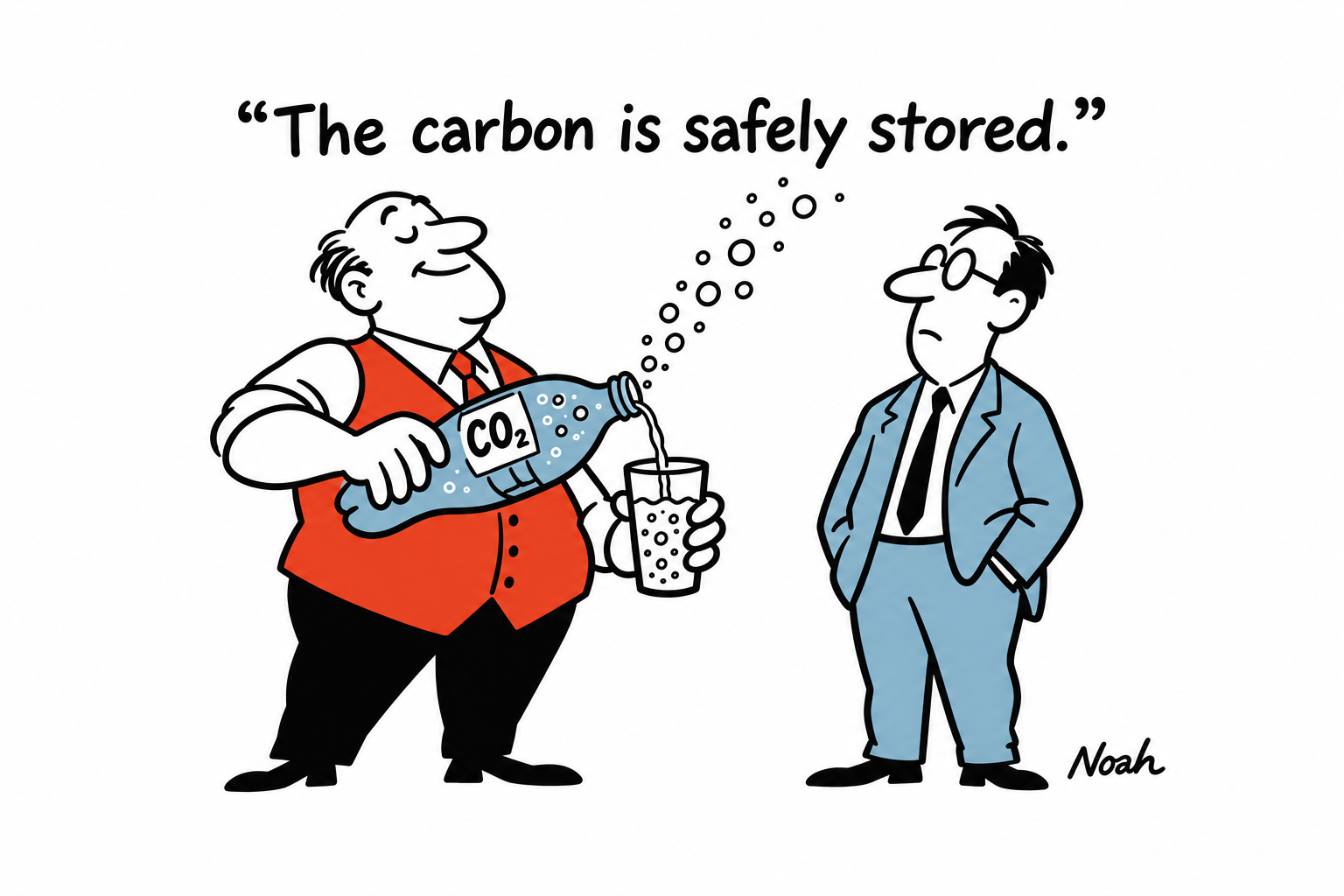
Cartoon · AI-generated
On 16 November the Guardian's Oliver Milman reported on a push to give carbon dioxide removal greater recognition at the COP31 climate talks. [1] Think Negative, an independent organisation advocating carbon dioxide removal, sent Tomorrow's Publisher a challenge: check whether the evidence supports the story.
We usually reserve this sort of attention for the Financial Times, so a change of target was welcome. We took the article back to its sources: the IPCC, the State of Carbon Dioxide Removal report, UNEP and the companies named. The exercise produced an irony. The Guardian's piece is largely sceptical of carbon removal, yet its most striking numerical error flatters the technology it doubts. Put the figure right and direct air capture looks considerably worse than the Guardian suggested, while the case for dismissing the whole sector looks weaker.
"It is too late to just reduce emissions, we have to remove as well," Think Negative told us. [10] The organisation describes its role as bringing together the range of actors needed to deliver the removal the IPCC says is necessary. It is an advocate for that outcome, which is why we tested its arguments against original publications.
A publication concerned with the future of journalism should care what established newsrooms get wrong as well as what new technology gets wrong. And a newspaper whose environmental coverage is central to its identity deserves close scrutiny when it explains a possible response to climate change.
What the Guardian got right
Milman's article raises legitimate concerns: cost, disappointing performance, and the danger that promises of future clean-up excuse emissions today. Those concerns are real and the Guardian is right to air them.
It is on firm ground, too, when it questions the industry's financial health. Climeworks has publicly acknowledged commercial pressures and planned workforce reductions. [7a] The article leaves out the other half of that picture. The company's September 2026 update reported 675 tonnes of net removal at its Mammoth plant in the first half of 2026, against 119 tonnes in the same period of 2025. [7b] These are company-reported figures and tiny quantities, but they are evidence of improvement. A serious account can say that a technology is getting better while remaining far short of its ambitions. It can also separate operating results from planned capacity, and signed contracts from delivered removal.
A fizzy drink is not a carbon store
The trouble starts in the opening explanation. The article describes carbon dioxide removal as taking CO₂ from the atmosphere and storing it underground, in oceans or in products such as carbonated drinks.
A fizzy drink is a poor place to keep carbon out of the atmosphere. The gas is released again shortly after someone opens the can. Atmospheric CO₂ can be used in beverages, but using carbon is different from removing it, and the IPCC makes durable storage part of the definition. [2] A reader introduced to the subject through this example starts with the wrong idea of what counts.
The Guardian needs to explain the difference between preventing further emissions and removing CO₂ already in the atmosphere. Carbon capture and storage (CCS) applied to fossil-fuel emissions can prevent some of that CO₂ reaching the air. Carbon dioxide removal (CDR) takes CO₂ from the atmosphere and stores it durably. Carbon capture, utilisation and storage (CCUS) is a broader label: using captured CO₂ in a product does not by itself establish permanent storage or removal. [2]
Removal is not confined to machines filtering the air or to planting trees. The IPCC assesses methods including storing additional carbon in soils, making biochar from biomass, bioenergy with carbon capture and storage, enhanced rock weathering and ocean-based approaches. Biochar converts plant material into a more stable carbon-rich form; enhanced weathering accelerates mineral reactions that bind CO₂. These methods differ in technical maturity, resource needs, environmental effects and the difficulty of verifying net removal. They should not be presented as one interchangeable technology. [12]
Permanence is a central distinction. Carbon held in vegetation and soils can be released by fire, drought or changes in land management. Geological storage can retain it for much longer, and the IPCC assesses storage timescales and reversal risks separately from the feasibility of deploying each method. Readers need that guidance on where different approaches can work and how long their storage can last. Leaving it out suggests a blanket uncertainty that does not reflect the distinctions already made in the scientific literature and the UN's assessments. [4] [12]
The number that flatters the technology
The article assigns a figure of two million tonnes to technological efforts that vacuum CO₂ from the air. The 2026 State of Carbon Dioxide Removal report puts all novel removal activity at approximately 2.04 million tonnes of CO₂ in 2025, most of it biochar and bioenergy with carbon capture and storage. Its documented estimate for direct air capture and storage is approximately 1,500 tonnes, subject to reporting limitations. [3] The broader total also includes transfers of previously captured woody carbon into more durable storage, and the figure should be labelled consistently as tonnes of CO₂ rather than tonnes of carbon.
Two million tonnes and 1,500 tonnes are different categories, and the distinction should have survived the journey from research report to newspaper.
This is the useful test of our own argument. Accurate reporting would have strengthened the Guardian's criticism of one technology while weakening a dismissive account of the sector as a whole. The point of checking the data is to find out which way it cuts.
The science left to the advocates
The more consequential omission is why removal is being discussed at all. The IPCC describes removal to counterbalance hard-to-abate residual emissions as unavoidable if net-zero CO₂ or greenhouse gas emissions are to be achieved. Its assessment places removal alongside deep cuts in emissions. [4]
The Guardian acknowledges that removal features in climate models and quotes an expert on its necessity. Yet it largely leaves the scientific case to advocates, while lobbying and controversy supply the organising frame. That blurs two separate propositions: the assessed need for some removal, and commercial claims about which companies, methods or subsidies deserve support. Accepting the first does not require accepting the second.
Think Negative believes the choice of voices reflects an editorial preference. "It gives weight to sources that support its ideological position and fails to provide balance," the organisation says. [10] That is its assessment. We can test the published selection and its omissions. We cannot establish a newsroom's motives from one article.
Possible, practical and likely are three different things
The article quotes a campaigner describing the technologies as hypothetical and a return from temperature overshoot as impossible. A journalist can report an opinion accurately and still leave readers unable to evaluate it.
Some removal methods operate today. Whether they can reach billions of tonnes a year, affordably and sustainably, remains profoundly uncertain. The IPCC assesses that sustained global net-negative CO₂ emissions would gradually reverse CO₂-induced warming, while warning that some other climate changes would persist. [5] Physical possibility, industrial capability and political likelihood are separate questions, and an article about the future of the climate should help readers tell them apart.
The same care is needed with the claim that warming will otherwise persist for thousands of years. Reaching net-zero CO₂ broadly stabilises CO₂-induced warming. It does not guarantee a quick return below a temperature threshold already passed, and the IPCC is uncertain whether temperatures rise or fall over the following decades. [11] A promise of automatic, dependable cooling after net zero would be just as misleading.
A real number without its conditions
The Guardian's 320 billion tonne figure is a subtler failure. The number is real. UNEP's October 2026 analysis describes roughly that amount of removal and permanent storage this century in its lowest possible overshoot scenario. But the same pathway requires exceptionally steep emissions cuts and offers about a 50 per cent chance of returning to or below 1.5°C by 2100. [6] The figure belongs to one scenario. It is not a universal clean-up bill calculated regardless of what the world does next.
Large numbers lend authority to an article while shedding the assumptions that gave them meaning. Readers need the conditions as well as the quantity.
Forests get a free pass
Scrutiny of the alternatives is uneven. The article reports a suggestion that eliminating fossil fuel use and letting reforestation absorb excess CO₂ could eventually bring temperatures back down. Reforestation is itself carbon removal. Its potential depends on land, additional uptake and continued protection, and its stored carbon can be released by fire, drought or other disturbance. The IPCC explicitly distinguishes those reversal risks from more durable storage. [4]
A fair investigation would interrogate the forest proposal as closely as the engineering ones. Calling a method natural does not establish how much it can deliver or for how long.
The safeguards that went unreported
The familiar story of an industry seeking permission to pollute does not explain the policy debate either. The risk that removal deters emissions cuts is real. So are the proposals designed to prevent it.
The European Scientific Advisory Board on Climate Change recommends separate legal targets for emissions, temporary land removals and permanent removals. [8a] Think Negative says removal must complement deep emissions cuts and requires net removal, durable storage and independent verification. [8b] Those commitments deserve testing. Their existence also deserves reporting.
Think Negative accepts that safeguards are needed. We would not assume they will be easy to agree or enforce. Measuring net removal, assigning responsibility when storage fails and deciding which emissions may be balanced are substantial policy questions, and a case for developing removal is compatible with demanding answers to them.
This is where the Guardian's emphasis is most questionable. Its readers get far more help understanding the suspicion around removal than understanding how a credible system might tell useful removal from an excuse for delay.
There is a better story available. A newsroom could investigate which methods have independently demonstrated net removal after accounting for their own emissions, how storage fails and who carries the liability. It could examine which subsidies buy delivered climate benefit and which merely buy announcements. That would serve readers better than asking them to choose between enthusiasm and rejection.
What this has to do with publishing
Tomorrow's Publisher has an interest here because the argument about journalistic quality too often stops at the identity of the producer. AI is examined closely for factual mistakes. Established news organisations must meet the same standard.
The Guardian's own editorial code, amended in March 2026, warns that generative AI can introduce errors unpredictably and requires active human oversight. It also requires accuracy and reliable corroboration throughout its journalism. [9] Those are sensible principles. The published result still has to show that they worked.
Asked what a newspaper should do before publication, Think Negative is direct: "Test it against a wider fact base and with a representative group of trusted sources." [10] That is a reasonable thing to expect of a publication asking readers to trust its reading of the science.
We have no evidence either way on whether AI was used in the Guardian's article, and it would be careless to call this an AI failure or proof that journalism without AI fails. What we can examine is the story readers received and the evidence available to check it.
We used AI-assisted research ourselves, including Noah's archive, and checked every substantive claim against the original publication. Automated research is not self-validating. Its useful role is to help an editor find the source behind a number, keep its definitions intact and test the assumptions inside a quotation. That work still needs accountable judgement. A fluent automated summary can lose context just as easily as a fluent newspaper article.
None of this establishes deliberate bias, or shows that the Guardian's wider environmental coverage is unreliable. One article supports a criticism of one article. Its errors and omissions are substantial enough to warrant correction and explanation on their own.
For publishers, the commercial implication is uncomfortable. If authoritative prose and a familiar masthead are the main signals of quality, those signals are becoming easier to imitate. The defensible value lies in evidence readers can inspect and explanations that survive the inspection.
The Guardian is right to question extravagant promises about cleaning up the atmosphere. Its readers are entitled to equally careful treatment of the science behind those promises, and on climate change the cost of confusing the two is especially high.
Tier one publishers need tier one data. They also need an editorial process that preserves its meaning.
Sources
1 COP31 carbon removal article. Oliver Milman, the Guardian, 16 November 2026.
2 Definition of carbon dioxide removal. IPCC AR6 Working Group III Technical Summary. Durable storage distinguishes removal from short-lived utilisation.
3 Removal quantities and accounting. The State of Carbon Dioxide Removal, third edition, Chapter 7, pp 162 and 172, 2026. The direct air capture estimate uses available registry data and excludes some unverified activity.
4 Residual emissions and storage reversal. IPCC AR6 Working Group III Summary for Policymakers, C.11 and C.11.3.
5 Temperature response to net-negative emissions. IPCC AR6 Working Group I Summary for Policymakers, D.1.5 and D.1.6.
6 The conditional 320 gigatonne estimate. UNEP, 21 October 2026. Emissions Gap Report scenario and its associated emissions cuts.
7a Climeworks commercial pressures. Climeworks CEO update.
7b Climeworks operating progress. Climeworks performance update, September 2026. Company-reported figures, not independent validation.
8a Separate targets and safeguards. European Scientific Advisory Board on Climate Change, 21 February 2025.
8b Think Negative stated position. Negative Emissions Platform, 9 November 2026.
9 Guardian editorial standards. Guardian News & Media Editorial Code, amended March 2026, pp 5, 12 and 18.
10 Think Negative, written responses to Tomorrow's Publisher and subsequent attribution clarification, 16 November 2026.
11 Temperature after cessation of CO₂ emissions. IPCC AR6 Working Group I Chapter 4, section 4.7.1.1.
12 Removal methods, storage timescales and applicability. IPCC AR6 Working Group III Chapter 12, section 12.3 and Table 12.6.
Source: Tomorrow’s Publisher