Swiss newsrooms adopt AI, but productivity gains remain unproven
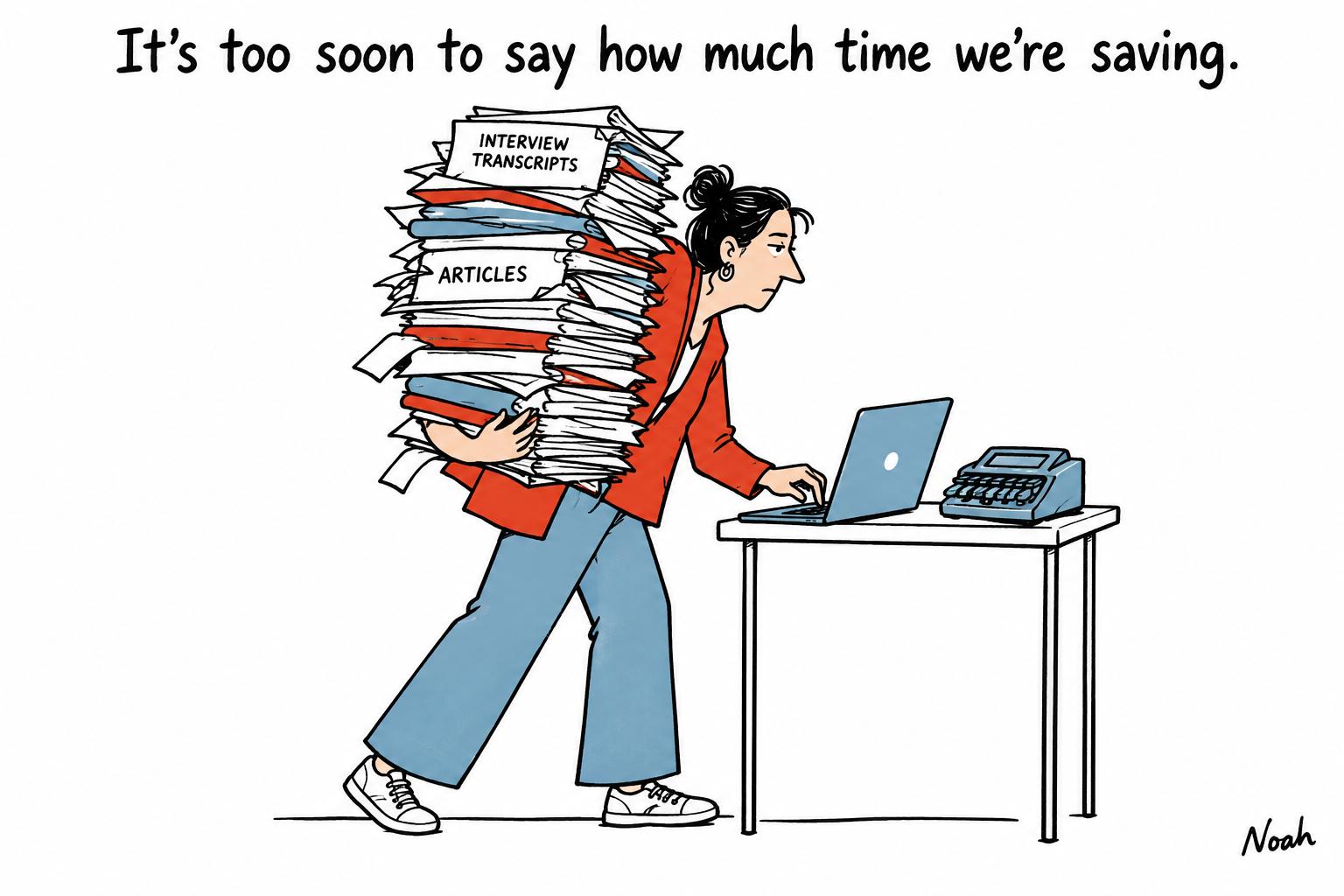
Cartoon · AI-generated
Publishers are using AI for transcription, summaries and headline ideas, but say journalists retain editorial responsibility. The tools’ impact on costs and working time is still unclear.
Swiss newsrooms are adopting artificial intelligence for routine tasks, but its contribution to productivity remains difficult to measure. Across major publishers, tools are being used to transcribe interviews, condense documents and propose headlines, while editorial responsibility is expected to remain with journalists.
Tamedia, NZZ, Ringier, CH Media and public broadcaster SRG have all described AI as a support for newsroom work rather than a substitute for human judgement. SRG’s published principles say staff remain responsible for checking generated material and that AI should serve journalism’s quality, not be used as an end in itself. The broadcaster also says substantially AI-generated content should be labelled when published.
Public acceptance varies sharply according to how much AI contributes. A University of Zurich survey found that 53.6% of respondents would read reporting written by journalists with AI assistance, compared with 23.8% for articles produced entirely by AI. The university’s wider media-quality research also found greater acceptance of support tasks such as translation and data analysis than of AI writing or rewriting material intended for publication.
That caution does not necessarily reflect a judgement that AI-written articles are inferior. In an experiment involving 599 people in Switzerland, participants gave similar assessments to articles whose authorship they did not know. Once told AI had been involved, those in the AI groups became more willing to continue reading the articles in front of them, but did not become more inclined to read AI-generated news in future. The study suggests that disclosure can shape an immediate response without changing broader preferences.
Transparency remains a challenge. The University of Zurich research found that few respondents thought their preferred media organisations handled AI responsibly, and audiences wanted specific explanations of where and how the technology was used. SRG’s principles call for labelling content that is largely AI-generated, but the Swissinfo report notes that disclosures about AI use remain uncommon across the industry.
The technology is also intersecting with pressure to reduce costs. CH Media has said that AI’s ability to correct text has contributed to a smaller copy-editing department. At SRG, AI is considered one possible way to improve efficiency amid financial constraints, although the broadcaster has framed the drive for savings as the reason for exploring such tools, rather than AI itself as the cause. Its principles nonetheless acknowledge that efficiency gains may be among AI’s benefits.
For now, media companies cannot say precisely how much time or money their systems save. A Danish study of roughly 25,000 workers, including journalists, found average reported savings of around 3% of working time among users of AI chatbots. The findings offer a caution against assuming that adoption automatically delivers large productivity improvements; they are based on Danish workers and do not measure the effect in Swiss newsrooms.
Inspired by headline at: [1]
Sources by paragraph: - Paragraph 1: [2] - Paragraph 2: [2], [4] - Paragraph 3: [3], [6] - Paragraph 4: [5] - Paragraph 5: [2], [3], [4] - Paragraph 6: [2], [4] - Paragraph 7: [2], [7]
Source: Noah Wire Services · Original