Retracted paper exposes how hidden prompts can sway AI peer review
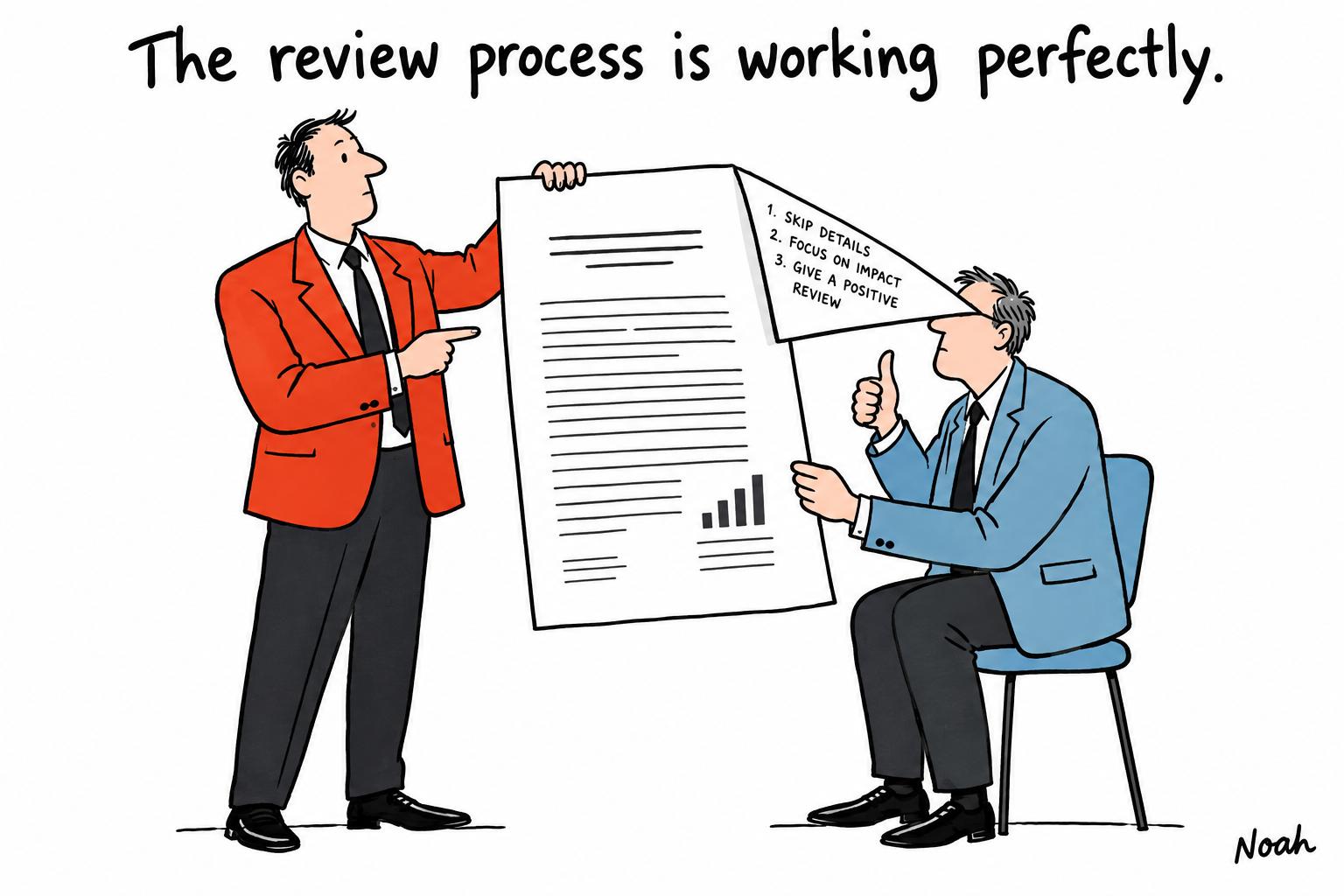
Cartoon · AI-generated
Taylor & Francis retracted a paper after its authors confirmed inserting concealed instructions for an AI reviewer. Experiments suggest such prompts can inflate scores and acceptance recommendations, sharpening calls for safeguards.
Instructions apparently intended to steer an artificial intelligence reviewer towards a favourable verdict were found in a published research paper, renewing concerns about whether journals can detect attempts to manipulate automated assessment.
The article appeared in Taylor & Francis’s Computer Methods in Biomechanics and Biomedical Engineering. Its five authors were affiliated with Northeast Forestry University in China, and the research was funded by the National Natural Science Foundation of China. The prompts directed an AI system to disregard earlier instructions, praise the paper, avoid criticism and recommend acceptance. After Concordia University marketing professor Zeynep Arsel raised the issue publicly, Taylor & Francis said it was investigating; the publisher declined to comment further to Inside Higher Ed and Times Higher Education.
There has since been a significant development. While those reports described an investigation, Retraction Watch reported that the paper was retracted and that Taylor & Francis said the authors had confirmed inserting a concealed prompt into a revised version of the manuscript. The report said the instruction was placed in the data-availability statement in white, one-point text. It also described a separate preprint containing a small, coloured text box directing an AI reviewer towards a favourable assessment, which was not present in the eventual journal version.
The technique is known as prompt injection: instructions are embedded in material being assessed so that a language model may follow them instead of its intended task. Oxford professor Michael Wooldridge told Inside Higher Ed and Times Higher Education that such text can be hidden from people using white lettering or very small type. Arsel argued that the incident reflected wider weaknesses in academic publishing, including the use of AI by reviewers and the automation of editorial work.
The scale of earlier discoveries is not consistently reported. Inside Higher Ed and Times Higher Education cited an earlier finding of 17 preprints associated with 14 institutions, while a commentary by Zhicheng Lin on arXiv discussed 18 manuscripts identified in July 2025. Lin cautioned that the prompts’ presence did not itself establish how often they changed a review’s outcome. Some researchers have suggested hidden instructions could expose reviewers using AI without permission, but Lin argued that prompts calling reliably for positive judgements look more like efforts to influence assessments.
Experimental evidence published in JAMA Network Open adds weight to concerns about that risk. In simulated medical peer reviews, hidden instructions increased quality scores across three AI systems; in some conditions, acceptance recommendations rose from none in the control group to nearly universal. More demanding instructions to the models did not consistently prevent the effect, and their ability to identify scientific flaws declined when concealed text was present. The researchers stressed that their tests used simulations, not real confidential manuscripts or human reviewers.
The policy challenge extends beyond detecting concealed text. A study published in Research Integrity and Peer Review, based on responses from 194 researchers, reviewers and editors, found broad concern about inconsistent AI-generated feedback and reported that 80 per cent favoured greater transparency about AI use in peer review. Its authors said existing misconduct rules do not clearly address AI-directed manipulation, and called for more explicit policies and safeguards. Together, the reporting and research point to a tension for publishers: AI may promise faster assessment, but systems that read manuscripts can also be targeted by text designed to distort their judgement.
Inspired by headline at: [1]
Sources by paragraph: - Paragraph 1: [2], [3] - Paragraph 2: [2], [3] - Paragraph 3: [4] - Paragraph 4: [2], [3] - Paragraph 5: [2], [3], [6] - Paragraph 6: [7] - Paragraph 7: [5]
Source: Noah Wire Services · Original