Readers are asking AI for their morning briefing. Publishers should be the ones selling it
The trade is being told, again, to fight back against AI assistants. Tomorrow's Publisher looked at what readers are actually doing with them, who is already charging for it, and how likely the money is to turn up. The assistants are not going away. The briefing they produce is a product, and at the moment almost nobody in publishing is selling it.
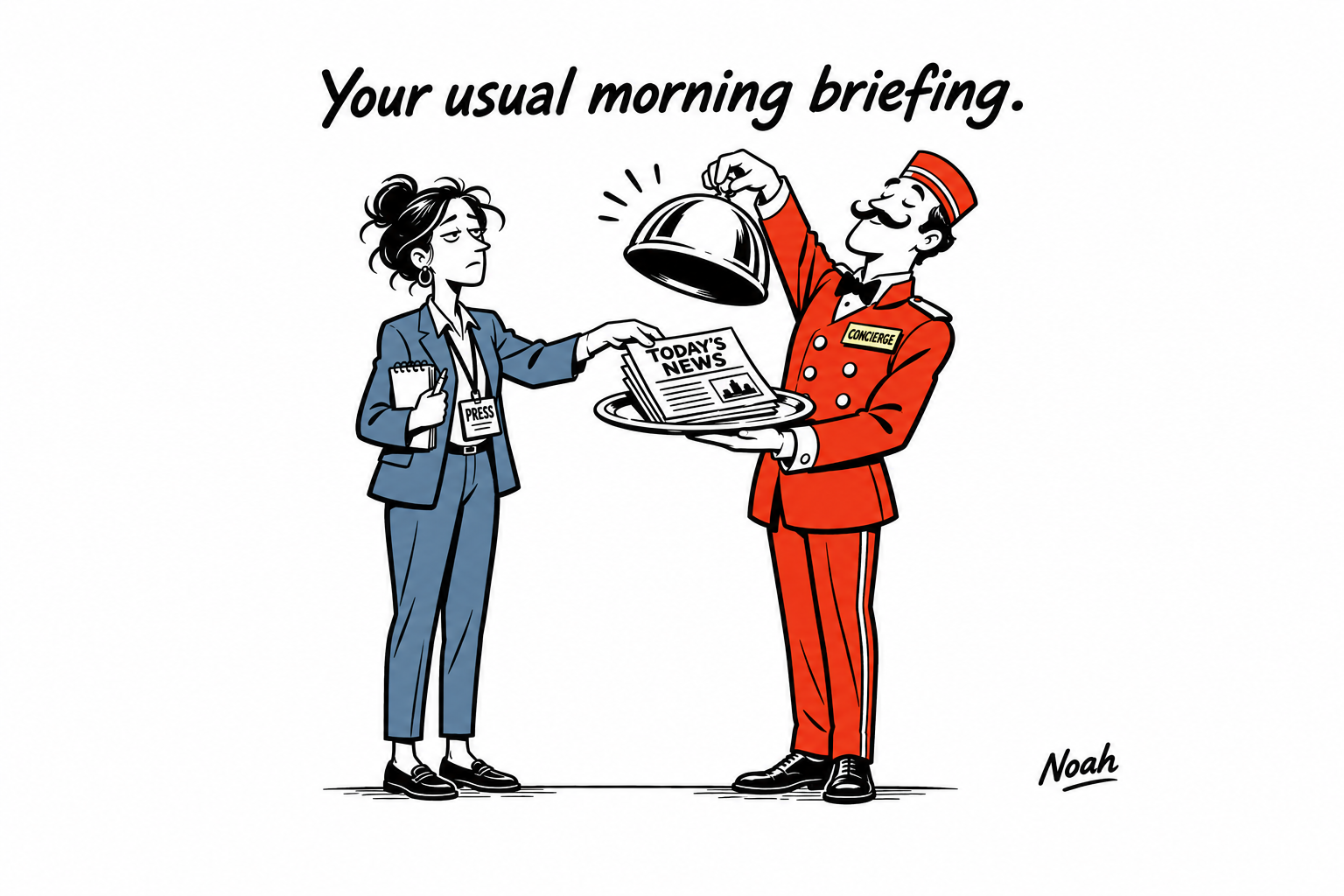
Cartoon · AI-generated
What this piece answers
Is the AI morning briefing real, or a demo? Real. It takes one sentence to set up.
How many readers are doing it? Few, so far. In the UK, 4% use a standalone AI chatbot for news each week.
Can a publisher charge for it? Some already do. The FT and Skift sell it inside professional subscriptions.
Will the platforms pay? The big names have deals. For everyone else, the price is still being discovered.
Will the platforms hand publishers an off switch? Probably not soon. Noah's forecast is 30% by the end of 2027.
It is 7.40 on a Tuesday. A compliance manager at a packaging firm, who is illustrative but will be familiar, opens her phone and reads four paragraphs on what changed overnight in the rules that govern her job. It covers three countries and names the materials affected. She asks one follow-up question about deadlines, gets an answer, and goes into her nine o'clock meeting better informed than anyone else in it.
She did not open a trade magazine. She did not open a newsletter. An assistant did the reading for her, and somebody's reporting was underneath it. That somebody was not paid, was not named very prominently and does not know she exists.
There are two ways for a publisher to respond to this. One is to try to stop it. The other is to notice that she has just described, in some detail, a product she would pay for.
One sentence, every morning
I decided to do this research after reading a lead story in Press Gazette. It urged publishers to fight back after the launch of Meta's Muse and OpenAI's Dots. Don't worry, I read it as a human. I didn't ask my bot to read it. Its most useful detail was a small one. It reported that a single instruction to Dots produced a daily briefing built from the BBC and Telegraph homepages, delivered on a schedule, without further effort. Press Gazette
Press Gazette's objection is fair. A request that runs itself every morning is a different thing from a reader choosing to open a homepage, and OpenAI's own documentation concedes two awkward points. It says some requests triggered by a user may fall outside the rules a publisher sets in its robots.txt file, the notice that tells automated visitors where they may go. And its help pages describe recurring briefings as a feature, on purpose. OpenAI crawler documentation · OpenAI scheduled tasks
Some caution is due about the test itself. It used public homepages. It does not show which route the assistant took to fetch them, or whether the briefing replaced a single visit that would otherwise have happened.
What it does show is how little work was involved. One sentence. A trade publisher reading that column could reasonably feel robbed. It could also feel that a stranger has just built the front end of its next product and left it lying about.
A stranger has just built the front end of the publisher's next product and left it lying about.
Few readers are doing this yet, which is the good news
The Reuters Institute's 2026 Digital News Report found that weekly use of standalone AI chatbots for news rose from 7% to 10% across the markets it surveys. In the UK the figure was 4%. That counts people who used a chatbot for news in the past week. Nobody has yet measured how many have made an automated briefing part of their routine, and the honest answer is likely to be a small fraction of a small number. Reuters Institute
It will not stay small on its own. Meta launched Muse in the UK this month and put it inside WhatsApp, which is where a large part of the country already spends its day. Whether people use it for news is an open question. That it is now one tap away is not. Meta's UK launch
50.94% The probability, on Noah's forecast, that UK weekly use of AI chatbots for news is at least three percentage points higher in the Reuters Institute's 2027 survey than in 2026. From a base of 4%, that would be close to a doubling in a year, and Noah rates it a coin toss.
The window is the point. A habit at 4% can still be shaped by whoever turns up with a good product. A habit at 40% belongs to whoever got there first.
What happens when the answer is enough
Search shows what the downside looks like. Pew studied the browsing of US Google users in March 2025 and found they clicked an ordinary result on 8% of visits where an AI summary appeared, against 15% where it did not. The two sets of searches are not identical, and the study covers Google alone. The commercial risk is still plain. If the answer satisfies the reader and the session ends there, the publisher never gets to show the advert, offer the subscription or suggest the next story. Pew Research Center
A strategy built entirely on getting those clicks back is a poor bet. The better question is what a publisher could charge for being the answer. In professional publishing, a sourced answer that saves someone an hour, or stops them making an expensive mistake, has always been worth money. It used to be called a newsletter.
Three things a publisher can sell
A better professional subscription. The Financial Times made Ask FT available to all FT Professional customers in April 2025, and says they use it to prepare for meetings, check facts and track developments. Skift builds its own answer engine into Skift Pro, its paid subscription for the travel trade. Both put the publisher's reporting and archive to work for customers who have a job to do. Neither has said publicly what it has done for revenue or renewals, which is the number everyone else would like to see. FT Strategies · Skift Pro
66.3% The probability, on Noah's forecast, that by 31 December 2029 a UK or US B2B publisher is keeping at least 80% of customers on a separately priced AI answer or research assistant, across at least 100 client organisations. Renewing a wider subscription with a free AI feature bolted on does not count. Two chances in three that somebody proves this is a business in its own right.
A licence to appear inside someone else's assistant. The New York Times signed a multi-year deal letting Amazon use summaries and short excerpts in products such as Alexa, alongside training rights. Google announced an Associated Press feed for Gemini. A platform has a reason to pay when it needs coverage that is reliable and current. The public terms tell a small publisher almost nothing about what it might earn, and the NYT's negotiating position is not widely shared. Collective licensing may give smaller titles a way to reach buyers they could not get a meeting with alone. Reuters on the Times and Amazon · Google on the AP feed · Press Gazette on collective licensing
Payment each time the reporting is used. Cloudflare is testing a system called Pay Per Use. A buyer offers a price for a specific use, the publisher chooses which offers to accept, and Cloudflare handles the billing. The catch is in the small print: usage is reported by the buyer. The economics depend on the price, the volume and whether the publisher can check what was actually taken. Cloudflare
The sums
A hypothetical, to show the scale involved.
At 2 cents net per use, it takes 50 million paid uses to make US$1 million.
At 20 cents net per use, it takes 5 million.
The lesson is in the gap. Interchangeable news summaries will be priced at the bottom. Information an assistant cannot easily get anywhere else will not.
36% by 2027, 56% by 2029 The probability, on Noah's forecast, that a UK or US news or B2B publisher earns at least US$1 million net in a 12-month period from third-party AI assistants paying per use for its content. Training licences, fixed guarantees and advertising are excluded. Unlikely next year. Better than evens by the end of the decade.
A specialist title is better placed here than a general one. Nobody needs to pay for a seventh summary of the Budget. A maintained record of which packaging rules changed in which market is another matter.
Deciding who gets in, and on what terms
Retail has been here slightly longer and is a useful guide. Reuters reported that Amazon blocked Muse in September. When Meta launched Muse in the UK in November, it named Trainline, Ocado Retail and Marks & Spencer among its partners. Same assistant, opposite decisions, each made deliberately by a company that had worked out what it wanted from the arrangement. Reuters on retail's response · Meta's UK partnerships
Publishers can be just as deliberate. They could let any assistant show an attributed headline. They could let paying readers reach their subscription through a login the assistant respects. And they could license recurring monitoring, or use in a platform's own commercial briefing, as a separate deal with a separate price. The questions that matter are who is asking, what they get and what comes back.
Return to the packaging title. A manufacturer might pay for a weekly briefing that says which rules have changed in each market, which materials are affected and when compliance is due. The title delivers it under its own name. For customers who prefer a different assistant, it makes the same maintained data available through a connection the subscriber authorises. Every answer shows the source, the date it was last updated and a route to the underlying reporting. The title watches who comes back, who renews, and whether the service pays for the editorial work needed to keep it right.
That can start with one beat and one paying audience. It needs no change in the law, no platform's permission and no industry-wide agreement.
It needs no change in the law, no platform's permission and no industry-wide agreement.
The scorecard
Five forecasts
Question Probability Range A B2B publisher keeps 80% of customers on a separately priced AI assistant, by end of 2029 66.3% 30% to 88% A publisher earns US$1m in a year from per-use AI retrieval, by end of 2029 56% 25% to 82% UK weekly use of AI chatbots for news rises 3 points or more in the 2027 survey 50.94% 30% to 72% A publisher earns US$1m in a year from per-use AI retrieval, by end of 2027 36% 12% to 65% OpenAI gives publishers a switch that blocks scheduled briefings but allows live reader requests, by end of 2027 30% 12% to 54% The likeliest outcome on the board is a publisher making its own assistant pay. The least likely is a platform handing over the controls.
The cost of waiting
That last forecast deserves a second look, because it is the one the "fight back" case depends on.
What publishers want from OpenAI is a simple control: let a reader's live question through, and stop the assistant helping itself every morning on a timer. Noah puts the probability of OpenAI shipping that by 31 December 2027 at 30%. Blocking training alone would not count. Nor would switching off retrieval altogether, which is the option publishers already have and mostly do not want to use.
So the industry is being asked to organise around a concession that has a seven in ten chance of not arriving in the next 13 months. The alternative on the same scorecard, a publisher proving that customers will pay for and renew its own assistant, is rated at two in three, although on a longer clock.
None of this makes the Press Gazette column wrong to be cross. Scheduled retrieval of a publisher's homepage, unpaid and barely credited, is a legitimate grievance, and rights are worth negotiating. But a negotiation is not a product, and the compliance manager at the packaging firm has a meeting at nine whether the terms are settled or not. Somebody will supply her briefing tomorrow morning. The only open question is whose name is on it.
Forecasts are from Noah Predict and run from 26 November 2026. Ranges are Noah's judgemental ranges and are wide because little transaction data is public. The compliance manager in the opening is an illustration, not a real person. Adoption figures are from audience surveys. Product and licensing details are from the sources linked.
Source: Tomorrow’s Publisher