Publishers seek new economics as AI upends discovery, metrics and licensing
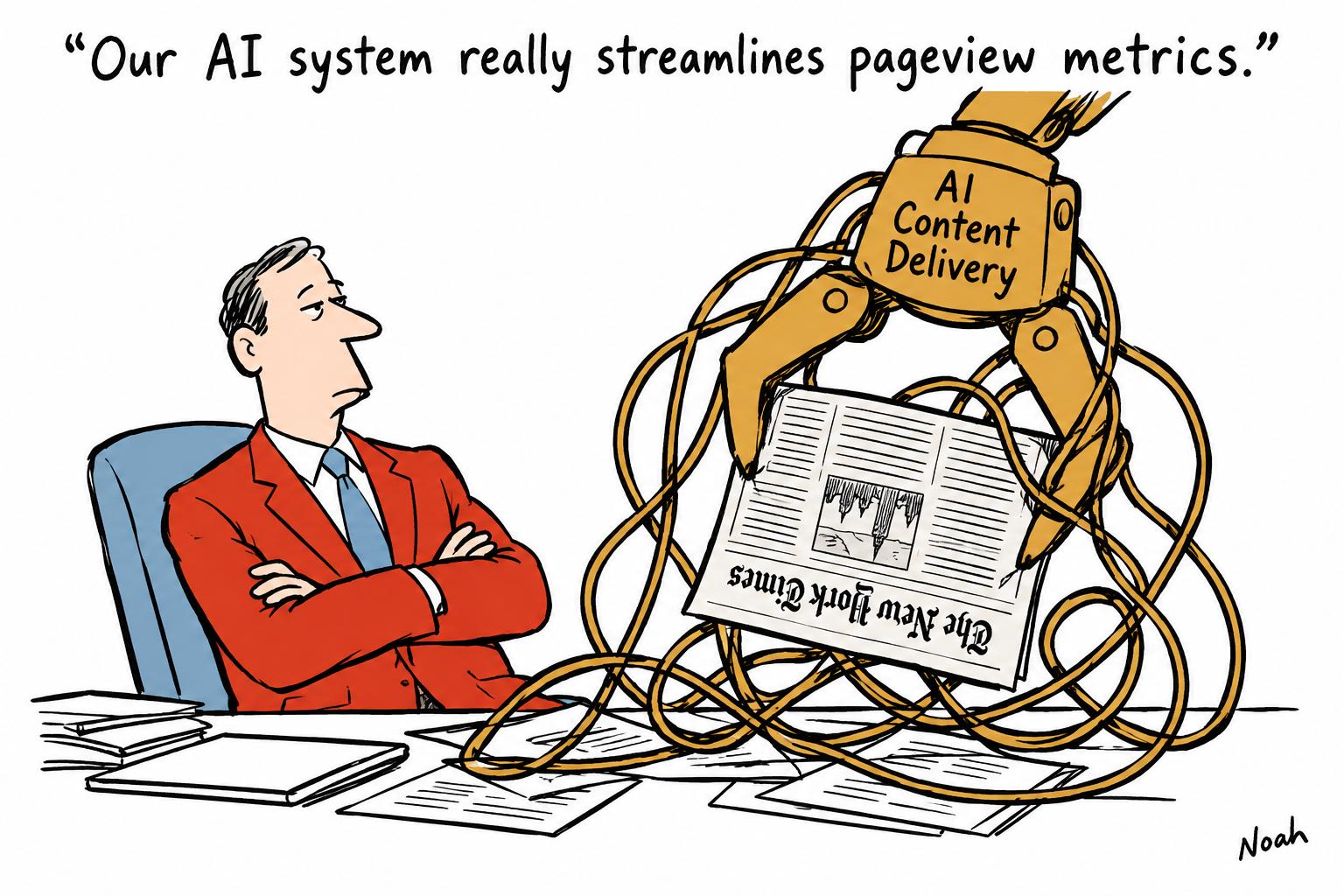
Cartoon · AI-generated
News organisations are reassessing page views, crawler access and licensing deals as AI systems reshape how journalism is discovered, consumed and valued.
Publishers are increasingly concluding that artificial intelligence is not only changing how audiences discover journalism, but also forcing a rethink of the basic economics of digital media. At Digiday’s Media Strategies London event on Tuesday, executives discussed the scramble to find a more useful measure than page views, the trade-off between blocking AI crawlers and preserving visibility, the shaky early market for licensing to large language models, and whether agentic media trading is ready for commercial use.
The uncertainty comes as major publishers continue to line up behind SPUR, the Standards for Publisher Usage Rights initiative. On 13 October, the coalition said it had added more than 40 members, including The New York Times, Agence France-Presse, The Economist and The Atlantic, taking total membership to more than 80 publishers in over 20 countries. SPUR says it wants to set common standards for how AI systems use journalistic content and has also introduced a Content Telemetry Standard designed to track that usage more transparently. AFP said its participation was intended to help shape the rules governing access, attribution and compensation for news content in the AI era.
That push for common standards reflects a broader frustration shared by publishers in London: the industry still lacks a single metric that captures real audience value. Some executives argued that page views are too crude for a world in which humans, bots and AI agents all interact with content differently. Others said the answer may lie in a combined measure that incorporates unique users, subscriber share, dwell time and conversions, while acknowledging that any new framework will only matter if agencies and clients can compare results across publishers. The challenge, they said, is not simply gathering better data, but turning it into something editorial teams can act on quickly.
AI crawlers were another major point of concern. Several executives said they were weighing the short-term risk of restricting access against the longer-term danger of disappearing from AI-driven discovery altogether. Some publishers believe scarcity could strengthen their hand in future licensing talks, but others warned that the market for paid access is still too immature to justify aggressive blocking. One senior publisher at the event said the outcome of The New York Times’ lawsuit against OpenAI could prove pivotal in establishing what fair compensation looks like. Fiona Spooner, managing director of consumer revenue at the Financial Times, said at the same event that one trialist account had tried to access about a million articles from 700,000 different IP addresses in just eight hours, underlining how heavily some publishers are already being scraped.
The economics of licensing remain equally unsettled. Several publishers said current referral traffic from LLMs is minimal, making direct monetisation through licensing deals more attractive in theory than in practice. But others warned that if users increasingly rely on AI tools to consume information, publishers risk weakening their own long-term relevance by staying out of those systems. The discussion around agentic advertising carried the same mix of optimism and caution. Some participants said publishers were experimenting with their own selling agents and saw an opportunity to win back value now captured by intermediaries. Yet many stressed that the work is still at an early stage, and that meaningful progress will depend on finding partners willing to test new models alongside them.
Inspired by headline at: [1]
Sources by paragraph: - Paragraph 1: [2], [4] - Paragraph 2: [2], [3], [7] - Paragraph 3: [1] - Paragraph 4: [1], [2], [3] - Paragraph 5: [1]
Source: Noah Wire Services · Original