Press Gazette launches newsroom tool to catch AI-generated content before publication
Cartoon · AI-generated
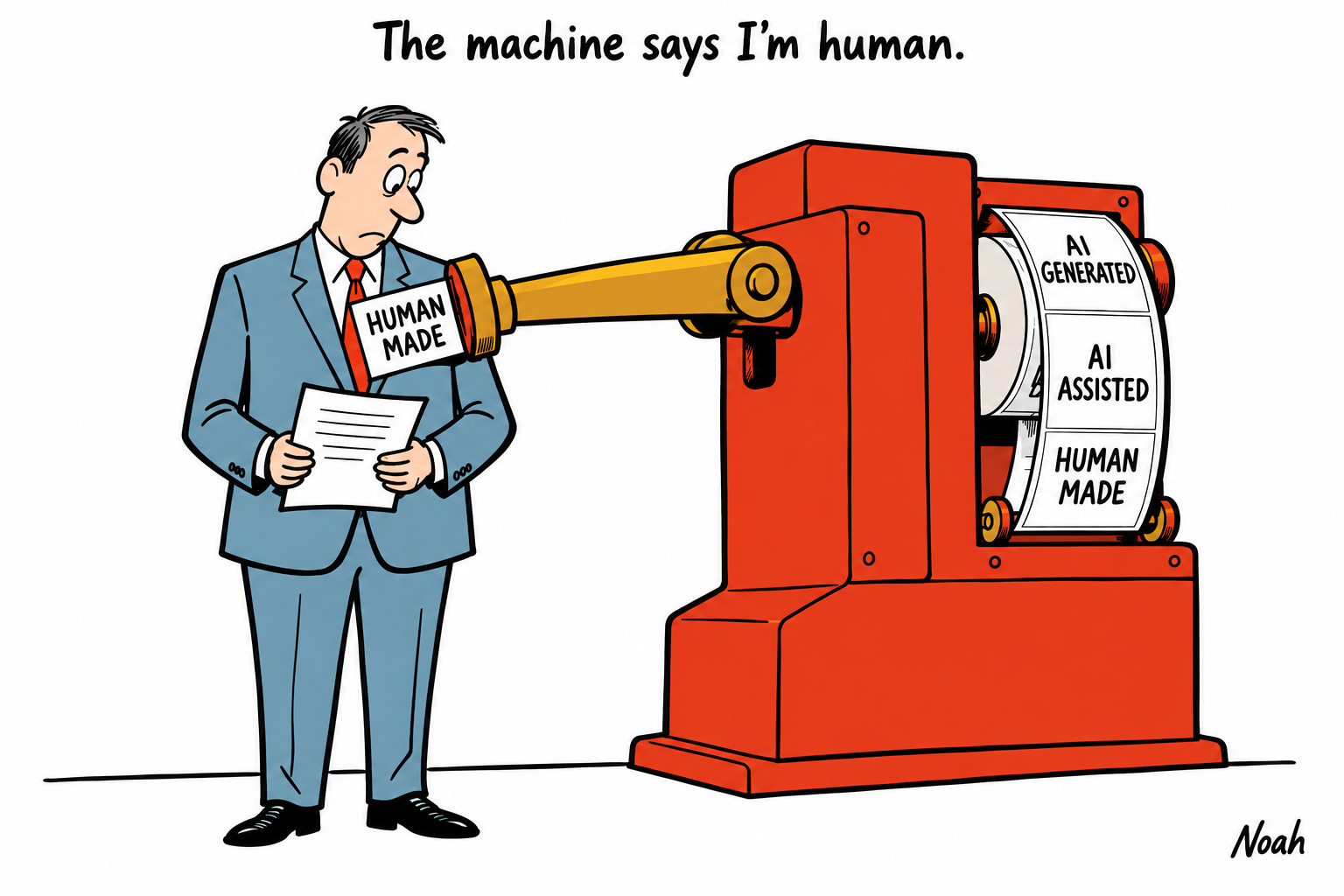
Press Gazette and Flip-Pay have launched Made by Humans, a content-management tool that classifies text, images, video and audio as AI generated, AI assisted or human made.
Press Gazette and Flip-Pay have unveiled a newsroom tool designed to help editors detect whether text, images, video or audio has been generated or altered by artificial intelligence before it reaches publication. The service, called Made by Humans, is aimed squarely at publishers navigating the European Union’s new transparency requirements, which are already forcing newsrooms to think more carefully about how synthetic material is identified, checked and labelled. According to the companies, the system sits inside a publisher’s content management environment and classifies material as AI Generated, AI Assisted or Human Made, leaving editors to decide whether to publish, review or flag it.
The launch comes as Article 50 of the EU AI Act places explicit transparency obligations on providers and deployers of certain AI systems, including requirements to disclose and mark AI-generated or manipulated content in a detectable way. Separate explanatory materials on the law note that these rules apply to synthetic audio, image, video and text, while industry summaries say the provisions took effect on 2 August 2026, with a grace period for some pre-existing systems running until 2 December 2026. Reuters-style concerns about compliance are already being amplified by the prospect of penalties for breaches, including substantial fines under the regime.
Press Gazette says the product grew out of its Reality Wars investigations, which identified more than 1,000 published articles in mainstream media that referred to fake or AI-generated experts. The publication also said a survey of more than 200 publishers, editors and journalists found overwhelming support for disclosure, with 95.3% backing flags for AI-generated content and 63.5% saying their organisation lacked a dependable way to check for unauthorised AI use. The tool has been trialled inside Press Gazette’s own content management system, and the company says it is meant to reduce the risk of reputational damage rather than replace human editorial judgement.
The technology draws on third-party detection products, including Pangram for text analysis and identifAI for image, video and audio screening. It also includes plagiarism checks, reverse-image searches, audit trails and reporting functions intended to support internal compliance workflows. According to the companies, the service works in English, French, Spanish and German and can be integrated with WordPress and other publishing systems for pre-publication review.
Press Gazette editor-in-chief Dominic Ponsford said the platform was designed to bolster newsroom safeguards at a time when synthetic media is becoming harder to spot by eye. In remarks quoted by the company, he said the product was intended to support, not supplant, editorial judgement, and that it could help prevent misleading AI-generated material from being published in the first place. Flip-Pay chief executive Paul McCarthy-Brain said the tool addressed both editorial and commercial risks, while identifAI and Pangram said the system could help editors distinguish between wholly generated output and human writing that had been lightly edited or assisted by AI. IdentifAI has said it has logged around 10,000 reported deepfake incidents in English-language media or on social platforms since January 2020, with reports rising sharply over that period, and its data suggest the United States and X account for a large share of the cases it tracks.
Inspired by headline at: [1]
Sources by paragraph: - Paragraph 1: [2] - Paragraph 2: [3], [4], [6] - Paragraph 3: [1] - Paragraph 4: [1] - Paragraph 5: [1], [3], [6], [7]
Source: Noah Wire Services · Original