Ozone’s ad upgrade puts publisher data to the test
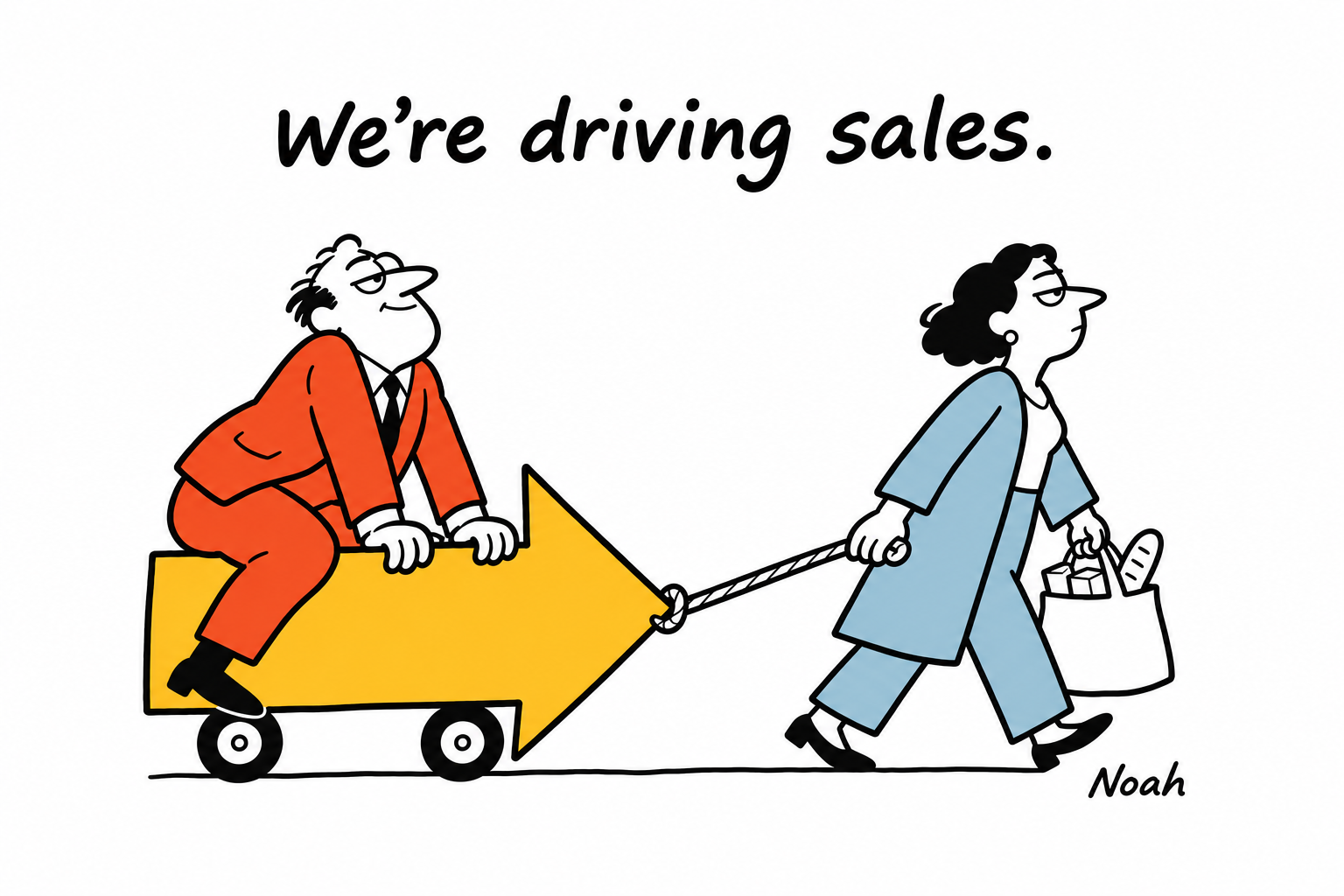
Cartoon · AI-generated
Ozone launched new advertising software this week with a striking claim: 63% more revenue per page at one unnamed global publisher, alongside 69% fewer ad requests. For a business founded by British newspaper groups, the opportunity is substantial: earn more from the readers already there. Advertisers, meanwhile, want evidence that those readers become customers. The investment deserves a commercial trial, but the announcement does not yet establish either a general earnings expectation or additional sales. Publishers deciding what to buy need to know which result is being improved, what it costs and who carries the risk when a campaign disappoints.
Ozone was created through a collaboration between News UK, Guardian Media Group, Telegraph Media Group and Reach. Its new OzoneOS suite brings knowledge of audiences into automated advertising decisions. The launch does not identify any of those founding publishers as the business behind its early result.
David Cohen, chief executive of the US industry body IAB, warned in its 20 October measurement-guide announcement that different methods can “each tell a different story about the same campaign”. That is the complication behind an otherwise attractive commercial pitch.
The broader change is that publishers are putting their own reader information closer to the sale of advertising. First-party data means information collected through the publisher’s relationship with its users. It can help decide which advertising opportunity to offer, to whom and at what price, rather than simply describing an audience in a sales presentation.
Schibsted offers a parallel experiment. In Anthony Vargas’s 12 November AdExchanger report, the Nordic media group described working with London-based Nodals AI on advertising optimisation. Its director of ad data capabilities, Christer Ljones, explained the target: “you don’t need to beat them on the average. You just need to beat them with meaningful scale at the margin.” He was discussing Meta, while acknowledging that Schibsted would not necessarily match its average performance.
That is a more credible ambition than replacing a platform’s entire advertising business. A publisher can compete for the next useful slice of a buyer’s budget. It still has to show that the slice adds value, rather than merely collecting credit for purchases the advertiser would have received anyway.
Different promises need different evidence
OzoneOS combines audience models with controls over advertising layouts and demand partners. Its reported revenue-per-page improvement is an encouraging publisher-side result. But the launch gives no test duration, comparison-group design or explanation of whether all technology costs are included. An anonymous case can be genuine and useful without establishing what another publisher should expect.
The 69% reduction concerns ad requests, which are software calls involved in obtaining advertising, rather than a count of visible adverts. Advertising systems can collect several bids before selecting what appears, as Prebid’s technical documentation explains. The percentage therefore cannot simply be translated into 69% fewer adverts on a reader’s screen. Fewer requests may be a useful efficiency gain; the reading experience needs its own measurement.
Revenue per page is also a rate, not the publication’s total income. A better return from each visit is valuable, but it cannot say how many visits remain or what the publisher retains after serving them. A stronger auction price and a healthier publishing business can move together. They are not interchangeable findings.
Ozone’s September launch of Arc addresses the advertiser side. It reported 59% more donations per user reached for an Alzheimer’s Society campaign with Medialab Group. The announcement’s footnote attributes the result to Ozone Arc modelling. It does not disclose a randomised estimate of extra donations caused by the advertising. The named client and outcome make this more specific than a generic performance promise, but the published measure still needs to be read as supplied.
An undated Tesco case study from Reach’s Mantis offers another instructive comparison. It reports an average 30% expansion in eligible advertising inventory and click-through-rate uplifts ranging from 5% to 101% across audience groups, compared with third-party segments in other campaigns on the Reach network. Click-through rate is the proportion of ad views producing a click. Those are claims about available placements and response, not a 30% rise in Tesco sales or an independently controlled sales experiment.
The risk moves with the price
Schibsted is building direct-sold native advertising products priced per click, according to the AdExchanger report. Native advertising is paid material presented in a format that fits the surrounding publication. Charging for a response changes the bargain from charging for an ad being shown.
Consider an explicitly hypothetical publisher with 100,000 ad views. At £5 per thousand views, those placements produce £500 before costs. At £1 per billable click, the publisher needs 500 clicks, a 0.5% click-through rate, to produce the same gross amount. If response disappoints, the publisher bears that shortfall. If response improves, the model can earn more, but the software, sales and campaign-service costs still have to be paid. These are illustrative prices, not Schibsted or Ozone tariffs.
Noah, a research and forecasting service, gives only a 30% chance that Schibsted delivers a paid direct-sold native campaign using its first-party-data optimisation offering after 13 November 2026 and by 13 November 2027 in which the advertiser is billed per completed sale or contractually qualified lead. Optimising towards a sale does not commit a publisher to being paid on it. A single lead-generation pilot could qualify; access to buyer data and disputes over lead quality could keep billing on clicks. The forecast concerns the unit of payment, not whether the software improves advertising.
A model trained to find likely clickers can be very good at its assigned job. That does not necessarily make it good at finding people whose purchasing behaviour changes because of an advert. Someone already intending to buy may be easy to identify and cheap to claim. That possibility is a reason to test the objective, not evidence that a particular supplier’s model is making the mistake.
The measurement problem is recognised by the industry itself. IAB and IAB Europe’s 2025 commerce-media guidelines distinguish causal impact from what would have happened without the advertising. They describe approaches for constructing that comparison and controlling bias. Those principles are useful here even though a newspaper’s advertising business is not identical to a retailer’s.
This does not mean every small campaign needs an expensive scientific experiment before it can run. Clicks can be a legitimate purchased outcome, and brand awareness can matter beyond an immediate sale. The error is using whichever measure improved as proof of a different promise. A decision to move a substantial budget deserves evidence suited to that decision.
Ownership is more than a product claim
Nodals says it trains one model per media owner and that the owner’s data stays under its control, without training another company’s model. Its website describes optimisation across direct campaigns, sponsored content and programmatic deals. That is a distinct proposition from sending every useful signal into a platform controlled by somebody else. It is also a supplier’s description of its product, rather than an independent audit of data flows or model portability.
The value of ownership appears when a supplier relationship ends or a buyer changes the objective. Keeping the underlying data does not settle who can inspect, retrain or move the model. Those operating questions belong in the trial and contract, alongside the price.
The audience itself may carry an input cost. Sara Guaglione’s 13 November 2025 Digiday report described anonymous executives at its Publishing Summit Europe discussing paid audience acquisition and traffic arbitrage. That is not evidence that Schibsted, Ozone or Nodals buys visits for these campaigns. It identifies a cost that a publisher using paid traffic must include, and a reason to distinguish purchased visits from existing direct readers when assessing the claimed advantage of audience data.
There is an editorial boundary too. Knowledge of what a person reads is commercially useful partly because it comes from journalism. A gain that depends on making the publication less usable, or obscuring the difference between reporting and advertising, would consume some of the relationship being sold. Reader experience and clear sponsorship labels belong in the commercial evaluation.
The result worth buying
The strongest evidence would connect the two sides: a named, reproducible improvement in what the publisher retains and a credible account of what the advertiser gains. The public announcements checked for this report do not yet provide that complete account. That limits the conclusion that can be drawn from them; it does not establish that the private trials failed.
A useful pilot would preserve a comparison and report fees, campaign-service time and any audience-acquisition costs alongside revenue. Easier buying and reporting could create value even without a better prediction. For a performance campaign, the parties should agree which actions count, how invalid responses are treated and what evidence justifies another allocation. The aim is a repeatable commercial product.
Ozone, Schibsted and Reach are trying to improve the machinery that values their audiences. The competitive advantage will come from making that machinery accountable. Publishers have a plausible case for a greater share of advertising spending when their own knowledge improves the result. A higher dashboard number becomes a durable business only when the benefit reaches the party paying for it and leaves enough behind to fund the publication.
Sources
- OzoneOS launch
- Ozone Arc launch
- Ozone company and founders
- Nodals product claims
- Schibsted interview, Anthony Vargas, AdExchanger
- Mantis Tesco case study
- IAB measurement decision guide consultation
- IAB/IAB Europe incrementality guidelines
- Prebid introduction: bids collected before ad selection
- Sara Guaglione, Digiday, paid audience acquisition reporting, 13 November 2025
- Research notes, evidence limits and original forecast register
Source: Tomorrow’s Publisher