Macmillan’s celebrated AI assistant NOA is shut down after staff found it ‘terrible’
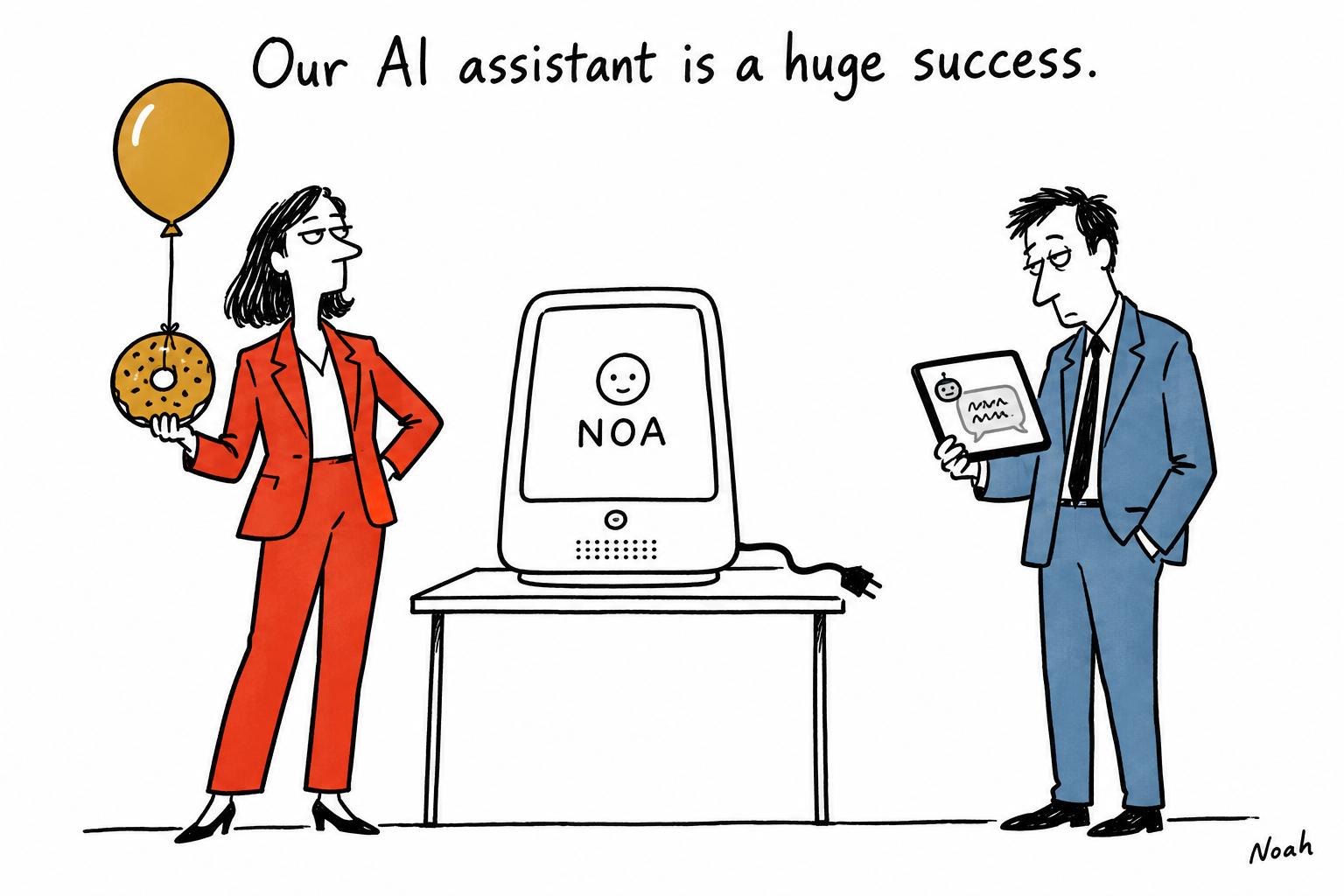
Cartoon · AI-generated
The publisher launched NOA with balloons, banners and doughnuts, but employees say the chatbot was unreliable, largely unused and ultimately abandoned.
Macmillan Publishers marked the arrival of its internal AI chatbot, NOA, with all the trappings of a corporate celebration. When staff arrived at the company’s Lower Manhattan headquarters in January 2024, several workers said they found the cafeteria decorated with purple balloons, banners and light-up marquee letters, while doughnuts had been arranged to spell out "NOA IS HERE". The bot’s name stood for "No Ordinary Assistant", a label that some human assistants at the publisher found offensive, according to employees who spoke to WIRED.
In an email to staff, NOA was presented as an AI chatbot developed by the German software company Chaptr, which is backed by Macmillan’s parent company, Holtzbrinck. The company told employees that the tool was designed as a safe environment in which they could enter proprietary material without risking disclosure to third parties. That description suggested a closed system that would not use the data for model training. Even so, workers said they were warned in training that NOA could hallucinate and would need to be checked by humans at every stage.
Despite those caveats, staff said they were encouraged to lean on NOA for a range of everyday tasks, including drafting emails, writing copy, carrying out marketing research and generating ideas. Employees were also told to paste only a portion of authors’ manuscripts into the system. Users could adjust the bot’s tone, with settings including "lighthearted", "spartan", "pessimistic", "sarcastic" and "regretful". Later in 2024, staff were even urged to use NOA to help write performance-review objectives, with one email telling them: "We built a specialised prompt to have NOA write goals for you!"
But many employees concluded that the tool did not justify the fanfare. Several staffers told WIRED that NOA was unreliable and largely unused, with one describing it as "terrible". One worker recalled a Chaptr representative telling staff at an early in-person session that the company understood publishers were dealing with something very important: content. That comment prompted one employee to reply internally, "And here I thought we were publishing literature," highlighting the scepticism that shadowed the project from the start.
By October 2025, Macmillan staff were informed in a company-wide email that Chaptr would be winding down NOA. Since then, employees say management has tried to fold Google Gemini into parts of the publishing workflow, but that effort has also fallen short. Some staff experimented with using Gemini to assess submission letters from literary agents, only to find the output, in one editor’s words, "useless". The episode reflects a wider tension in publishing: companies are eager to market AI as a productivity gain, while the people expected to use it often find the tools inconsistent, intrusive or simply not helpful.
Inspired by headline at: [1]
Sources by paragraph: - Paragraph 1: [2], [3] - Paragraph 2: [2], [3] - Paragraph 3: [2], [3] - Paragraph 4: [2], [3]
Source: Noah Wire Services · Original