HellerWeather adds AI drafts for more than 20 forecast-led formats
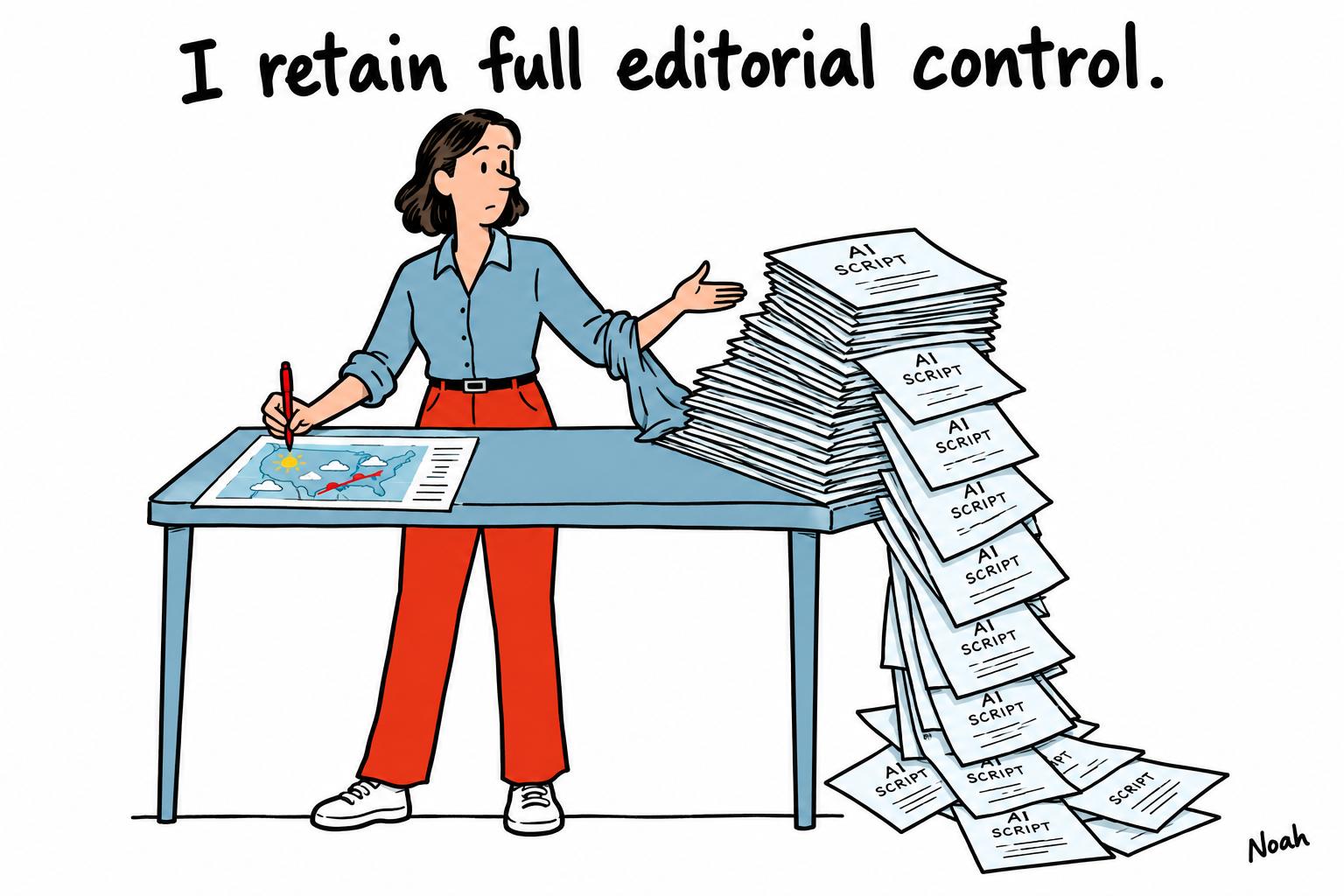
Cartoon · AI-generated
The browser-based Content Creator turns forecast data into drafts for TV, websites and social media, with the company stressing that meteorologists retain editorial control.
HellerWeather has introduced a revised version of its AI Content Creator, a browser-based tool intended to help broadcast meteorologists turn forecast information into material for television, websites, social media and other platforms. The company says it can generate initial drafts in formats including vertical video, webcasts, digital shorts, blogs and newsletters, while leaving final editorial decisions to weather staff. HellerWeather’s product page describes the tool as part of a broader workflow for researching forecasts and developing audience-focused stories, rather than a substitute for meteorological expertise.
The company says the system can suggest story ideas after forecast updates and recommend graphics and supporting data. Meteorologists provide a location, after which prompts developed from chief developer Tim Heller’s 35 years of on-air experience guide the output. Heller said: “There’s never a quiet weather day thanks to Content Creator,” adding that the tool is designed to identify potential angles as forecasts change.
HellerWeather says its wider AI Tool can save most meteorologists three to five hours of preparation each week. The system is also presented as a research assistant, drawing on conventional forecast models and newer AI systems, including Google’s WeatherNext. Google’s technical documentation describes WeatherNext as a probabilistic forecasting system with several ways for developers to access its data; it does not establish which version, if any, HellerWeather uses.
The company says the tool can produce more than 20 draft items from the same underlying data, for use on air and across digital channels. It generates material in English and can adapt it into conversational American Spanish, a capability the company says it added last summer. Research published in the American Meteorological Society’s journal has examined generative AI for weather-chart interpretation, hazard summaries and communication in English and Spanish, while stressing that such work does not establish that automated output is consistently reliable or suitable without review.
HellerWeather says users retain control over material before it is created, published or shared. “Zero prompting doesn’t mean zero input,” Heller said. “Meteorologists have 100% editorial control before anything is produced, published, or shared. There is always a human-in-the-loop.” The company also claims the service is designed to protect data and prevent hallucinations, and says it neither requires nor stores proprietary client data. These are company representations, not independently verified findings.
The emphasis on human oversight reflects a wider principle in professional meteorology. The World Meteorological Organization says AI can help generate faster forecast insights, but highlights the need to evaluate models and communicate uncertainty responsibly. The American Meteorological Society likewise identifies human judgement, local context and clear communication as essential parts of the forecasting process, even as AI tools take on tasks such as processing forecasts and preparing draft discussions. Heller said the aim was to help colleagues work more efficiently, adding: “Content Creator and the HellerWeather AI Tool don’t replace meteorologists. It empowers them.”
Inspired by headline at: [1]
Sources by paragraph: - Paragraph 1: [2] - Paragraph 2: [2] - Paragraph 3: [3] - Paragraph 4: [6] - Paragraph 5: [2] - Paragraph 6: [4], [5]
Source: Noah Wire Services · Original