HarperCollins’ TikTok sales are growing. The missing figure is profit
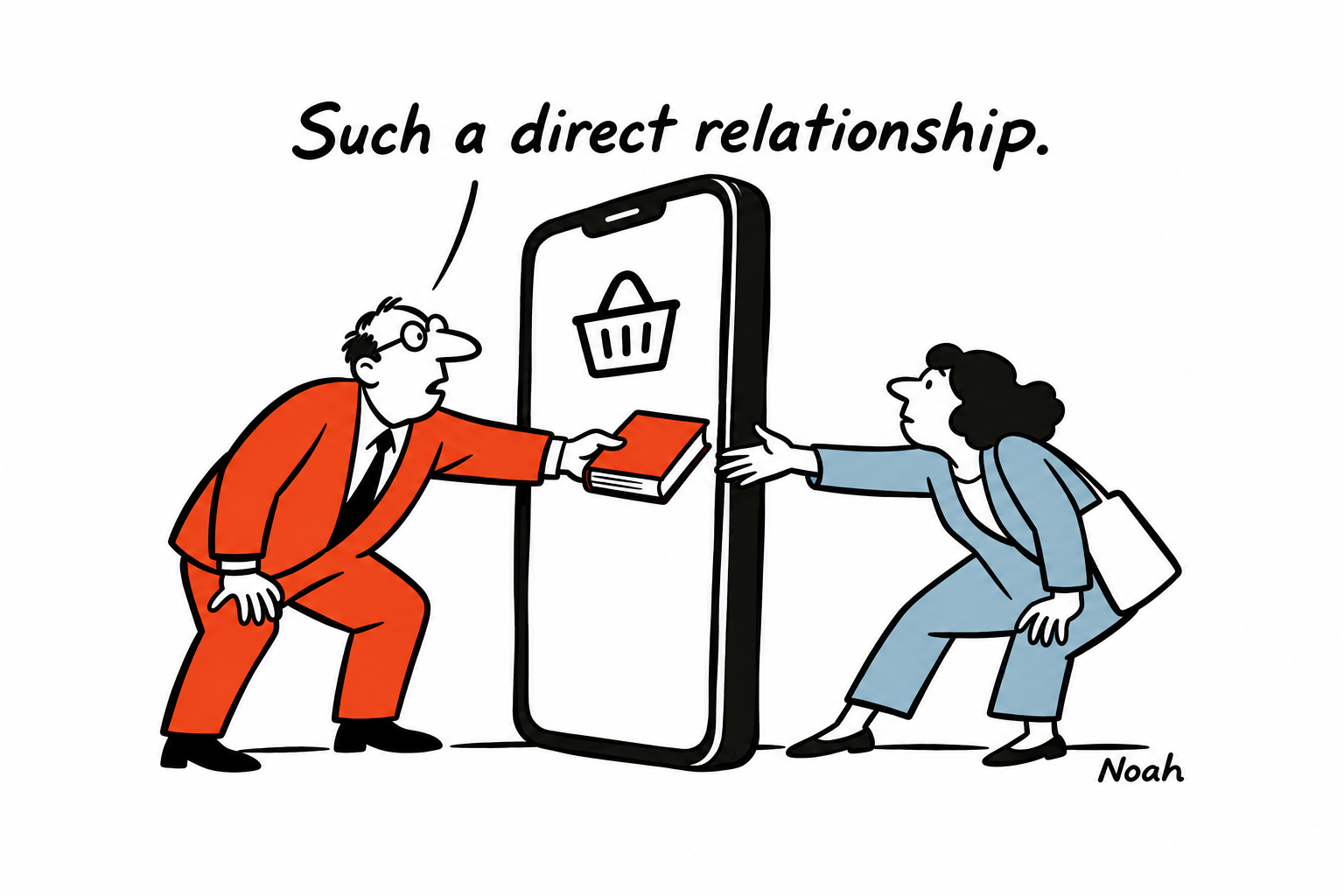
Cartoon · AI-generated
HarperCollins’ revenue from selling books live on TikTok Shop has risen 225% since it began using the format in 2023, according to seller data in TikTok’s new UK report. Staff recommend titles while viewers can order inside the app. The publisher is operating a shop floor as well as introducing readers to books.
That is a consequential opportunity for publishers with a catalogue and people who know it. They gain another route to paying readers; TikTok captures the transaction within its marketplace. The work includes presenting, stock management and customer service. The decision is whether the contribution from genuinely additional sales pays for that operation, after allowing for purchases shifted from elsewhere.
The report, released on 12 November, describes a range that has grown from 40 titles to more than 24,000 and reports 193% sales growth for the wider HarperCollins shop. Those measures describe different things. The 225% figure concerns live-shopping revenue; the catalogue count establishes availability, not sales across every listed book. No absolute live revenue or profit figure accompanies the case study.
Christina Storey, HarperCollins’ senior social commerce manager, describes “taking the time to create content and recommendations specifically for our audience” in TikTok Shop UK’s LIVE Shopping Report 2026. The phrase identifies the work behind the format. The statement is a practitioner’s account in TikTok’s own report.
The commercial case deserves serious attention. A knowledgeable presenter can answer a reader’s question at the moment of interest and show a physical edition rather than rely on a jacket thumbnail. An extensive catalogue creates scope to recommend another book after a viewer has arrived for one familiar title. Whether that opportunity produces profitable extra demand remains a separate empirical question.
HarperCollins’ own earlier recruitment material shows how practical the operation is. An archived social commerce assistant vacancy, with a May 2024 deadline, listed TikTok videos and live sessions alongside catalogue uploads, prices, promotions, creator relationships, stock checks and ISBN administration. The role combined content, selling and stock administration.
A shop is a different commitment
Publishing companies have long helped readers discover books through other people’s recommendations. Hosting a live sales session adds an operational obligation. A book must be listed correctly, available at the advertised price, sold in the right edition and delivered as promised. A successful presentation creates orders that somebody must fulfil.
The distinction matters for smaller houses. A publisher may have unusually deep expertise in its subject and a committed audience, while lacking spare people to operate a frequent live schedule. Its advantage could be a focused session around a particular author or edition. A large catalogue and a permanent on-air operation are possible choices, not prerequisites established by HarperCollins’ percentage growth.
There are different routes into the same discovery environment. TikTok’s November 2022 books launch included HarperCollins and a Bookshop.org route involving Bloomsbury titles and independent booksellers. Its April 2026 reading announcement named Penguin Random House, HarperCollins, Pan Macmillan and Hachette among publishers using the marketplace. Participation is already broader than one company; it does not establish that each runs its own live checkout.
An analysis of publishing and live-commerce coverage by Noah, a research and forecasting service, puts only a 42% chance on at least two independently owned UK trade publishing groups making their first-ever publisher-operated TikTok Shop LIVE book sales between 18 November 2026 and 17 May 2027. For the same threshold by 17 November 2027, it gives 55.5%. Existing operators’ extra sessions, new imprints and creator or bookseller shops do not count. The estimate concerns entry, not sales scale or profit. The eligible pool is uncertain: an existing marketplace seller could still qualify if it has never completed its own LIVE sale. Two small pilots could clear the threshold.
Today, Bookshop.org’s UK website describes its model as financially supporting independent bookshops and allowing those shops to curate recommendation lists. The useful comparison is where the sale lands and who provides the service. A publisher promoting a book through a bookseller and one fulfilling its own marketplace order may create similar reader interest while earning and spending money differently.
A direct order can offer a publisher more room between the selling price and the cost of the book. It also introduces platform charges, any creator payment, promotion, handling, delivery and returns. TikTok’s published UK commission policy, dated September 2025, states a 9% standard rate before incentive reductions. That is a platform schedule, not disclosure of HarperCollins’ agreement or its margin.
The same analysis gives only a 33% chance that a standard mandatory UK book commission rise of at least two percentage points above its 17 November 2026 rate takes effect between 18 November 2026 and 17 November 2027, comparing the same VAT basis. Optional advertising, affiliate charges and the expiry of seller-specific introductory discounts are excluded. A larger marketplace gives TikTok a reason to seek more revenue, while competition for sellers argues for restraint. The increase is a budget risk, not the expected outcome, and unchanged standard fees would not freeze every selling cost.
The missing counterfactual is the sale elsewhere
A deliberately hypothetical example makes the distinction clear. Suppose 100 orders each leave £4 after variable costs, before £300 spent preparing and presenting a session. The session contributes £100. If 50 of those customers would otherwise have bought through another channel yielding £2 each, the lost £100 elsewhere removes the incremental gain. These are illustrative assumptions, not HarperCollins’ prices, costs or customer behaviour.
The example is not a claim that live selling merely moves existing demand. A session could introduce an unfamiliar writer, reactivate an older book or persuade someone who would not otherwise buy. It could also prompt a purchase in a physical shop later. Those benefits require evidence beyond the orders recorded during the broadcast.
Storey’s statement in the report also argues that the effect extends into other retailers. That is a plausible account from a practitioner with an interest in the channel’s success. The case study supplies no comparison group or method for separating that effect from other publicity, publication schedules or demand that already existed. The claim should inform a measurement question, not settle it.
TikTok’s wider BookTok numbers require the same care. Its April announcement attributed more than 11 million UK book sales in 2025 to BookTok, worth £86 million, citing its data partners. The same announcement separately described purchases completed on TikTok Shop. Discovery associated with a title across the retail market and an order placed inside the app are different measures. Neither can stand in for HarperCollins’ incremental live-shopping profit.
The report’s survey also has a defined audience
The new report combines seller figures, internal platform data and surveys. Its methodology identifies 735 UK small-business decision-makers whose businesses already use live shopping. OnePoll collected those answers from 6 October to 6 November for research commissioned on TikTok’s behalf. That is a survey of users of the format, not a representative sample of all publishers or businesses deciding whether to adopt it.
Those respondents can report useful experiences. They cannot supply the result for a publisher with a different list, audience, staffing model or commercial agreement. Nor does a seller saying it reached new customers establish what those people would have done in the absence of the live session. Self-reported experience and causal sales measurement answer different questions.
TikTok has a commercial reason to promote more sellers, activity and transactions. That does not invalidate its data. The case studies still need cost and comparison information before their results can guide a different publisher’s investment.
The platform’s own guidance asks sellers to plan a theme, choose products, arrange a suitable background and create a discoverable live event. Even before a viewer arrives, the format requires a production decision. Adding more broadcasts can increase opportunity and increase expense at the same time. Neither outcome follows automatically from more minutes on air.
Keep the publishing judgement in the experiment
The most interesting possibility is the connection between editorial knowledge and retail service. Someone who understands a list can explain why one reader might enjoy an unfamiliar book, distinguish formats and recommend a sequence. The test is whether that knowledge changes purchasing behaviour enough to justify the delivery mechanism.
A useful result would show which titles sold, what remained after costs, how buyers returned and what happened to sales in other channels. It would distinguish a one-off promotional surge from a repeatable operation. The published HarperCollins example is encouraging evidence of revenue growth; it supplies no warrant for assuming that every extra listed title or live hour contributes equally.
For publishing executives, the implication is to put live commerce on the retail budget as well as the marketing plan. The people presenting books need stock, order handling and an economic measure that rewards profitable demand, including any demonstrable benefit elsewhere. A large growth percentage is a reason to investigate that model. It is not the missing profit figure.
Sources
- TikTok Shop UK LIVE Shopping Report, 12 November 2026, particularly pages 4 and 18
- TikTok: release and methodology, 12 November 2026
- TikTok: UK books launch, 17 November 2022
- HarperCollins archived social commerce job via SYP, deadline 27 May 2024
- TikTok: BookTok discovery and UK shop sales, 27 April 2026
- Bookshop.org: UK independent bookshop model, checked 17 November 2026
- TikTok Shop UK: LIVE selling preparation, 16 April 2026
- TikTok Shop UK Commission Rate Policy, dated 18 September 2025
- Research notes and full forecast definitions, 17 November 2026
Source: Tomorrow’s Publisher