Guardian sharing: 61% chance of shared access at three of six UK publishers on 20 October 2028
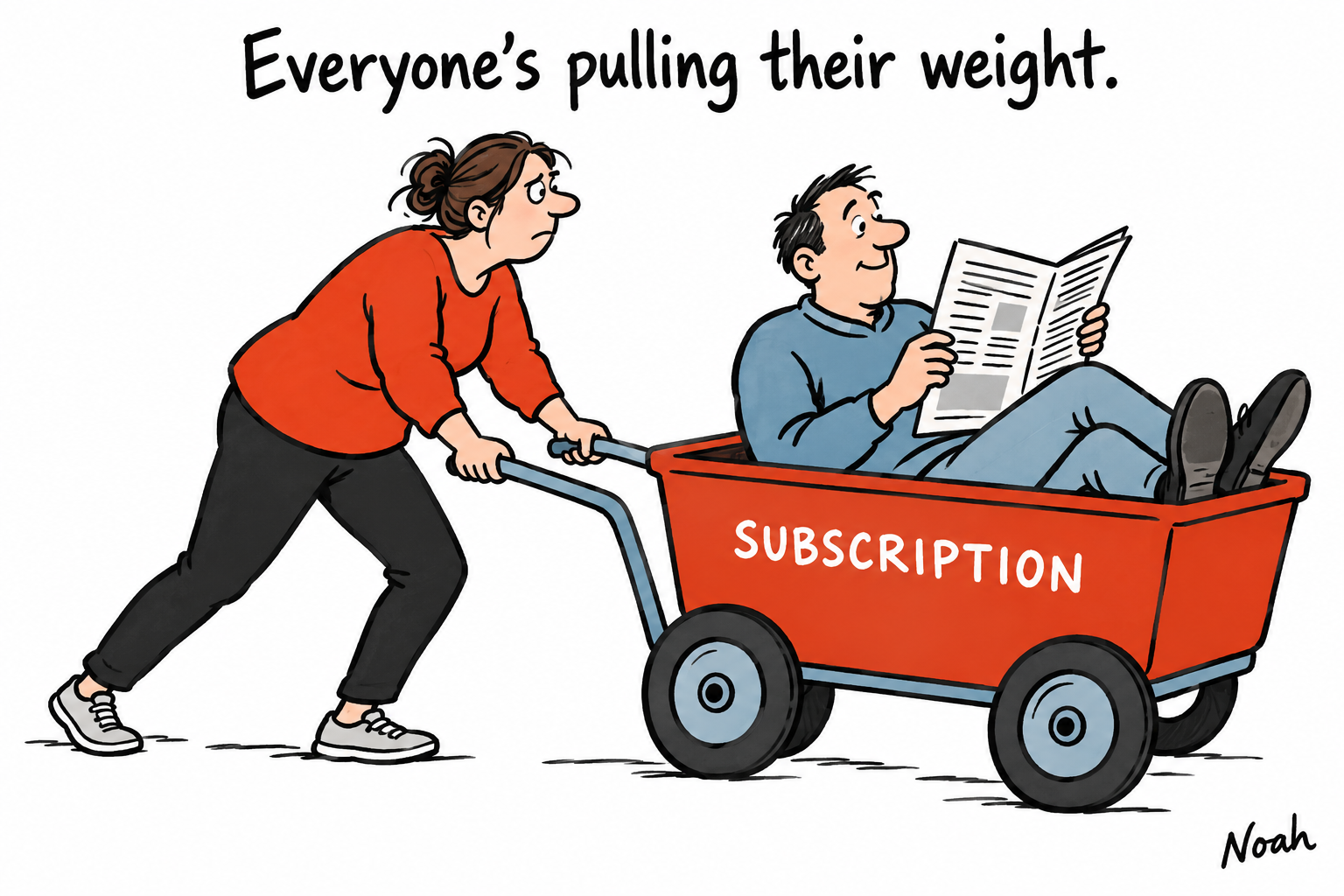
Cartoon · AI-generated
The Guardian’s new extra accounts point towards a broader change in how publishers sell access. Noah assigns a 61% probability that at least three of six named UK publishers will have qualifying permissioned sharing live on 20 October 2028. That is a forecast of product availability, not proof that sharing will lift revenue or keep readers paying.
One subscription can now introduce a publisher to several readers without producing several payments. That is the commercial question behind the Guardian’s new sharing offer. It creates a route from an existing supporter’s enthusiasm to somebody else’s daily reading. Whether it creates more durable revenue depends on what happens after the invitation.
On 19 October, the Guardian introduced extra accounts for Digital plus and print subscribers, with up to three invitees.
The feature matters because it brings three different relationships into the same product: the person funding it, the person recommending it and the person using it. Sometimes one reader fills all three roles. Sometimes the payer barely opens a particular app while an invited friend becomes its most committed user. A subscription business needs to recognise those differences before it can judge what sharing is worth.
Five forecasts to watch
These are Noah’s modelled probabilities as of 20 October 2026, not observed rates or measured industry frequencies. The UK availability forecast concerns current official product terms on its settlement date. The four Guardian outcome forecasts require the specified milestone and qualifying public verification by Guardian or Guardian Media Group: no public verification settles them as NO even if the internal outcome occurred. Their lower odds must not be read as probabilities that sharing itself fails.
61% — At least three of Guardian, Financial Times, Times and Sunday Times, Telegraph, Independent and Economist will offer qualifying sharing on 20 October 2028. Times and Sunday Times counts as one provider. A paying consumer must be able to invite another adult to a distinct personal login with ongoing access; gift links and shared passwords do not count. Existing qualifying offers can count: this is not a forecast of three new launches.
31% — By 19 October 2027, Guardian will publicly verify at least 100,000 activated extra accounts with invitees’ own logins. Invitations alone do not count. A large reader-funded business makes scale plausible, but the eligible subscriber base and acceptance rate are not yet established here.
32% — By 19 October 2028, Guardian will publicly verify at least 50,000 distinct extra-account readers using a Guardian digital product while logged in during one reported calendar month. Activation without use is insufficient. The opportunity is a reading habit; the countercase is a stock of little-used accounts or loss of access when the payer leaves.
20% — By 19 October 2028, an official Guardian result will show at least a 5% relative reduction in cancellation or non-renewal among payers whose guests activated and used an account, against an explicitly comparable control or matched cohort. This is not a five-percentage-point drop. More social value could help retention, but enthusiastic customers may already be more loyal; a useful result must separate those effects and be publicly reported.
23% — By 19 October 2029, Guardian will publicly verify that at least 5% of identifiable former extra-account readers, whose invited access ended, began their own paid subscription or recurring-support relationship within 12 months. That is not 5% of all guests. Familiarity could help conversion; light usage, consolidated payments and no published cohort result could prevent this target settling YES.
The 61% estimate is the strongest positive call, supported by a live Guardian offer and established international product designs. It remains uncertain: this research has not verified the current qualifying status of the other five UK providers, and offers can change or disappear. The forecast is a reason to investigate the model, not a completed census. Noah’s uncertainty ranges, exact resolution conditions and calculation references are retained in the claim audit.
A premium offer with more people inside it
The public UK purchase page checked on 20 October lists Digital plus at £18 a month. All-access digital is advertised at £10 a month for six months, then £14, for eligible new subscribers. Those are the displayed monthly offers, not every existing customer’s renewal price. The higher tier adds sharing alongside editions and archive benefits; the underlying bundle also includes news and cooking.
The comparison gives sharing a commercial role beyond generosity. A publisher can put an invitation benefit into a more valuable package rather than selling each extra reader an independent subscription at the entry price. The displayed difference between £18 and £14 is £4 a month, but that is a comparison of two public monthly prices, not an identified charge for three guests or a forecast of upgrade revenue.
For the payer, value may arrive through somebody else’s use. A customer who enjoys the news can offer another person a reason to explore cooking or a digital edition. A product that previously looked excessive for one person might become useful to a small network. That is a plausible mechanism for upgrading or renewing; it is not a reported result from this launch.
The same mechanism has a less convenient possibility. A reader who would otherwise have paid separately may accept access funded by a friend. The publisher then has to weigh the benefit to the original relationship against the revenue displaced. More people inside the product can accompany either a stronger business or a weaker one.
A reader needs an identity of their own
Invitees receive separate logins and private reading profiles, covering News, Feast, Editions and archives.
That architecture matters. A publisher can welcome a person with different interests, reading times and preferences, rather than forcing everyone through one set of credentials. Recommendations and service communications can be directed to the recipient’s own relationship with the publication. The product should feel like an invitation to read, rather than an instruction to borrow somebody else’s identity.
There is an editorial advantage in knowing what different people actually value, provided the publisher respects the permissions and promises governing that information. An account created by invitation is still a reader’s account. It should not become permission to treat the payer as an observer of another person’s habits or to assume that personal recommendations are a sales-consent mechanism.
For product teams, the useful unit is the active recipient. An available slot establishes capacity. A sent invitation establishes an attempt. An accepted invitation establishes an activated entitlement. None alone establishes a habit, a recommendation to another reader or a future payment. These are different stages and deserve different measures.
The distinction already features in UK publishers’ public discussion. In Adam Tinworth’s live conference notes from September, The Times and The Sunday Times’ Anna Sbuttoni describes a daily-return measure based on daily active users divided by monthly active users. The Guardian’s Liz Wynn emphasises frequency, sign-ins, newsletters and apps. These are first-hand notes, rather than audited performance data, but they identify the operational question: does a reader come back?
For sharing, I would ask that question separately for the payer and the guest. Strong usage by the person receiving an invitation could coexist with declining use by the person paying. A combined audience total can hide that difference. Conversely, a recipient’s daily use might explain why a less active payer still values the package. The product team needs to see both relationships without assuming one causes the other.
The Financial Times supplies a useful warning against mistaking correlation for a sharing result. In WAN-IFRA’s December 2025 account of a webinar, FT group product manager Muj Ali reported that app users were 37% less likely to cancel than non-app users, describing a correlation. He also outlined onboarding, personalisation and formats designed for short visits. The finding concerns FT subscribers and app use, not Guardian guests, and it does not isolate the effect of installing an app.
That is still a practical lesson for shared access. Giving another person an entitlement starts the relationship; making it easy to find something worth returning for is a separate job. The right experiment would connect guest onboarding and sustained use to payer outcomes, with an honest comparison group. A strong association in another publisher’s app is a reason to test that chain, rather than a percentage to transfer into a sales presentation.
The invitation has a clock
The Guardian’s help centre sets a 30-day invitation window, followed by expiry and release of the slot. Invitations distinguish pending from accepted access. The primary owner controls billing and removal; guests cannot manage the subscription. Eligible invitees must be adults with valid email addresses. Existing paid subscribers may accept shared access, but must separately cancel their own payment if they want to stop it. When the owner cancels or moves to an ineligible package, guests lose benefits.
Those rules make the product operationally interesting. The publisher needs to help the intended person get from an email to the correct account, explain what has changed and show how to begin using the service. A misspelt address, an overlooked message or confusion about an existing login can stop the relationship before the journalism has a chance to matter.
The right response is useful onboarding. Show recipients how to find the part of the product that drew them in. Let them choose their interests. Explain who pays, what they can control and what happens if the arrangement ends. The practical task is to turn a successful invitation into an intelligible service, rather than maximise messages announcing that a benefit exists.
What the payer is deciding to keep
Shared access changes the renewal decision. The payer may consider another person’s enjoyment alongside their own. Cancelling can become a conversation about a service used by several people. A customer who reads less for a few weeks may still value providing access to somebody else.
That is the retention thesis. Its strongest version would show comparable paying customers renewing more often after guests became active, with enough additional revenue to cover the commercial cost. Its weak version would merely count accepted invitations and assume that renewal improved because of them.
Customers who choose to share may already be unusually enthusiastic, engaged or loyal. Comparing them with all other subscribers can therefore flatter the feature. A useful evaluation needs a credible comparison: for example, a properly designed invitation rollout or a matched cohort with clearly stated limitations. The result must concern money and sustained use, not just the number of accounts provisioned.
The countercase deserves equal attention. A household or friendship group may consolidate payments. Some recipients might not read enough to create value for anyone. A subscription that looked socially indispensable can still be cancelled when budgets tighten. None of those possibilities makes sharing a mistake; they identify what the business has to measure.
The cancellation can travel further than the bill
One billing decision can remove access for several users. A publisher that treats cancellation as an interaction only with the payer risks surprising people who neither chose the package nor control the payment. The recipient needs a clear explanation of the changed entitlement and the available next step.
There is also a distinction between choosing to leave and losing a payment. Bihag Karnani’s August contribution to WAN-IFRA’s subscription series separates voluntary churn from failed-payment churn. Sharing might give a payer a stronger reason to stay; it does not, by itself, fix a declined card. If lost payment ultimately ends the entitlement, the potential disruption extends to recipients. That is a product-design risk, not a reported Guardian incident, and any grace period or recovery process must be checked against the publisher’s actual rules.
That creates a possible acquisition moment, but a delicate one. Someone who already values the service may decide to pay independently when shared access ends. Someone who has barely used it may simply leave. The publisher should not assume either outcome or count that future conversion before it happens.
The customer experience also affects the original recommendation. If a friend’s invitation leads to confusing bills, unexplained access loss or relentless upgrade prompts, the publisher spends some of the trust that made the introduction possible. Good account management is part of the commercial proposition, not an administrative detail to repair after launch.
The international examples show different kinds of sharing
The Guardian is joining an established product category. The Washington Post’s official help describes three extra accounts in its Premium offer, activated through email with individual logins. It also offers a monthly 30-day pass. Those are different entitlements: one lasts with the qualifying subscription, while the other creates a temporary period of access. The documentation establishes how the products work, not their effect on retention.
The New York Times’ family help describes one primary payer and up to three additional accounts. Its All Access Family bundle includes News, Games, Cooking, Audio, Wirecutter and The Athletic; Games Family is a narrower offer. The owner manages invitations and billing, while individuals retain account controls. Again, the number of recipients is an entitlement limit, not evidence of how many people actually use a package.
The distinction between a broad bundle and a single-purpose product is useful for UK publishers. A recipe service, a puzzle habit and a daily news briefing can appeal to different people within the same paying relationship. A specialist title may have a different opportunity, such as another professional in a small firm. That does not mean every consumer plan permits workplace use; the product’s own conditions must settle that.
Le Monde provides a European comparison. Its public offer lists one-, two- and four-account tiers. Its explanation keeps recipients’ selections and newsletter choices separate, while allowing the owner to add or remove beneficiaries. That is another way to sell a broader relationship around journalism. It establishes a package design, not the number of people using each subscription or a measured advantage over an individual plan.
A publisher does not need to copy every element of a large general-interest bundle. It needs to identify a form of sharing that makes sense for its journalism and its audience. A generous-looking account allowance will not compensate for a service that the recipient has no reason to open.
Count the relationship you actually sold
The Guardian’s September results reported 1.4m digital recurring supporters and £126m digital reader revenue, up 17%. Those figures predate the launch.
The totals provide context for a reader-funded business. They do not tell us how many eligible subscribers will invite anyone, how many people will accept or whether sharing changes subsequent revenue. Multiplying a supporter total by a maximum guest allowance would turn possible access into fictional audience growth. Treating every invited user as another paying subscriber would make a different error.
The useful reporting separates paying relationships, invitations, activated recipients, regular usage and independently paid conversions. It also records the payer’s package and renewal behaviour. These measures should be read together: a modest number of active guests might support a valuable renewal effect, while an impressive invitation total might conceal little use and no commercial improvement.
The New York Times’ filing for the quarter ended 30 June 2026 shows why definitions matter. It counts each higher-priced family subscription as “one billed subscriber and one additional subscriber” to reflect the extra entitlements. That is its disclosed reporting convention; it does not mean two independent bills or that every available guest slot is occupied. A reader comparing subscription businesses has to read the definition alongside the headline total.
The same issue carries into average revenue per user. A number calculated against the reported subscriber base answers a different question from revenue per invoice or revenue per active person. Changes in package mix can therefore affect how growth looks even when the reporting is consistent and transparent. Publishers considering a shared plan should decide how they will describe its success before the first campaign goes live.
I would also want the business to explain displaced payments. If existing subscribers move onto somebody else’s access, that is a real commercial change, even if the publication gains a clearer picture of the people reading it. Shared access can still win overall, but a fair assessment must include both sides of the ledger.
Make the introduction worth renewing
The strategic opportunity is to make an existing reader’s recommendation work as a product. The publisher supplies legitimate access, a separate identity and an intelligible route into a useful habit. The payer supplies an introduction that an anonymous acquisition campaign cannot automatically reproduce.
The test comes after activation. Do recipients find something worth returning to? Does their use strengthen the paying relationship? Does the business earn more durable revenue after accounting for displaced subscriptions and the costs of serving people well? The answers could justify a wider role for permissioned sharing. The launch alone cannot provide them.
Research note: Noah completed the planned research checks; the exact method, counts, calculations and source trail are retained in the Claim audit.
The additional archive investigation left its payment-grace-period countercheck unmeasured; this report therefore makes no claim about the Guardian’s payment-recovery policy.
Sources
- Guardian: extra-accounts launch, 19 October 2026
- Guardian Help Centre: extra-account eligibility, invitations, billing and privacy; checked 20 October 2026
- Guardian: current public UK subscription offers; checked 20 October 2026
- Guardian: reader introduction to extra accounts, 19 October 2026
- Guardian Media Group: 2025/26 results release, 10 September 2026
- Washington Post: extra accounts and 30-day passes; checked 20 October 2026
- New York Times Help Centre: family subscription; checked 20 October 2026
- New York Times: SEC filing, quarter ended 30 June 2026; subscriber definitions and ARPU
- Le Monde: current subscription tiers and account-sharing explanation; checked 20 October 2026
- Adam Tinworth: first-hand conference notes on audience yield and engagement, 10 September 2026
- Bihag Karnani for WAN-IFRA: voluntary and involuntary churn, 13 August 2026
- WAN-IFRA: FT product manager on app use, retention correlation and onboarding, 10 December 2025
Source: Tomorrow’s Publisher