Future shows why publishers need more than a place in an AI answer
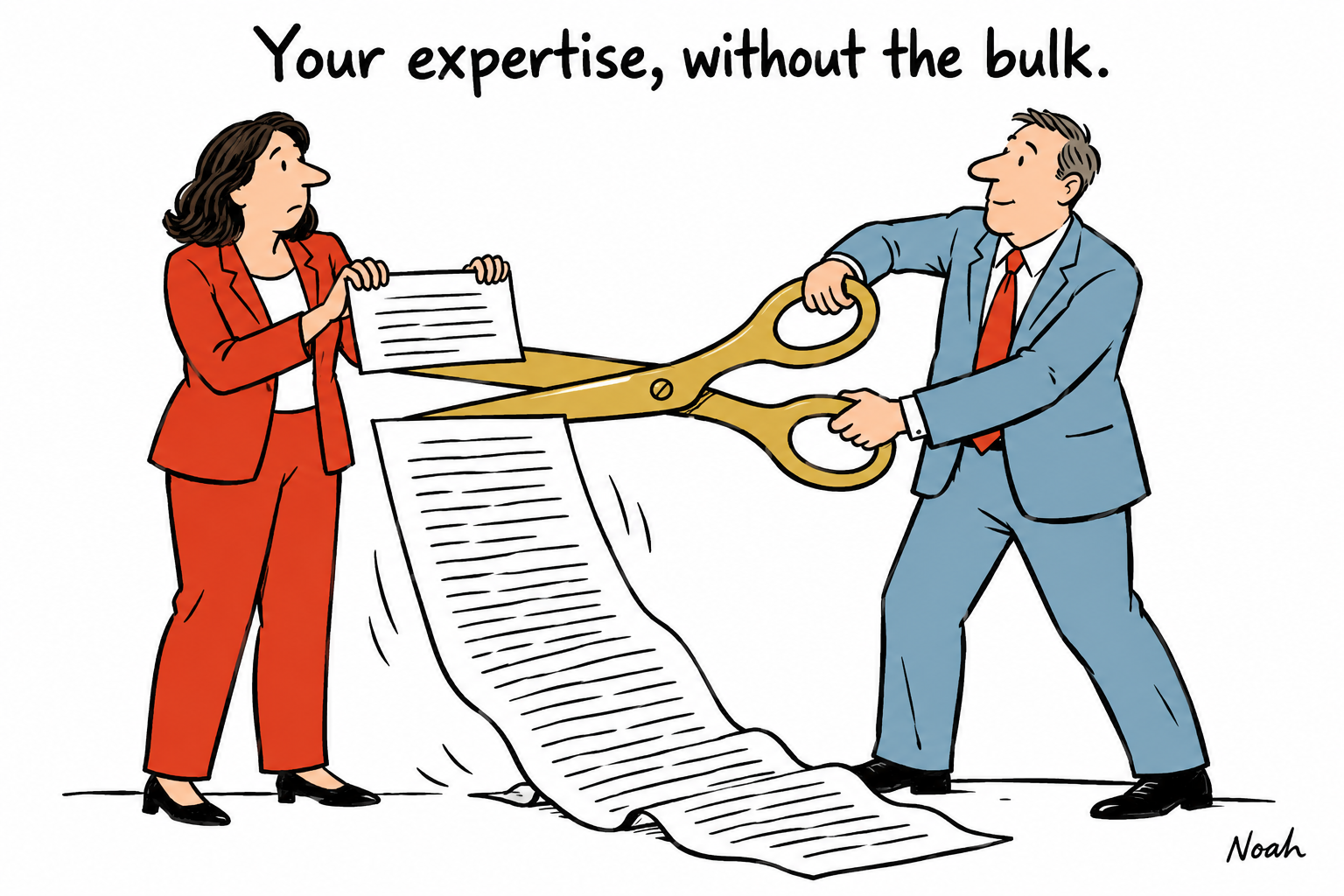
Cartoon · AI-generated
Future has already made AI visibility something it sells to advertisers. A new analysis of ChatGPT shows why that business needs a better ruler: a publisher can help inform an answer without gaining a visit, a customer or even a complete representation of its work.
The opportunity favours publishers with distinctive expertise and content that helps people make decisions. The cost falls on those that supply the underlying work but cannot establish what it earns. Licensing teams should ask for evidence of that return; editorial teams should protect the reason readers trust the material in the first place.
UK publishers should treat AI distribution as a product relationship that needs testing and negotiation. A place in an answer is useful. It is not, by itself, a business model.
The summary is another editorial decision
David Konitzny, a researcher at Peec AI, reports a distinct partner-content route in ChatGPT’s configured news engines. He identified 12 providers covering 43 domains, including Future, and observed partner URLs arriving with pre-generated summaries ahead of other web results in the inspected prompts. This is a researcher’s observation of undocumented behaviour, not an OpenAI guarantee of preferential treatment across all answers.
His sample of 1,000 summaries from ranked-list pages is especially relevant to specialist publishing. Entries in positions one to three were named 70% of the time; those in positions seven to ten, 23%. Those figures describe which entries appeared in the summaries—not their likelihood of being recommended in a final answer.
In an explicitly hypothetical example, a review site’s eighth-ranked laptop may be the best choice for someone who needs an unusually light machine. If a summary keeps only the first few entries, that useful exception disappears before the reader’s needs are considered. The issue is what information survives compression, not whether a publication can move a sponsor up its independent rankings.
Publishers should test whether important conditions survive alongside conclusions: who a recommendation suits, what it costs and where it falls short. Selling influence while allowing those distinctions to vanish would weaken the expertise that makes the content valuable.
The same review should cover updates: when a recommendation changes or a mistake is corrected, ask how the supplied summary is refreshed. Request a traceable example of a corrected source and the resulting summary.
Future is building two different businesses
Noah puts only a 41% chance on Future, Financial Times Group, Guardian Media Group or News Corp releasing a new numeric measure of ChatGPT-originated referrals, engagement or revenue for a UK publishing property by 31 March 2027. That rises to 59% by 28 October 2027. The estimate concerns public disclosure, not whether those businesses privately receive valuable traffic. More reporting opportunities help the later case; commercial sensitivity and aggregated reporting work against it.
Future’s OpenAI partnership was announced in December 2024, promising attribution and links across a portfolio then described as more than 200 brands. The new observation is about possible implementation, rather than the arrival of a previously unknown deal.
In its May 2026 half-year update, Future described AI visibility services through Future Optic as a new source of revenue. It also reported 8% year-on-year growth in high-yield direct advertising, which was twice the size of programmatic advertising. The company said 16% of total revenue was directly correlated with website sessions. Those are company-reported business measures; they do not isolate the return from OpenAI or make falling traffic harmless.
The distinction matters. One business sells advertisers a publisher’s ability to help them be discovered. Another monetises a reader who comes to the publisher. Each can be worthwhile, but they need different evidence. A client’s product appearing in an answer does not automatically produce an advertising impression on the publication’s own website.
Keep commercial services visibly separate from independent recommendations. An agency-style promise to improve a brand’s visibility must not become an unspoken promise to award it a better review. Trust is the asset being licensed and sold around; it cannot be spent twice without consequence.
Build a reason to leave the answer
Tom’s Guide offers a concrete response. Its April relaunch combined an AI product finder based on editorial testing and current prices with live expert Q&As, more video and additional newsletters. Future put the reader club at 78,000 members at that time. These are announced features and a dated membership figure, rather than proof of a subsequent conversion uplift.
The useful strategic idea is that the full experience should do something a short answer cannot. A reader may want to compare changing prices, ask a question, understand a testing method or return to advice from people whose judgement they recognise. The website then offers a service rather than a longer version of the same paragraph.
The Financial Times and Guardian show why one generic AI strategy will not fit every publisher. Their partnership announcements describe attributed summaries and links; the FT also describes product collaboration, while the Guardian discusses extended summaries. The business question for each is how distribution supports its own reader proposition. A specialist shopping title’s success measure need not resemble a subscription news organisation’s.
Choose a small set of real reader tasks and follow the journey. Record whether the publication supplied material, whether it received a visible citation, whether the link worked and whether the arriving reader did something valuable. Repeat the test as the product changes. Do not blend all four observations into one rising visibility score.
Smaller publishers have another route
Noah’s research also surfaced collective licensing as an alternative to negotiating alone. In its October update, Publishers’ Licensing Services says more than 350 publishers have opted into its generative AI product-licensing options. It warns that significant short-term revenue should not yet be expected. A separate workplace AI scheme is already operating: PLS reports more than 800 participating publishers, with payments going out since March.
These are different rights and markets, and the groups may overlap. Neither figure is a count of ChatGPT partners. The distinction is commercially useful: permitting controlled use inside an organisation is different from supplying a public answer engine. Smaller publishers should compare the rights granted, how payment is allocated and what reporting they receive, rather than assume a giant platform deal is the only available route.
Microsoft offers a different comparison. Its February Publisher Content Marketplace announcement describes publishers setting licensing and usage terms, with usage-based reporting and voluntary participation. It began with selected Copilot scenarios and was expanding its pilot. That is a concrete design for valuing content use, not evidence that every participant has earned a worthwhile return. Publishers can ask prospective partners to explain their equivalent.
Measure the journey without waiting for a dashboard
Noah assigns only a 43% chance that, by 28 October 2027, OpenAI will make a publisher analytics product available to its contracted news partners that separately reports both answer appearances or citations and outbound clicks. Existing relationships and tracking infrastructure offer a route to building it; leaving citation measurement to outside suppliers or bespoke arrangements is the countercase.
Publishers can start without it. OpenAI’s current guidance says ChatGPT referral links include utm_source=chatgpt.com, allowing inbound traffic to be tracked in ordinary analytics. That does not reveal every answer in which the publication appeared. It does give an audience team something concrete to measure alongside its own engagement and customer data.
Ask a measurement supplier which interface, model, location, date and reader tasks its figures represent. The consumer chatbot and the programming interface used by a monitoring service may differ. Keep underlying counts and a stable comparison set: a falling share of citations can reflect growth elsewhere rather than fewer appearances.
That need not become an expensive surveillance project. Start with the decisions that matter to the business and a repeatable sample. Use the findings to improve representation, repair broken paths and negotiate useful reporting. The aim is a defensible business decision, rather than a dashboard impressive enough to postpone one.
There is already a regulatory precedent for demanding better information. The CMA imposed Google’s publisher conduct requirement on 3 June 2026, including effective controls over generative AI use and clear engagement metrics. That is an existing Google obligation, not an OpenAI reporting product. It strengthens the practical case for asking what a distribution partner can show.
Build the negotiation around a business case
Noah assigns an 83.8% chance that neither Financial Times Group nor News Corp will terminate, or let expire without renewal, an OpenAI publisher-content licensing or supply agreement between now and 28 October 2027. That is not a prediction that their terms remain unchanged or that every publisher will stay.
Existing commercial integration supports continuity. The countercase is an undisclosed expiry date, a dispute or economics that make an agreement unattractive. For publishers evaluating their own options, the useful lesson is to build negotiating evidence before a decision is forced: what rights are supplied, what representation is acceptable, what value is received and what can be changed.
AI platforms gain from publishers’ expertise. Publishers should make that expertise available on terms that support its continued production, and give readers a reason to build a relationship beyond the answer. Future’s combination of distribution, commercial services and owned products is worth examining precisely because those are separate ways to earn value. Being seen is the opening transaction.
Research note: Four useful automatic Noah forecasts appear in the article. A regulatory estimate is retained in the linked audit because its baseline and consent definition remain unresolved. Full forecast conditions, ranges, source checks and the bounded follow-up findings are available below.
Sources
- David Konitzny: ChatGPT Labrador News Engine
- OpenAI and Future partner on specialist content — 4 December 2024
- Future half-year results — 14 May 2026
- Tom’s Guide relaunch — 15 April 2026
- Financial Times content partnership — 29 April 2024
- Guardian Media Group content partnership — 14 February 2025
- PLS: update on AI licensing — October 2026
- Microsoft: a sustainable content economy for the agentic web — 3 February 2026
- OpenAI: Publishers and Developers FAQ
- CMA: Google search publisher conduct requirement — 3 June 2026
- Full forecast register, sources and claim audit
Source: Tomorrow’s Publisher