Frankfurt Book Fair exposes publishing’s battle for relevance in an AI-powered market
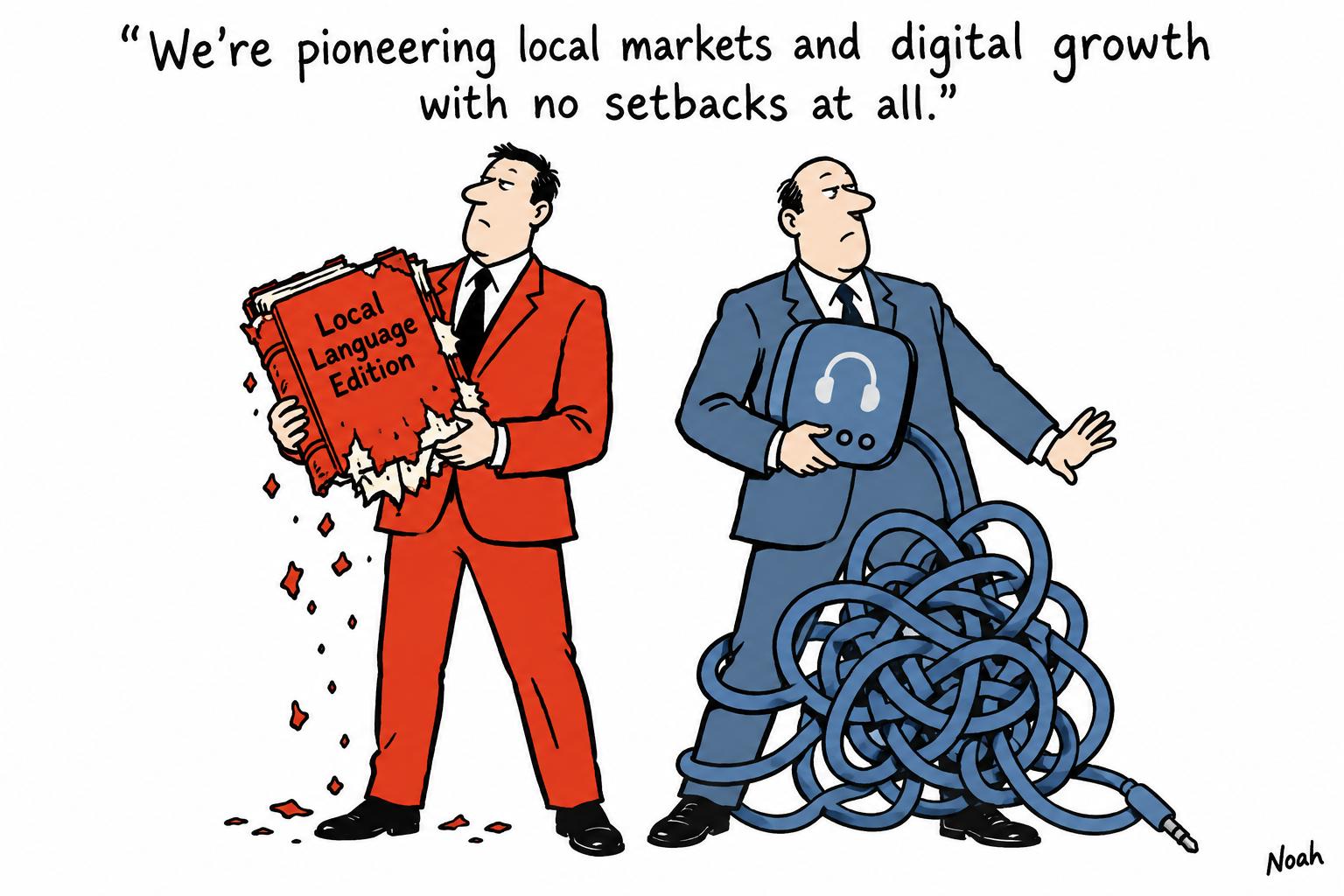
Cartoon · AI-generated
Publishers are racing to exploit audiobook growth and digital platforms while confronting AI-driven job losses, shrinking margins and the erosion of local-language markets.
Frankfurt Book Fair once again served as the publishing calendar’s busiest marketplace and an unusually useful barometer for the trade’s anxieties. With so few regular venues for industry-wide news, the fair has become one of the few places where rights, money, technology and market trends are discussed in the same room, and this year the dominant themes were impossible to miss: artificial intelligence, audiobooks, shrinking margins and the growing internationalisation of English-language publishing. According to SHuSH, October has become the heaviest month for publishing news precisely because Frankfurt lands amid the autumn release season, when most publishers have their biggest titles on the shelves and their sharpest commercial concerns on display.
AI was everywhere, but mainly as a labour question. Ghostwriters reported fewer commissions as would-be clients turned to chatbots, while translators said they were increasingly being asked to clean up machine-generated copy. A 2026 survey cited at the fair found that about 70% of translators had experimented with AI for research or for handling specific terms, yet just under 30% said their workload had fallen because of it. The same tension was visible among publishers, who are simultaneously alleging copyright infringement by large language models, licensing book content to AI firms, and experimenting with AI for publicity, research and other back-office functions. Reuters and WIRED have both reported that major houses are testing these tools even as they insist on keeping them away from manuscripts.
The anxiety is not limited to editorial and rights staff. Frankfurt sessions suggested that AI could hollow out the junior roles through which many people traditionally enter publishing, especially routine tasks in administration, data entry, research and marketing. That concern fits a broader shift in the market: self-help sales have weakened sharply in the United States, with print revenue down 23% through the first nine months of 2026 compared with the same period in 2025, according to SHuSH’s account. Tim Ferriss’s warning that "the market for information is collapsing into the chatbot" seemed to capture a wider industry fear that advice and reference books may be especially exposed to machine-generated substitution.
Audiobooks, by contrast, remain one of the sector’s clearest growth stories, and the fair underlined how aggressively platforms are moving to capture that demand. Audible said in Frankfurt that it wants to make "every book in every language" available as audio, and that AI will be central to getting there. Its own newsroom has said audiobooks are the fastest-growing format and that AI is helping expand the catalogue into non-English languages, while a survey of 18,000 listeners found roughly half were open to AI-narrated titles. Spotify, too, has been expanding audiobook ambitions, and a separate Frankfurt report described plans to use AI narration to reach markets where human voice talent is scarce. Sweden, where audiobooks account for roughly a third of publisher revenue and more than half of fiction revenue, is increasingly treated as a preview of what a platform-heavy market can look like.
That shift is feeding a larger structural change in the business. SHuSH noted that Simon & Schuster’s annual revenue is about $1 billion, roughly matching the scale of Tencent’s China Literature, while Webtoon Entertainment posted $1.35 billion for 2024, figures that suggest much of the commercial energy in reading now sits outside the traditional Big Five model. Amazon’s Kindle Direct Publishing may be larger still. Simon & Schuster’s new Simon Stream imprint looks like a response to that reality: it targets self-published writers, offers no advance, pays a monthly share of net ebook receipts, and launches titles simultaneously in ebook, print-on-demand and audio with the backing of the parent company’s marketing machine.
The other major fault line at Frankfurt was territorial rights, especially in Europe, where publishers are struggling to defend local-language markets against quicker, cheaper English editions. For years, many European houses relied on a protective lag between English originals and translated editions, but that model is under strain as English proficiency rises, online retail improves and readers simply buy the English-language version when it appears. Some publishers now want a formal release window so translations can be prepared without being undercut; others are trying to finish translations in time to appear alongside the English edition, or even to acquire English rights for their own markets. The Federation of European Publishers said its members’ revenues fell 1.2% in 2025, unit sales are down 6% since 2021, and the sector has shrunk by about 34% in real terms since 2007. Against that backdrop, NielsenIQ data showing first-half 2026 print growth in a majority of markets offered at least some consolation, with adult fiction leading the way across many territories even as non-fiction continued to weaken.
If there was a theme running through the fair’s fiction conversations, it was that the market still wants books that feel instantly legible but emotionally absorbing. Horror drew attention because of film and television interest, dark romance remained commercially potent, and multigenerational family sagas, especially those centred on three generations of women, continued to travel well. Literary publishers, facing flatter sales, are increasingly looking for genre hooks, whether supernatural or speculative, while non-fiction buyers kept returning to history, true crime and books that explain politics, technology and culture. Puzzle and gaming titles were also in demand, a reminder that one answer to digital distraction may be print that helps readers put their phones down rather than reach for them.
Inspired by headline at: [1]
Sources by paragraph: - Paragraph 1: [2], [6] - Paragraph 2: [5], [2] - Paragraph 3: [3] - Paragraph 4: [2], [4], [7] - Paragraph 5: [1], [3] - Paragraph 6: [1], [3]
Source: Noah Wire Services · Original