Bolting the doors won’t feed the garrison: 10 ways to save your publishing empire
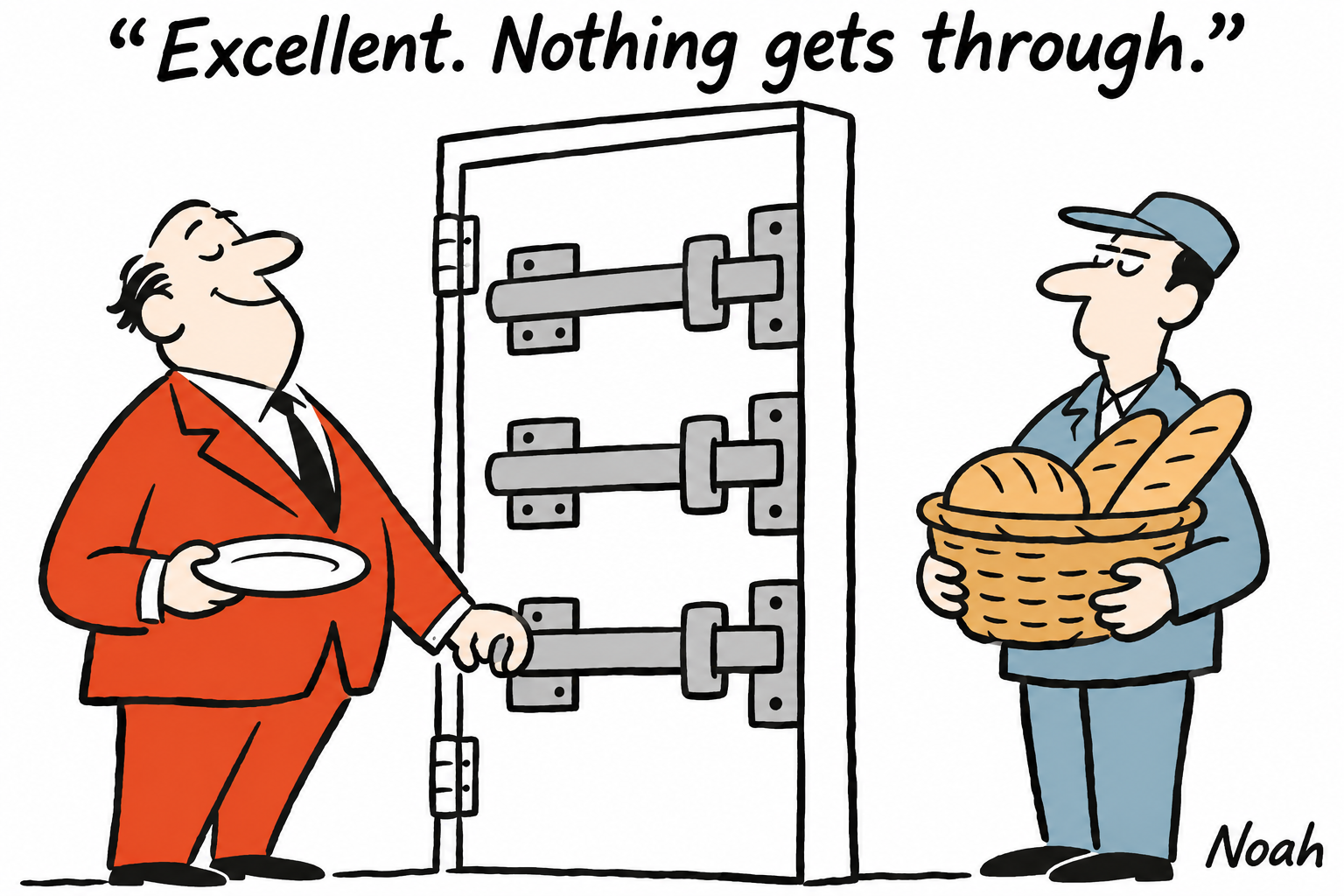
Cartoon · AI-generated
David Buttle's new report, From Search Risk to Agentic Risk, is the clearest map yet of how AI is drawing value away from publishers. It shows where the walls are weakest. This is the companion piece about the food: how publishers earn once the doors are bolted.
At a recent private gathering in New York, the chief executives of ten of the largest publishing groups sat in one room. According to a senior executive who was there, only two of them expected their businesses to survive the next two years. They described journalism cloned within hours and passed around WhatsApp groups, and paywalls that leak faster than they can be patched.
That is the mood, and the instinctive response is to fortify: tighter paywalls, harder bot blocking, more lawyers, better locks. Some of that is necessary. But a siege is not decided by the quality of the door. It is decided by whether the stores last, and a publisher that spends the next three years reinforcing the gate while revenue drains away behind it will have defended a building it can no longer afford to heat.
Tighter paywalls also collide with an awkward fact about the audience. Readers increasingly expect intelligence on tap. Roughly one in 20 UK adults already pays for a personal AI subscription, according to research from the University of Warwick published on 6 November. Those people are paying for something that answers their questions, not for a gate that declines to. A publisher asking them to choose between its paywall and their assistant should not be too confident of the result.
The alternative is less defensive and rather more obvious. Publishers already hold what most AI start-ups would pay heavily for: an audience that turns up, a brand it trusts and an established place in a market. They can give more of the reading away and treat the publication as the front door to something people will pay for: a service, a transaction, a community, a data relationship worth having. The article stops being the whole product and becomes the landing page.
The best map of the siege
Buttle is well placed to draw it. Before founding DJB Strategies he was the Financial Times' director of public affairs and platform strategy, and led its response to AI, including licensing negotiations. He is now lead consultant on the SPUR Coalition, formed by global media organisations to advance technical measures that protect their content and shape the AI licensing market. Few people in the industry know more about locks.
His October report is careful work, and a must-read for anyone running a content portfolio. It shows that AI disruption is uneven. In his study for the Association of Online Publishers, how-to and guide content lost around a fifth of its Google referrals in a single quarter, while reportage fell by around 4%. It sets out four uncertainties for 2029 (adoption, delegation, market structure and the law) and arrives at a base case in which AI becomes a substantial secondary route to information without displacing search or direct publisher consumption. It is not a doom tract. On the pace of change it is notably calmer than the room in New York.
That gap is instructive. If Buttle's base case is right, the chief executives are panicking early. If the chief executives are right, the base case is too kind. Both can hold at once. The market can shift gradually while a business built on the pageview fails anyway, because thin margins do not need a collapse to break, only a few years of steady erosion.
Where the report runs short is the second half of the story. Its final section asks the right questions (where to invest, what to build, how to strengthen demand) and then hands them back as a framework, followed by an invitation to get in touch. It is a thorough account of how the walls are being breached and a sound method for deciding which to defend. It says much less about how the garrison eats.
His own download page supplies a modest demonstration of the answer. The research is free in exchange for contact details, with follow-up and consulting services behind it. Buttle understands perfectly well that a document can be worth more as an introduction than as a product. Publishers should apply the same logic to their journalism. The contact form has, rather helpfully, joined the argument.
Ten ways to eat during a siege
Each is examined in the sections that follow, with the evidence for and against and, where useful, a dated forecast.
1. Sell a service, not an article. A narrow, separately priced AI service built on maintained publisher information, answering a defined customer's own questions. We put the chance of a UK publisher reaching 1,000 paying accounts for one by the end of 2029 at 60%.
2. Turn readers into participants. Forecasting communities such as ForbesPredict give readers a score, a reputation and a reason to return. A copied paragraph carries none of those.
3. Make the article the front door to a purchase. Wirecutter's affiliate referral revenue rose by $4.8m year on year over the first nine months of 2026. The Independent says social commerce has now overtaken its search-led commerce.
4. Get paid for influence without the click. Partnerize says it is already compensating publishers for verified influence in AI-mediated journeys that never produce a visit.
5. Give the agent something to buy. If the assistant never visits the page, sell it something it can use directly: a current comparison, a bookable service, a maintained data feed.
6. Let subscribers bring their own assistant. Lexology and IDC already serve paying customers inside Claude. Blocking a subscriber's agent risks losing the subscriber.
7. Separate access from payment. The Guardian has 1.4m recurring digital supporters and £126m of digital supporter revenue while keeping its journalism open.
8. Earn data by giving something back. First-party data is worth having when the reader gets better alerts, recommendations or membership in return. Hoarding it for its own sake is not a strategy.
9. Use AI to fund reporting, not replace it. Set hard economic targets for AI and spend the capacity it creates on original journalism, which every service on this list depends on.
10. Count the money honestly. Price each pilot, set a threshold for continuing and a reason to stop, and measure what is left after technology, verification, support and acquisition costs.
None of these is a rescue on its own, and several are unproven at scale. But each puts a publisher somewhere the paywall alone cannot: useful after the reader, or the reader's assistant, has come through the door.
The most credible near-term opportunity is a useful service for a defined audience, with an explicit customer and price. An enthusiastic visitor is not yet a customer. A quotation in an AI answer is not yet an invoice. But a strategy that measures only lost pageviews will struggle to recognise a business that earns somewhere else.
Finding the first paying customers
We put the chance at 60% that, by 31 December 2029, at least one UK-headquartered journalism publisher's separately priced, AI-personalised information service launched after 7 November 2026 will reach 1,000 simultaneously paying customer accounts. It must use maintained publisher information to answer user-specific questions or perform user-specific workflows. Static article access, advertising-funded chatbots, free trials and accounts paying only for a general publication subscription do not qualify. The equivalent chance by 31 December 2027 is 42%.
That makes one new paid service reaching this threshold more likely than not over the longer period, while an early result remains less likely. The additional two years allow a publisher to redesign the product, acquire customers and learn which use deserves a separate charge. These are two dated estimates for the same outcome, not a prediction of the precise month at which the business will take off.
One thousand paying accounts would be a useful first test of demand. It would not establish the amount of revenue, the cost of serving those customers or the funding of an entire newsroom. The forecast has no minimum subscription price, and accounts are not seats. The strongest route is a narrow service that repeatedly completes a valuable task. The strongest countercase is that customers expect AI within an existing subscription or prefer a general assistant. Both would leave room for useful AI without satisfying this particular forecast.
The reader with better glasses
For a reader using an assistant to interrogate several accounts, ask follow-up questions and understand an unfamiliar subject, AI can function like a pair of glasses. The reader acquires a capability. An economic strategy that depends on making those glasses less useful is asking customers to surrender something they value.
That capability already has paying customers. Research publicised by the University of Warwick on 6 November estimates that one in 20 UK adults pays for personal standalone AI subscriptions, using anonymised bank and card transactions. This measures payments for AI tools, not willingness to pay a news publisher. It nevertheless makes the commercial challenge clearer: publishers are competing to be useful inside a paid information habit that already exists.
The better question is which part of that expanded capability a publisher can supply well enough to earn from it. Its distinctive assets may include original reporting, tested product knowledge, a carefully maintained database or a community whose members have reasons to keep returning. Those assets can support an article, but they need not stop at an article.
Wider access does not require every publisher to abandon subscriptions. A publication can leave discovery open while charging for a service, preserve premium reporting within a bundle or invite readers to fund journalism that remains widely available. Different customers can pay for different benefits. The serious test is the amount left to fund reporting after delivery, selling and support costs.
Participation that a copied article cannot reproduce
We assign 36% to a UK-headquartered journalism publisher reaching 10,000 distinct registered users who each submit predictions on at least two different days within one calendar month, through a non-wagering prediction product, in a month beginning on or after 1 December 2026 and ending by 31 December 2028. Users must risk no money or purchased stake on the outcome. The publisher must be UK-headquartered; the participants need not live in the UK.
This is a substantial possibility with a clear hurdle, rather than a prediction that forecasting will become standard at every title. A single high-interest month could qualify. Ordinary quizzes, registrations without returning participation and third-party odds displays cannot. Nor does the threshold establish sponsorship revenue or a profitable community. A working model elsewhere makes the product transferable; the difficult part is persuading enough readers to register and return.
ForbesPredict supplies a concrete starting point. Forbes' January announcement describes a platform built with Axiom where readers forecast outcomes and accumulate a reputation for accuracy without wagering money. The company connects the experiment with loyalty and understanding what its audience thinks. The live service links predictions with articles relevant to the question.
The attraction is that a developing story can create a continuing relationship. A reader makes a judgement, returns as events change and eventually discovers whether they were right. A copied paragraph does not reproduce their prediction history or their standing among other participants. A sponsor could support a competition; a specialist audience could pay for a deeper forecasting service. Those are commercial hypotheses, however, rather than disclosed results from ForbesPredict.
There are three different businesses here. A publisher can display an external market's prices as an editorial data source, build its own participation product or strike a commercial partnership with a wagering platform. Kalshi's announced CNN integration demonstrates the first mechanism through coverage and a ticker. It does not disclose a publisher profit figure. Treating every odds widget as a new business model is rather like counting cash registers before anyone has opened the shop.
For a publisher-owned forecasting community, the useful questions include whether readers return after the first question, whether registration produces a continuing relationship and whether participation improves paid conversion or attracts repeat sponsorship. An impressive number of predictions can coexist with a disappointing business. Real-money activity also adds operational and jurisdictional demands that a free forecasting game does not share.
The resulting data needs an equally sensible interpretation. Participants' predictions reveal what this self-selected group expects, and the questions they choose reveal what interests them. That can inform editorial and commercial product design. It does not turn a forecasting community into a representative opinion poll, or establish that its collective judgement will be accurate.
The article as an introduction to a service
Content can be a landing page for a commercially valuable need. A food-industry story about new packaging requirements could lead to a maintained comparison of suppliers. A local account of planning changes could lead to alerts about particular applications. An equipment review could lead to a shortlist based on the buyer's actual requirements, with current prices and stock. These are proposed products, not claims that such services already make money for every publisher.
AI's useful contribution is to make the interaction less rigid. It can ask what matters to this customer, assemble relevant information and explain the alternatives. The publisher can earn from a qualified introduction, a transaction or a maintained service. Its responsibility is to make recommendations trustworthy enough that the customer comes back. Selling the highest bidder as the best answer would consume the asset the business relies on.
Wirecutter shows that purchase assistance has real economics. The New York Times' latest quarterly filing reports that Wirecutter affiliate referral revenue increased by $1m year on year in the third quarter of 2026, and $4.8m over the first nine months. The filing does not disclose that business's absolute affiliate revenue in those lines, and the increases cannot be assigned to AI. They nevertheless show that useful editorial judgement can earn when a reader acts.
The Independent offers a relevant shift in where that earning happens. In Digiday's 16 October reporting, CEO Christian Broughton says social-commerce revenue narrowly exceeded SEO-based commerce revenue in September. The company does not separately publish the figures, so neither the size of the gap nor incremental profit can be established. It is an attributed commercial milestone, not proof that AI caused the change.
Broughton's wider argument is to build revenue around trusted brands and audiences across platforms. He also calls for “really hard economic targets” for AI, with productivity creating capacity for original journalism. That is a more useful ambition than measuring how much copy a newsroom can manufacture. It also needs a continuing test: does revenue earned away from search survive the next change in the platform carrying it?
AI can also intercept that purchase. If the assistant reads the recommendation, supplies the answer and sends the customer straight to a merchant, the publisher may lose both the visit and its commission. Commerce therefore needs its own account of distribution and attribution. Replacing a vulnerable advertising click with an equally vulnerable affiliate click would be a fairly elaborate way of remaining in the same predicament.
When influence produces no visit
Partnerize announced a limited release of VantagePoint for Publishers in January, naming Vox Media and BuzzFeed as charter participants. It describes measuring content's contribution to AI-mediated purchasing and a pilot of compensation based on influence. Profound's March partnership announcement connects AI discovery signals with Partnerize's verification and payment infrastructure. By October, Partnerize said its Lighthouse early-access programme was already compensating publishers for verified influence in journeys without clicks. That is a vendor-reported commercial application, rather than merely a proposed measurement tool; the announcement does not establish the scale or profitability of those payments.
The distinction between measurement and money matters. A method can attribute influence without a buyer agreeing to pay for it. An advertiser can agree to pay without the publisher earning enough to cover its costs. A certification of a measurement process is not a certificate that a media business has recovered its lost revenue. The evidence to watch is settled payments, agreed compensation rules, renewals and the margin left for the publisher.
An agent needs somewhere to buy
We put 46% on a UK- or US-headquartered journalism publisher earning transaction-linked referral commissions on at least 1,000 completed retail orders through one AI-agent integration between 8 November 2026 and 31 December 2028, with the agent completing merchant checkout and the customer visiting neither the publisher's nor the merchant's website. Customer authorisation inside the agent interface is allowed. Cancelled and refunded orders do not count.
The number tests a new commercial connection, not simply whether AI helps people shop. The volume is modest once an integration works, but checkout, attribution and a publisher's right to a commission must all work together. A citation in an answer, a referral to a merchant's website or a partnership announcement does not satisfy it. The opportunity is considerable enough to investigate; it remains short of an even chance on this exact definition.
The landing-page idea has a difficult second chapter. The customer's assistant may never visit the page. A publisher that wants to serve that customer needs a product the assistant can use: a current comparison, a bookable service, a maintained data feed or a way to purchase access to a valuable function.
Adyen's June announcement illustrates infrastructure moving in this direction. Its agentic commerce offering connects product information, carts and payments across conversational platforms. At announcement it had limited availability for enterprise merchants operating in the US. That is a merchant capability, not evidence that publishers have already earned from it. The implication for publishers is to define what they are selling and how an assistant can obtain it without rebuilding the old website journey inside a chat window.
There is also evidence of friction. OpenAI's March product announcement shifted emphasis from the initial Instant Checkout experience towards discovery and merchants' own checkout experiences. Its current merchant page continues that emphasis. A merchant store opened in an in-app browser still fails our no-website test. Deeper native integrations remain possible; it would be equally wrong to infer that all agent checkout has stopped or that every AI-assisted sale already qualifies.
Serving subscribers through their own assistant
Sometimes the customer has already paid. An INMA conference account published on 28 October describes an FT subscriber who uses her own agent to turn her subscription into a personalised feed, and says she would cancel if it were blocked. It is an individual's reported experience, not a representative churn study. It identifies a question worth taking seriously: can a publisher recognise and serve an assistant acting for a legitimate subscriber, rather than treat every machine visit as the same commercial threat?
There are now named professional-information examples of that route. Lexology's 26 October announcement describes regulatory intelligence available inside Claude for Lexology PRO subscribers. Its access documentation requires an active individual subscription with MCP access, and says the connector can retrieve source material without being able to change the account. Here, the assistant is a permitted way to use a paid product.
IDC's 28 October account says its Quanta research has been available in Claude since July. Customers can ask for analysis using IDC forecasts and market data, with citations to the underlying research. This is a research company's account of an available service, not evidence of a separately disclosed revenue uplift.
Both are professional information products, with different economics from mass-market news. Neither establishes the future new-launch and paying-account milestone in our forecast. They nevertheless make the design choice tangible: the supplier keeps a valuable information service while allowing the customer to use it within an assistant they already find useful. The customer can keep the glasses on.
The same question applies to first-party data. Asking a reader to identify their interests can improve alerts, recommendations and membership. Gathering data for its own sake is a strategy with a spreadsheet where the customer proposition ought to be. The publisher needs to know what benefit it gives in return, what relationship it retains and who can actually use that information when the journey crosses platforms.
Welcoming readers and funding the work
The Guardian demonstrates that access and payment can be separated. Its 2025/26 annual review reports 1.4m recurring digital supporters and £126m in digital supporter revenue. It also records £17m of operating cash outflow and a substantial endowment. A growing supporter relationship is real; a universal formula for profitable open-access publishing is not established. This is a mature reader-funding model, not an AI-created success.
Future provides a different mixture of progress and pressure. Its May half-year announcement describes Future Optic services around visibility in AI systems and Signal shopping services. It reports 8% growth in direct advertising. Its investor figures also show revenue down 8% and adjusted EBITDA down 24% for the half. The opportunity is being pursued inside an existing business under strain. That is a reason to inspect the product economics, rather than to dismiss innovation or declare victory.
The practical value of these examples is the range of ways a publisher can serve demand. A stronger membership offer, a forecast community and a purchase service have different customers and costs. Combining them indiscriminately would create a complicated publisher, rather than necessarily a better one.
The Guardian's October update also confirms that Guardian Jobs has closed. Familiarity with an audience does not guarantee permission to win every adjacent business. A publisher considering a marketplace needs to understand what it will do better than the specialist suppliers already serving that need.
Showing what is left after costs
Our fifth forecast is a test of evidence rather than commercial success. We assign 33% to a UK- or US-headquartered journalism publisher publishing, after 7 November 2026 and by 31 December 2029, a numerical account of its own AI information service, non-wagering prediction product or qualified-introduction service that gives incremental earned revenue and incremental operating profit or loss for the same period, explicitly accounting for technology, editorial verification, support, rights and customer-acquisition costs, including any zero-cost categories.
A loss-making service could satisfy this forecast. A successful service whose owners never disclose these details would not. The estimate therefore says nothing directly about the chance that such businesses are profitable. It tests whether boards will get a public account detailed enough to learn from, rather than another case study that stops at engagement or revenue. A product launch is quite capable of generating a conference presentation before it generates a customer.
Public disclosure may remain patchy because publishers bundle services, protect pricing and treat acquisition and editorial costs as shared overhead. A small or grant-supported project could nevertheless publish a transparent account. Whatever appears in public, the publisher's own investment decision needs these numbers. Count commissions net of reversals and the staff time spent maintaining and checking answers. Ask whether customers renew when the service costs enough to sustain it.
What copying cannot buy
Opening more of a publication can reduce dependence on excluding non-payers. It cannot make copying cease. Search indexing, answer synthesis, unauthorised republication and sharing a paid article are different activities; a claim about one does not establish another. They also have different commercial consequences.
A publisher should ask what remains valuable after a static article has circulated. A live maintained service can be updated. A community gives members an ongoing relationship. A purchase service can complete an action. A forecasting product can keep score. Original reporting supplies information that these services need. None is magically impossible to imitate; each offers more than a paragraph that can be pasted into a group chat.
Welcoming attention becomes commercially sensible when there is a credible route from usefulness to revenue. The publisher should be able to name who pays, what they receive, how the transaction is attributed and what delivery costs. A pilot needs a threshold for continuing and a reason to stop if customers will not pay. Technology lowers some barriers to testing. It does not remove the need to sell something worthwhile.
Buttle is right that powerful intermediaries can take value from publishers, and right that every publisher should know exactly where its walls are thin. Bolt the doors where it makes sense. But a publisher that measures its strategy by how much it keeps out will slowly starve behind very good locks. The growth question is where publishers can create a valuable service of their own, including inside those intermediaries.
The chief executives in New York are right to be frightened of the business they have. They have less reason to be frightened of the one they could build. They still own the brand, the audience and the attention, which is precisely what everyone else in AI is spending billions trying to acquire. Readers who can see further will have more questions and more things they want to do. Publishers should be building businesses that benefit from the glasses, and treating every article as the way in.
Sources
- David Buttle From Search Risk to Agentic Risk October 2026
- Forbes corporate announcement of ForbesPredict 23 January 2026
- ForbesPredict live service checked 7 November 2026
- Kalshi CNN partnership announcement 2 December 2025
- The New York Times Company Form 10-Q quarter ended 30 September 2026
- Partnerize VantagePoint for Publishers announcement 14 January 2026 republished 15 January
- Profound and Partnerize partnership announcement 12 March 2026
- Partnerize We Have Seen This Movie Before 19 October 2026
- Alliance for Audited Media interview on Partnerize certification 27 April 2026
- Adyen Agentic announcement 16 June 2026
- Guardian Media Group Annual Review 2025 26 published September 2026
- Future half year announcement 14 May 2026
- Future investor relations checked 7 November 2026
- Guardian Jobs status update first published 2 September updated 16 October 2026
- Future half year regulatory results 14 May 2026 issuer release carried by Stockopedia
- University of Warwick CAGE Who Pays for AI research announcement 6 November 2026
- INMA conference account Readers agents are becoming customers 28 October 2026
- OpenAI Powering Product Discovery in ChatGPT 24 March 2026
- ChatGPT merchant participation page checked 7 November 2026
- Digiday report on The Independent commerce shift 16 October 2026
- Lexology PRO company launch announcement published 26 October 2026
- Lexology PRO MCP access documentation checked 7 November 2026
- IDC Quanta in Claude company account 28 October 2026
Source: Tomorrow’s Publisher