As news traffic collapses, Nevada outlet puts AI to work without handing over editorial control
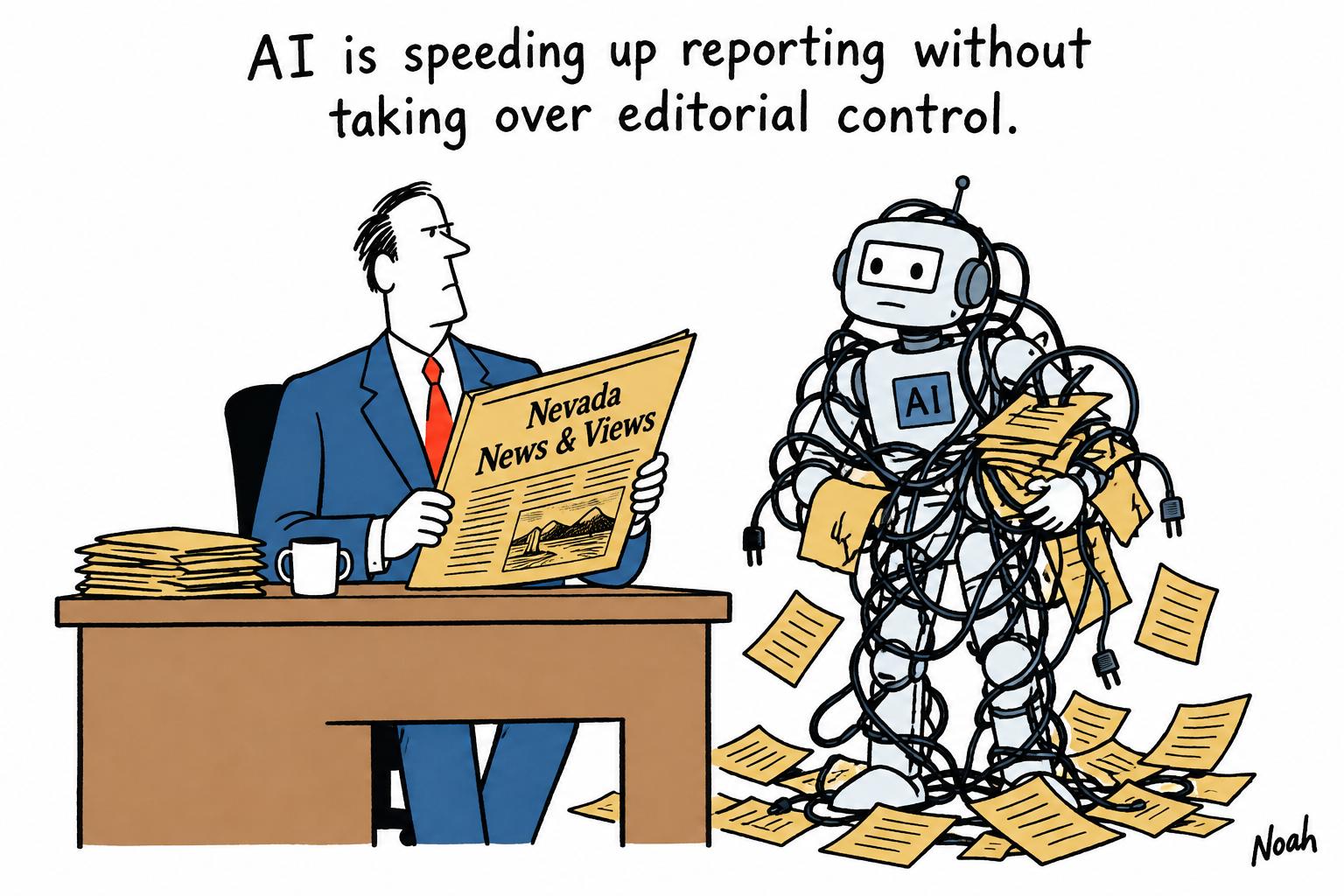
Cartoon · AI-generated
Falling search referrals and direct visits are squeezing major publishers, but Nevada News & Views says AI-assisted reporting can help smaller newsrooms work faster while keeping human journalists in charge.
The old news business is under strain as audience habits shift and artificial intelligence changes how people find information. According to Similarweb data reported by Axios, U.S. traffic to around 100 major news sites fell sharply in July compared with the previous year, while search referrals have weakened and direct visits have also declined. Other recent analyses point in the same direction: Media Copilot said traffic to the top 50 US news websites dropped by 37% between July 2024 and July 2026, and that generative AI still accounted for only a tiny share of visits.
That collapse has not happened in a vacuum. Search engines now answer more questions on the results page, while AI assistants can provide quick summaries that reduce the need to click through to publisher sites. As Fayfo reported, the biggest US news brands have seen audience erosion large enough to force publishers to rethink both distribution and monetisation. The result is a familiar industry squeeze: fewer clicks, weaker advertising economics and newsroom cutbacks that can further reduce the depth and pace of coverage.
Against that backdrop, Nevada News & Views is presenting itself as proof that smaller outlets can use the same technology without surrendering editorial control. The site says it uses AI as a research aid, sifting through public records, checking figures and helping reporters work faster, while insisting that sourcing, judgement and the final copy remain human responsibilities. That approach mirrors a broader pattern identified by the Associated Press, whose survey found that most journalists and newsroom leaders have used generative AI in some capacity, even as they call for clearer rules, training and oversight.
The publication points to its coverage of Republican congressional candidate David Flippo as an example of that model in practice. It says senior political writer Brittany Sheehan used federal election filings, aided by AI-supported research, to examine campaign loans and donor refunds, including repeated contributions from some of the same names. The outlet argues that the work demonstrates how automated tools can speed up the document-heavy parts of reporting without replacing the human task of chasing leads, questioning filings and deciding what matters.
The wider industry picture suggests that this is no longer an experiment at the margins. WAN-IFRA has described a shift from tentative testing to broader deployment of AI across newsroom production and audience strategy, while TheWrap has reported that publishers are increasingly using such tools to produce faster service journalism and routine updates. At the same time, critics continue to warn that speed alone cannot substitute for judgement, verification and trust. That tension now defines the sector: legacy brands are losing traffic, while leaner outlets are trying to use the same technology to work more efficiently and retain readers directly.
Inspired by headline at: [1]
Sources by paragraph: - Paragraph 1: [2], [3] - Paragraph 2: [2], [3] - Paragraph 3: [4], [5] - Paragraph 4: [1], [4] - Paragraph 5: [5], [6], [7]
Source: Noah Wire Services · Original