AI’s next media product is the newsroom’s own expertise
Cartoon · AI-generated
Publishers are moving beyond AI-powered efficiency to turn archives, reporting and editorial judgement into answer services, personalised alerts and lower-cost video products.
For years, publishers have framed artificial intelligence in media largely as a question of speed: faster research, faster edits, faster headlines, faster clips and, in some cases, faster copy. That logic still matters, but it is beginning to look incomplete. AI is now being used not simply to compress familiar workflows, but to create new kinds of audience-facing products, from archive-based answer tools to personalised alerts and publisher-owned video pipelines. In that sense, the most important change is not efficiency alone, but the possibility of turning editorial expertise into something more interactive, more useful and more commercially durable.
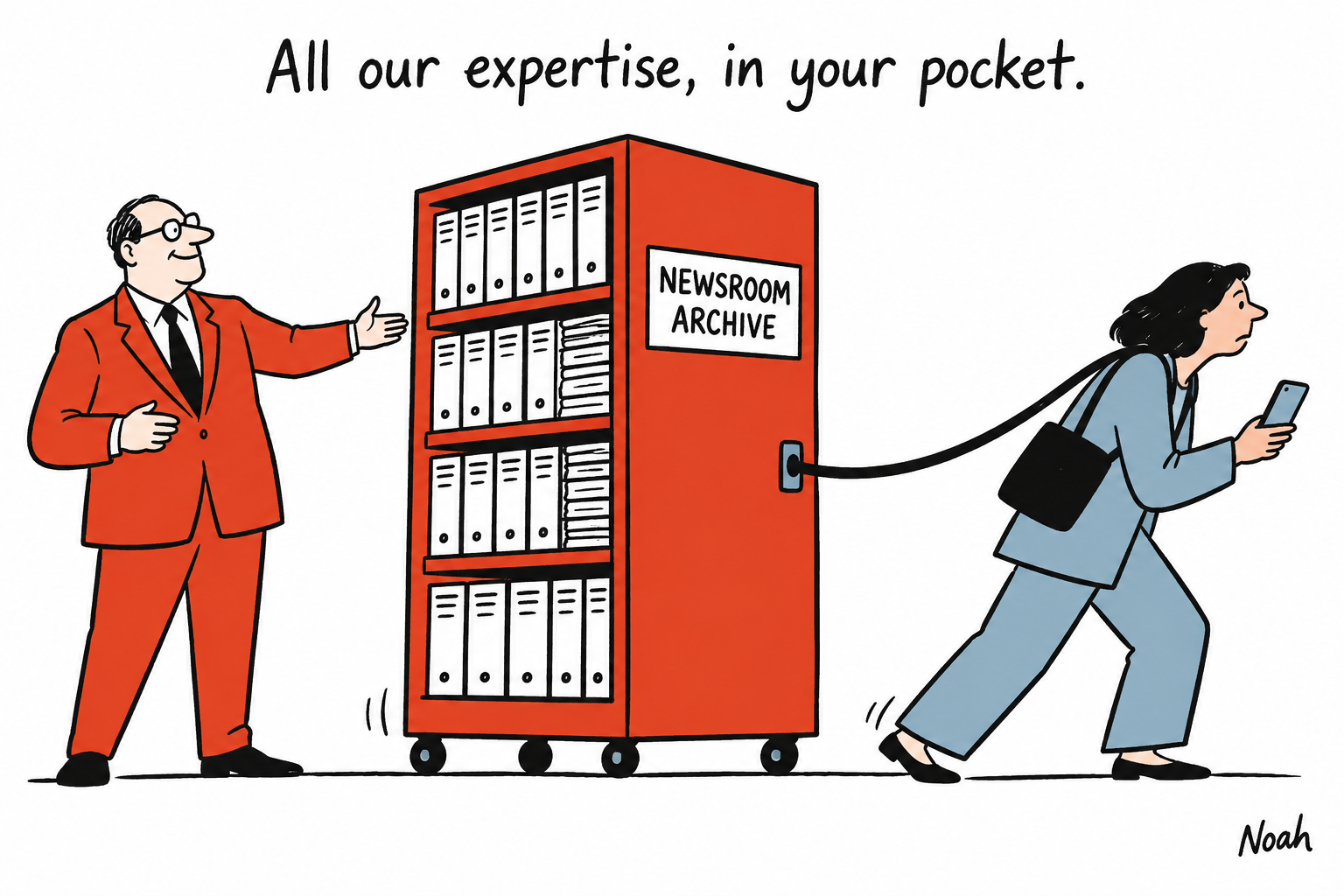
That shift is visible in the way news and specialist publishers are rethinking their archives. Fast Company has described how titles such as Nursing Times have turned long-running reporting into an answer engine that draws only on their own material, while Skift has built a similar service for travel professionals. In both cases, the goal is not to replace journalism with a chatbot, but to package a publication’s accumulated knowledge as a product readers can return to whenever they need it. Other experiments go a step further by letting audiences connect that archive to their own AI tools, effectively making a publisher’s back catalogue available as a personalised research layer rather than a static site.
The same logic is emerging in local and service journalism. According to Fast Company, The Texas Tribune used one of its chatbot experiments to channel reader questions back to its reporting team, with unanswered queries helping to shape future stories. In São Paulo, Agência Mural has combined public weather and flood data with editorial judgement to send tailored WhatsApp alerts to underserved communities. These are not simply content distribution tactics; they are attempts to build continuous services around the needs of specific audiences, particularly where timely, practical information matters more than a conventional article format.
Video is another area where AI is being positioned as a creator of opportunity rather than merely a labour-saving device. As Morgan Stanley has noted, generative AI could reduce production costs substantially across parts of the media and entertainment sector, while also enabling smaller organisations to produce content that once required larger teams and budgets. Other industry analyses say AI is increasingly being used for editing, script analysis, content tagging and audience targeting, with the promise of shorter production cycles and stronger engagement. In publishing terms, that could mean reporter-led short-form video that is assembled, captioned and distributed through automated pipelines, allowing a newsroom to show up in formats that have been difficult to sustain with traditional staffing models.
That potential is real, but so are the limits. A systematic review published on ResearchGate found that AI can materially reduce production time and improve accessibility, yet it also flagged concerns around bias, authenticity and the narrowing of informational variety. Fast Company also pointed to experiments that did not last: one university-backed chatbot pilot with local outlets drew relatively little usage, and Politico shut down a bespoke report-generation tool after concerns over hallucinations. The pattern suggests that the most durable projects are usually narrow in scope, low in cost and placed where readers already have a clear reason to ask a specific question, rather than being launched as broad, general-purpose chat interfaces.
What emerges from these experiments is a different test for AI in media. The question is no longer whether technology can make a familiar process quicker, but whether it can create something readers could not easily get before. Morgan Stanley and other industry commentators have argued that AI is pushing media firms towards new operating models in which savings can be reinvested in talent, rights and better products. The more interesting newsroom uses follow the same principle: an archive becomes an answer service, a beat becomes a guided conversation, a local warning becomes a personalised alert and a reporter becomes visible in a format the audience actually wants. In that world, the article is still important, but it is no longer the only thing a publication has to sell.
Inspired by headline at: [1]
Sources by paragraph: - Paragraph 1: [2], [3], [4], [7] - Paragraph 2: [1] - Paragraph 3: [1] - Paragraph 4: [2], [3], [4], [7] - Paragraph 5: [5], [1] - Paragraph 6: [2], [3], [4], [5], [1]
Source: Noah Wire Services · Original