AI is rewriting the illustrator’s brief
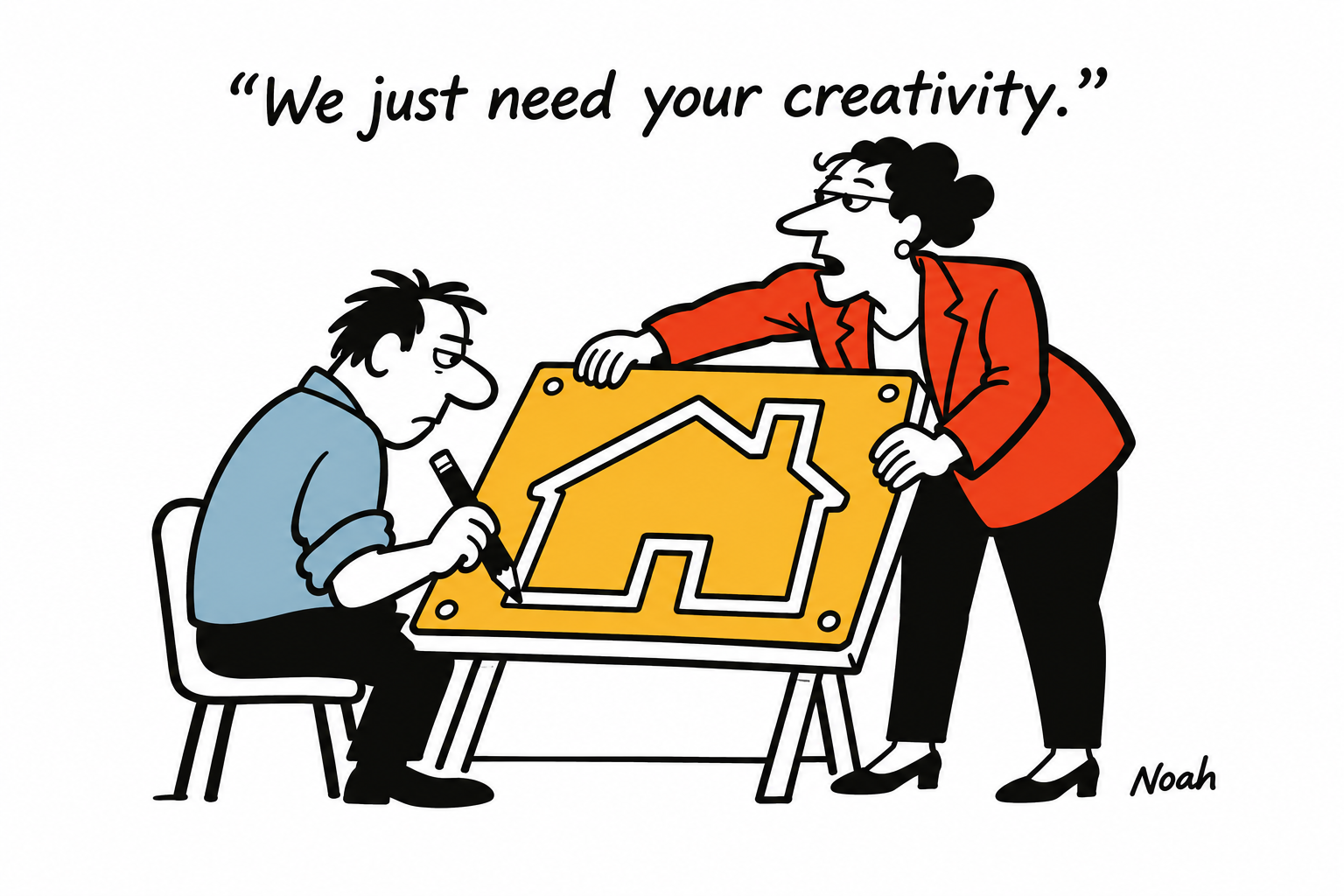
Cartoon · AI-generated
The commission still arrives, but the creative decision has already been made. In the Association of Illustrators’ new survey, respondents describe clients supplying AI-generated images and asking them to redraw an approved direction. The illustrator remains on the job while losing part of the work that made the commission valuable.
For publishers, the attraction is understandable: faster visual development and potentially lower production costs. Illustrators face pressure on fees and creative control. The business decision is whether the new process produces a better finished image for the money, rather than simply a smaller freelance invoice. The survey makes that question urgent. It does not answer it.
The AOI received 549 responses in 2026. Some 46% said they knew they had lost work because a client chose generative AI instead, compared with 32% in its 2025 survey of 5,000 respondents. These were separate samples, not the same illustrators followed over time. The figures describe respondents’ experience, not the share of all commissions displaced.
One respondent, working across advertising, branding and other commercial fields, put the change plainly: “I’m basically stripped out of the concept and research work to be left only with an execution role.” The words appear in the AOI’s report, which anonymises its participants. They were not given in an interview with Tomorrow’s Publisher.
Across respondents to the relevant questions, 62% had encountered generated images in briefs or moodboards, 36% had been asked to copy, refine or redraw them, and 31% reported clients expecting lower fees because AI tools exist. A moodboard is a set of visual references. When its contents become a settled instruction, reference has turned into direction.
That is a change in bargaining power as well as production. A commissioner can arrive with something visible and declare the thinking complete. An illustrator may still need to solve composition, consistency and meaning, but now has less scope to challenge the chosen approach. Generating alternatives quickly can be useful. Confusing that speed with completion is the mistake.
Practice can also diverge from public positioning. WIRED’s October reporting described anonymous US staff accounts of AI use, including cover art. Hachette said it supported operational uses but not creative ones; Simon & Schuster said approved enterprise tools were optional; HarperCollins did not comment. Those accounts are not a UK production audit.
“We need publishers to be clear about what is being used and when,” Emma Dries, an agent at Triangle House Literary, told WIRED.
The cheaper image has a longer bill
A generated concept may make a brief clearer, spare an unproductive round of sketches or make an illustration affordable where none would otherwise have been commissioned. Those are legitimate gains. They should be judged against the actual alternative, which might be stock photography, an existing asset or no image at all. Assuming every generated image replaces a paid commission would exaggerate displacement just as surely as ignoring it would.
Consider a wholly hypothetical comparison. A conventional commission costs £300. An AI route costs £20 in tools and three hours of editing and checking, valued at an assumed £60 an hour, bringing the total to £200. Two further hours of revisions take it to £320. These are invented assumptions, not observed fees or workflow averages. They show why the result depends on accepted output and staff time.
The invoice is visible; the art director’s afternoon may be harder to allocate. A publisher that records only the former can report a saving while moving work onto salaried staff. Equally, a well-designed process could genuinely reduce both. None of the survey’s lost-work figures establishes which has happened at a particular publisher, and the sources checked for this report provide no comparable publisher-level net savings measure.
A policy can draw a useful boundary
Bloomsbury’s policy for authors and illustrators, dated December 2025 and still publicly available, distinguishes assistance from generated submissions. It permits research and brainstorming, and specified editing. It prohibits submitting AI-generated content for publication, including material substantially edited afterwards, and extends that prohibition to cover and interior illustrations.
The same policy permits editing an illustrator’s own original images using Adobe Creative Cloud, under a specific exception. It requires disclosure beyond research and brainstorming. This is a publisher’s rule for submitted work, not a general statement of what the law permits. Its value is that the boundary is explicit enough for an author, illustrator and editor to discuss before production.
Penguin Random House’s US guidance, published in September and dated 15 August 2026, similarly supports limited assistance and asks creators to discuss planned AI use with their editor. It says the finished work must remain the creator’s own. That document is US guidance; it should not be silently promoted into a uniform rule for every Penguin Random House business.
In the UK and Ireland, Penguin’s current Cover Design Award excludes entries containing generated elements. It also offers a six-month mentorship to each category winner. The competition is a portfolio opportunity, and winning entries are not used in published works. It therefore demonstrates a particular choice about developing talent, not a company-wide prohibition on AI cover production.
These distinctions matter commercially. A licence for a tool is not permission to upload a commissioned illustrator’s work. Approval of an internal reference is not approval of a final cover. Leaving those decisions to an individual designer at the deadline invites disagreement later, even where everyone originally intended the technology to help.
Policy also needs someone to operate it. The relevant question for a publisher is who can approve the input, who reviews the result and who carries the cost when an approved direction has to change. A rule that merely transfers all responsibility to the last freelancer in the chain will not tell management whether the process is efficient.
Disclosure is part of production
A study of the Financial Times by Liz Lohn and Felix M. Simon, published in AI & Society on 3 October, offers a useful newsroom comparison. Based on 13 interviews with 12 participants in May to July 2025 and internal documents, it found that disclosure varied with factors including human oversight and the nature of the task. Lohn worked at the FT when the research was conducted and has since left.
The study identified practical difficulties, including consistent labelling across devices and keeping staff informed. It is a qualitative account of one organisation, not evidence that a particular label restores trust or that AI saves money. Its relevance is simpler: choosing and explaining an acceptable use involves work beyond producing the output.
Tomorrow’s Publisher uses an AI-generated cartoon with this article, labelled as such. That choice is no evidence of industry-wide savings. An openly illustrative cartoon and an image offered as evidence of an event also carry different editorial obligations. The purpose of the image must be clear before its production method is judged.
A recent 2000 AD cover shows what that interpretation can involve. In the publisher’s 21 October process account, Simon Davis described choosing imagery from Megan Huang’s Ghosted artwork, developing a composition and painting the cover for issue 2505 in oils over about a week. This is a documented creative process, not a comparative productivity trial. It supplies a useful answer to what the publisher is buying beyond the final file, without proving that every cover should be made the same way.
The longer-term cost is less readily priced. If illustrators are hired only to finish an approved direction, publishers may preserve execution while buying less of the interpretation that makes a visual distinctive. That need not happen in every AI-assisted commission. It becomes a risk when the generated reference is treated as an answer that cannot be questioned.
An image generator can earn its place by removing work that adds little and making useful work possible. The AOI’s evidence challenges publishers to be more precise about what is being removed. A smaller role for the illustrator is an observable change in a commission. A better publishing product remains something the publisher has to demonstrate.
Research note: Noah, a research and forecasting service, searched publishing coverage for this report. Survey figures and publisher policies were checked against the linked original documents. No numerical forecasts are included.
Sources
- Association of Illustrators: AI and the Future of Illustration, full 2026 report
- Association of Illustrators: survey findings and commissioning
- WIRED, Adam Morgan, 9 October 2026: staff accounts and publisher responses
- Bloomsbury: AI policy for authors and illustrators, December 2025
- Penguin Random House US: guidance for authors and illustrators, August 2026
- Penguin UK: Cover Design Award rules and mentorship
- Lohn and Simon, AI & Society, 3 October 2026: FT transparency case study
- 2000 AD, 21 October 2026: Simon Davis’s Ghosted cover process
- Research notes and source qualifications
Source: Tomorrow’s Publisher