AI is removing the training wheels from the first rung of the career ladder
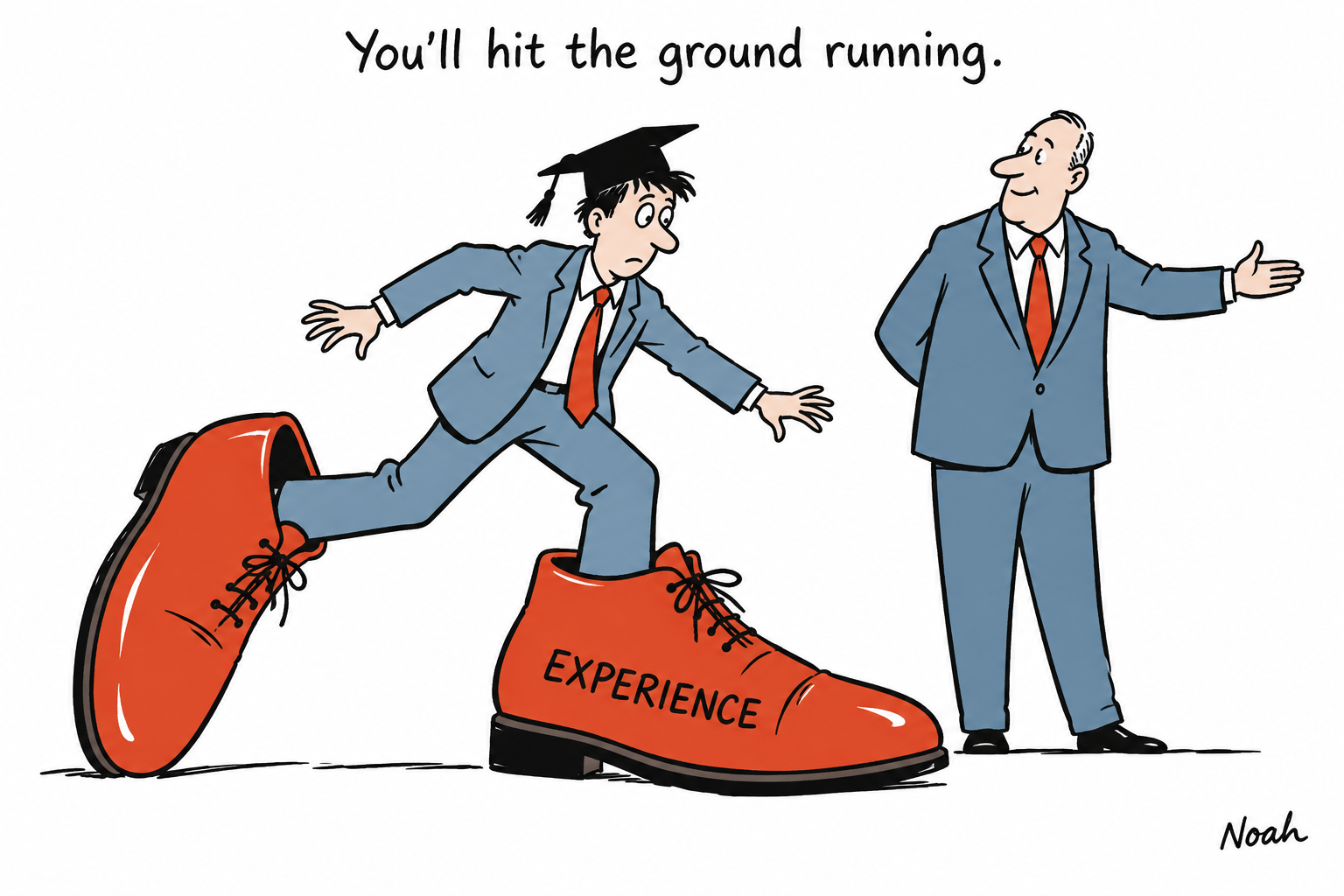
Cartoon · AI-generated
As AI takes over routine tasks, employers are hiring fewer beginners or expecting them to contribute at a higher level , raising concerns about how the next generation will gain the experience to know when technology is wrong.
Artificial intelligence is quietly redrawing the first rungs of the career ladder, especially in sectors that once relied on large cohorts of graduates to handle repetitive tasks. At Catalyst, a London advertising agency, founder Tobias Green says one junior employee can now do the work that previously required several people, because AI now handles research, first-draft copy and data gathering while humans step in later to refine the output. What was once an apprenticeship in basic execution is increasingly becoming an exercise in supervision, prompting a wider debate about how new entrants are meant to learn if the easiest work disappears first.
The shift is not confined to advertising. Open University’s 2026 Business Barometer, which surveyed 1,500 business leaders in the UK, found that 51% said AI was changing how they hire, while 19% reported cutting entry-level recruitment, with 42% of those pointing to AI adoption as the reason. Gartner reported in July that 22% of chief human resources officers said automation had reduced entry-level hiring in their organisations, reinforcing the view that routine tasks are being stripped out of some junior roles before graduates ever reach them.
Yet the picture is not simply one of shrinkage. In a separate survey of 500 UK and Irish mid-market leaders by technology consultancy Klarus, 45% said AI was helping junior staff work faster and better, while almost a quarter said it was creating new roles and opportunities. IBM has also argued that entry-level work is being redefined rather than erased, with an emphasis on analysis, problem-solving and responsible AI use, alongside greater willingness to hire for learning agility and potential rather than a fixed job description. That suggests some employers are using AI less as a replacement for new hires than as a way to raise the baseline expectation for what juniors can contribute from day one.
The biggest change may be in software and other technical roles, where junior staff are increasingly expected to oversee systems rather than build everything from scratch. Sheila Flavell of FDM Group told CNBC that tools such as Claude Code and Codex are pushing developers towards managing both AI agents and colleagues, a shift that may make collaboration and oversight more valuable than narrow technical repetition. Similar thinking is appearing in recruitment more broadly: some employers are moving away from hiring graduates into rigid slots and instead look for transferable capabilities, such as critical thinking and adaptability, then decide where those people fit.
That strategy, however, carries a risk. Cheney Hamilton of Bloor argues that the menial tasks now being removed were never merely busywork; they were the means by which younger workers built judgement, learned to spot errors and absorbed the unwritten rules of corporate life. AI may allow a junior employee to produce more polished work, but it does not automatically teach the experience needed to know when that work is wrong. For employers, the challenge is no longer just how to use AI efficiently, but how to preserve enough exposure, repetition and responsibility for the next generation to become capable managers of the technology rather than passive users of it.
Inspired by headline at: [1]
Sources by paragraph: - Paragraph 1: [2], [5] - Paragraph 2: [4], [5] - Paragraph 3: [3], [4] - Paragraph 4: [3], [6] - Paragraph 5: [4], [5], [7]
Source: Noah Wire Services · Original