AI checks can be quick — if the reviewer knows the story
Cartoon · AI-generated
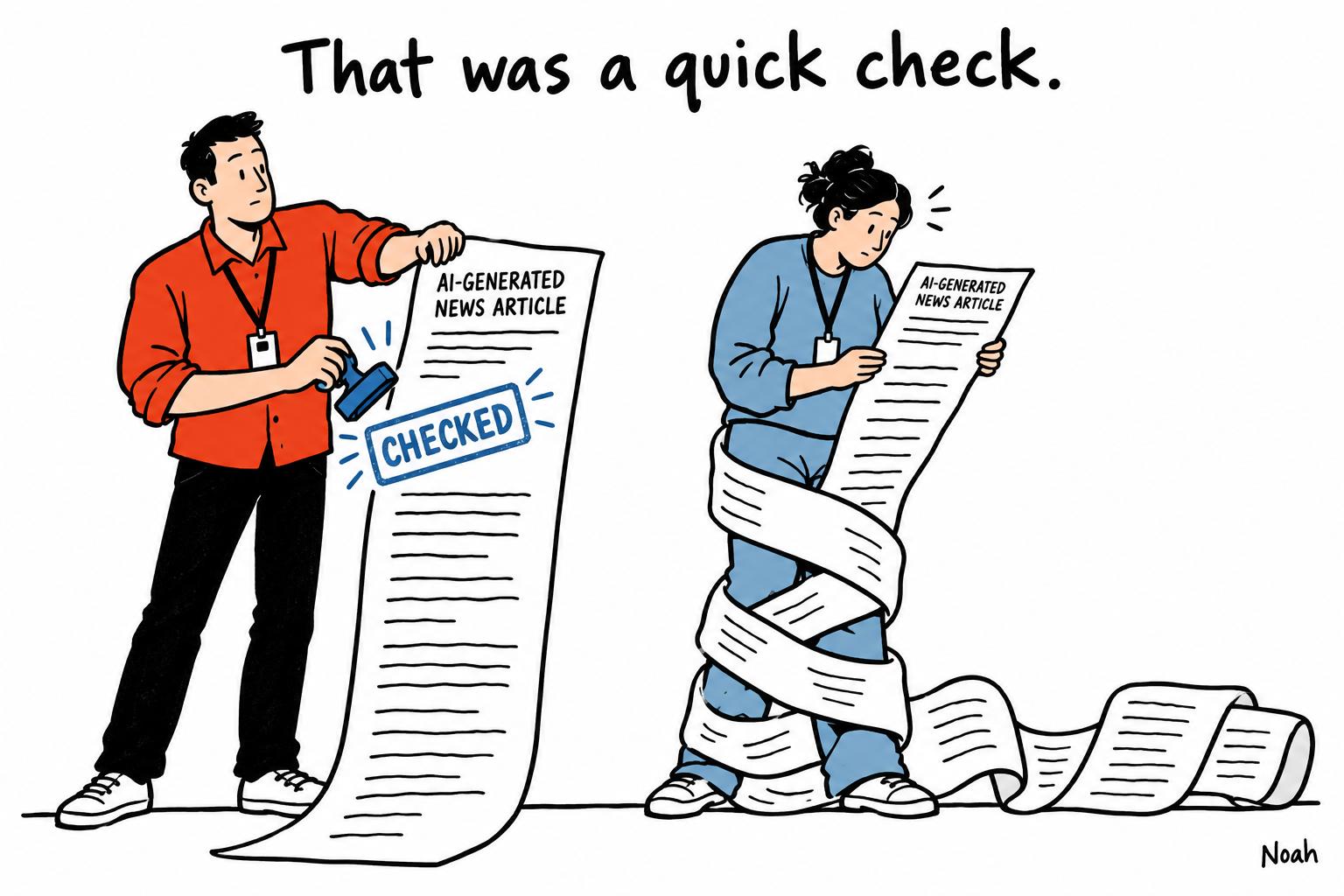
Norwegian newsrooms suggest that human review need not erase AI’s time savings when journalists already know the material , but checking unfamiliar outputs can take far longer.
At VG, Norway’s biggest newspaper, artificial intelligence is involved in preparing material for about 200 articles each day. One model proposes headlines, search terms and related details; another reviews those suggestions before a journalist checks them and, in some cases, an editor has a further look. The process puts human judgement at the end of the chain, rather than treating a second automated check as a substitute for editorial responsibility, according to Fortune’s account of the newsroom.
The time needed for that human review varies with the task and with the reviewer’s familiarity with the material. At Bergens Tidende, AI produces a brief version of a reporter’s completed story, which the reporter and an editor then check. Development editor Jan Stian Vold estimates that a journalist who knows the story can review the summary in seconds or a few minutes; writing one from scratch takes three to five minutes. Those figures are estimates rather than timed results, but they suggest that review can be quicker than the work it replaces when the checker has already reported the story.
The comparison looks different in many workplaces, where a colleague may have to assess AI-generated material without knowing its subject or how it was produced. Workday’s research announcement says nearly 40 per cent of the time saved through AI is absorbed by reworking outputs. Separately, a BetterUp Labs and Stanford Social Media Lab survey of 1,150 full-time US desk workers found that respondents estimated it took an average of two hours to resolve an instance of “workslop”: material that looks complete but requires repair or further investigation. Both sets of findings rely on survey responses, and concern broader workplace tasks rather than newsroom summaries, so they are not direct comparisons with the Norwegian examples.
The newsroom evidence also points to a distinction between kinds of error. Vold estimates that roughly one in ten of BT’s short summaries needs correction, usually for awkward wording or for missing what the reporter sees as the central point. By contrast, Johanna Johansson, who works in Schibsted Media’s AI Foundations unit, has described hallucinations as common in AI-generated material generally. The accounts are not necessarily at odds: one concerns AI output as a whole, the other a limited task based on a story its checker already knows. Schibsted’s own discussion of AI in news products likewise stresses that summaries and republished versions can mislead, and that editorial safeguards remain important as publishers use AI across more formats.
At Fjell-Ljom, a small local newspaper recognised as a 2025 local newspaper award winner, review is built into the reporting process rather than reserved for a final stage. Development editor Iver Waldahl Lillegjære says AI contributes to about one to three stories a day, and that journalists remain involved throughout. The paper’s experience illustrates why errors of judgement may be harder to catch than straightforward factual slips: recognising what has been left out or misweighted often depends on understanding the story. An Aalto University thesis records a freelance journalist making a related point about transcription: typing an interview can foster familiarity with it that a later scan for mistakes may not provide.
The evidence does not establish a universal cost for checking AI work. A Georgia Institute of Technology researcher has argued that the mental effort of verifying outputs can erode the efficiency gains from AI, while the newsroom examples suggest that the burden depends partly on whether the reviewer has already engaged with the underlying material. At BT, the estimates point to a short check; at Fjell-Ljom, checking is part of the work and has not become a distinct extra stage as AI use has grown. Neither newsroom account amounts to a controlled time study, but both underline that review cannot be understood separately from the workflow around it.
For organisations adopting AI, the practical lesson is to account for the labour of checking as well as the apparent time saved: how many outputs are reviewed, by whom, and for how long. Better tools may reduce some errors, but the sources cited here offer no basis for treating that as a reason to abandon human oversight. Schibsted’s account of its own safeguards similarly presents editorial review as necessary even as models improve. The more consequential question may be whether the person reviewing an output still knows enough about the work to recognise, quickly and reliably, when something is wrong.
Inspired by headline at: [1]
Sources by paragraph: - Paragraph 1: [2], [5] - Paragraph 2: [2] - Paragraph 3: [3], [4] - Paragraph 4: [2], [5] - Paragraph 5: [2], [6], [7] - Paragraph 6: [2], [8] - Paragraph 7: [2], [5]
Source: Noah Wire Services · Original