











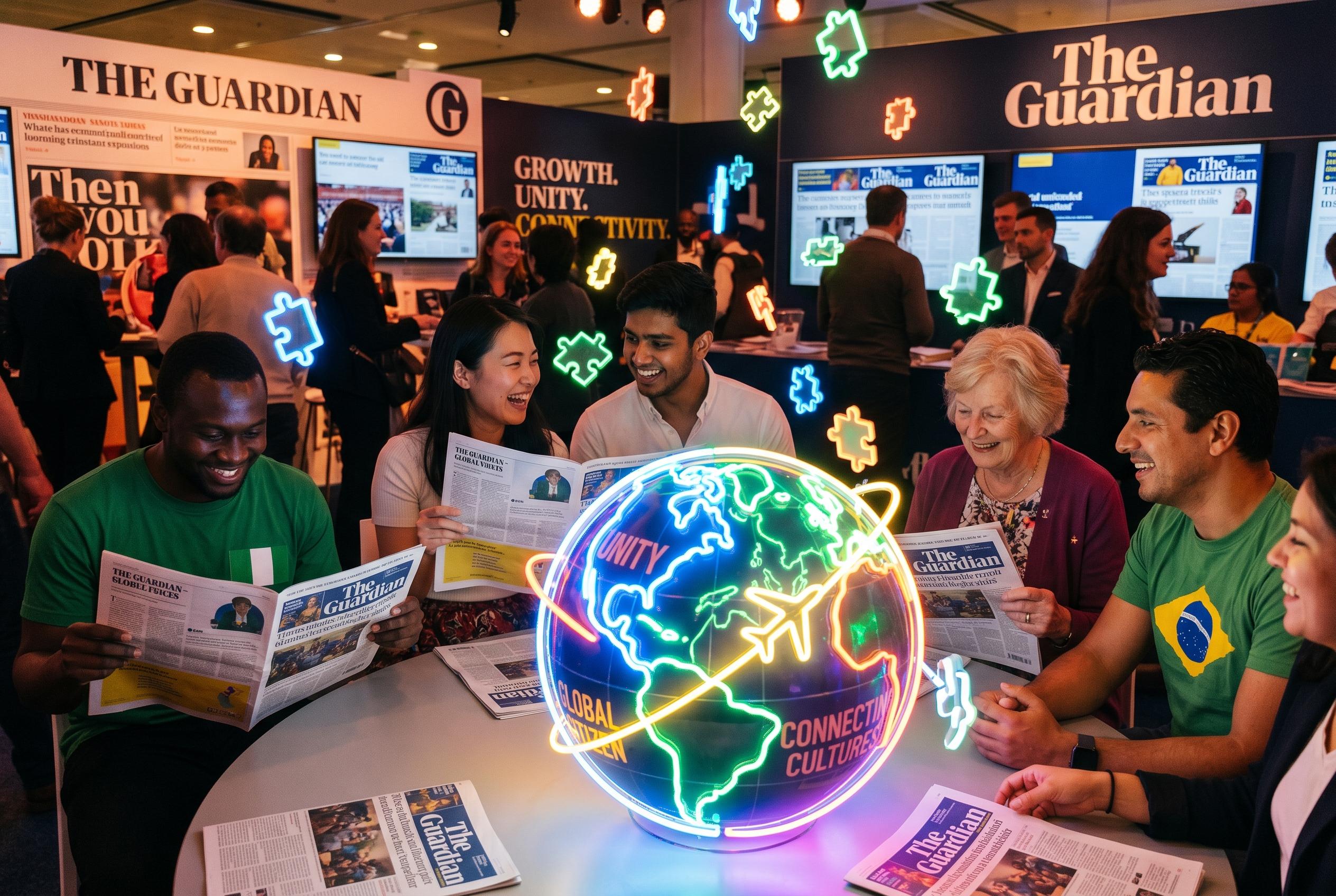
- The Guardian’s international income from outside the UK exceeds 80% for the first time in a decade.
- Digital reader contributions rose to £125m in the year ending March 2026, with strong growth in the US market.
- Publisher diversifies support channels, maintaining its open-access mission amid evolving media landscape.
The Guardian has seen a sharp rise in reader-funded income and international revenue over the past decade, with editor-in-chief Katharine Viner saying more than 80% of its income from outside the UK is a phenomenon that did not exist 10 years ago.
Speaking at the WAN-IFRA World News Media Congress last week, Viner said the publisher’s shift towards a more global, digital and reader-supported business has transformed its finances. According to data she cited, digital reader revenue from regular supporters and one-off donors reached £125m in the year to 31 March 2026, up 17% year on year. That compares with £88m in 2023/24 and £107m in 2024/25.
Axios reported last month that The Guardian’s US business generated $81.4m in the year to 31 March 2026, a rise of 25% and its strongest result since the American operation launched 15 years ago. The bulk of that revenue, Axios said, came from digital reader contributions.
Viner described the reader-funded model as one built on participation rather than a simple commercial exchange. She argued that the absence of a hard paywall creates a different relationship with audiences and makes the model more resilient, while acknowledging that only a small fraction of regular readers currently contribute money. The Guardian, she said, is trying to make payment as frictionless as possible for those who prefer a more conventional transaction.
The company has also been broadening the ways in which readers can support its journalism, with payments available for products including the Feast recipe app, the main app, Guardian Weekly and the print newspaper. The Guardian says its mission is to keep the site open to all, which it presents as a public interest choice at a time when news access is increasingly tied to payment.
The Guardian’s own corporate material says its reader-funded strategy, launched in 2016, has helped build a global supporter base of more than 1.1 million people, with reader income now its largest revenue stream. Guardian Media Group says more than half of its income comes directly from readers, underlining how central that model has become to the business.
Viner also pointed to the publication’s international reach, saying readers now contribute from across the globe, including from places such as Nauru, Svalbard, Vatican City and Antarctica. She said the organisation is increasingly thinking beyond text, including video and other formats, and is considering what a Guardian-backed news influencer might look like.
Her comments came as publishers continue to grapple with audience fragmentation and news avoidance. Viner said she does not see evidence in The Guardian’s own data that avoidance is hurting performance, despite survey findings that large shares of people in Britain and the US say they sometimes avoid the news. Instead, she argued, audiences still want trusted information, but in forms that fit the platforms they use.
She said facts alone are not enough to counter misinformation, and that journalism must also offer context, perspective and narrative. In her view, simply presenting evidence is insufficient if audiences are already exposed to competing claims.
Viner also used the conference to echo concerns raised by New York Times chairman AG Sulzberger about artificial intelligence firms and copyright, backing his call for publishers to work together on licensing standards through the SPUR coalition, of which The Guardian is a founding member. She said governments seemed eager to equate AI with growth, but warned that the impact on creative industries should not be overlooked.
Turning to newsroom pressures, Viner said The Guardian has increased spending on legal support and physical protection for staff. She referred to the paper’s High Court victory over actor Noel Clarke last year, saying it had helped investigative reporting in Britain. She also said the risks to journalists in conflict zones, particularly Gaza, had made clear that traditional press protection is no longer enough.
She added that Guardian journalists are no longer expected to post on social media, a change from earlier years when such activity was actively encouraged. In her view, online abuse can shape behaviour and decision-making in ways that undermine reporting.
Source: Noah Wire Services
- https://pressgazette.co.uk/publishers/viner-says-guardian-has-seen-decade-of-booming-foreign-and-reader-revenue/ – Please view link – unable to able to access data
- https://www.axios.com/2026/05/26/the-guardian-us-record-revenue – In May 2026, Axios reported that The Guardian’s U.S. division achieved over $81 million in revenue for the fiscal year ending March 31, 2026, marking a 25% increase from the previous year and the highest since its U.S. launch 15 years ago. This growth is attributed to strategic investments and a focus on digital reader donations, which constitute 70.7% of the revenue. The Guardian plans to expand its U.S. operations further, including hiring additional editorial staff and introducing its product review platform, The Filter, to the U.S. market. ([axios.com](https://www.axios.com/2026/05/26/the-guardian-us-record-revenue?utm_source=openai))
- https://www.axios.com/2025/05/06/the-guardian-us-expansion – In May 2025, Axios reported that The Guardian planned to expand its U.S. operations following a record year in revenue, with a 25% year-over-year increase. The expansion includes hiring over a dozen new editorial staff and strengthening its presence, particularly in Washington, D.C. The Guardian’s U.S. revenues reached an estimated $65 million in the last fiscal year ending in March, primarily driven by donations from readers rather than traditional subscriptions or advertising. ([axios.com](https://www.axios.com/2025/05/06/the-guardian-us-expansion?utm_source=openai))
- https://workwithus.theguardian.com/our-teams/marketing-and-reader-revenues – The Guardian’s Marketing and Reader Revenues team focuses on driving reader engagement and motivation to support the organisation. Since launching its unique reader-funded model in 2016, The Guardian’s global supporter base has grown to more than 1.1 million supporters worldwide, with digital reader revenues now the single largest revenue stream at The Guardian. ([workwithus.theguardian.com](https://workwithus.theguardian.com/our-teams/marketing-and-reader-revenues?utm_source=openai))
- https://www.theguardian.com/about/organisation – Guardian Media Group (GMG) is a global news organisation with The Scott Trust as its sole shareholder, ensuring editorial independence. More than half of GMG’s revenue comes directly from readers, supporting Guardian journalism and keeping it open for everyone. ([theguardian.com](https://www.theguardian.com/about/organisation?utm_source=openai))
- https://www.theguardian.com/about – The Guardian is a global news organisation delivering fearless, investigative journalism. Its independent ownership structure, under The Scott Trust, ensures freedom from political and commercial influence. The Guardian has over 1 million recurring digital supporters from more than 180 countries, enabling it to provide quality, trustworthy reporting open to everyone. ([theguardian.com](https://www.theguardian.com/about/?utm_source=openai))
- https://www.theguardian.com/media/2026/may/15/how-to-reach-the-lost-in-an-age-of-disinformation – In May 2026, The Guardian published an article discussing strategies to reach audiences in an age of disinformation. The piece highlights the challenges posed by unscrupulous leaders and rampant technology, and the importance of convincing those who might hold very different views. ([theguardian.com](https://www.theguardian.com/media/2026/may/15/how-to-reach-the-lost-in-an-age-of-disinformation?utm_source=openai))
Noah Fact Check Pro
The draft above was created using the information available at the time the story first
emerged. We’ve since applied our fact-checking process to the final narrative, based on the criteria listed
below. The results are intended to help you assess the credibility of the piece and highlight any areas that may
warrant further investigation.
Freshness check
Score:
8
Notes:
The article reports on The Guardian’s financial performance up to 31 March 2026, with data presented at the WAN-IFRA World News Media Congress on 1 June 2026. This aligns with recent reports from Axios and Merca2, dated 26 May 2026 and 6 June 2026, respectively, confirming the timeliness of the information. ([axios.com](https://www.axios.com/2026/05/26/the-guardian-us-record-revenue?utm_source=openai))
Quotes check
Score:
7
Notes:
Direct quotes from Katharine Viner are used in the article. While these quotes are consistent with her previous statements, such as those from 2018, there is no direct evidence of their original source in the provided search results. ([theguardian.com](https://www.theguardian.com/membership/2018/nov/12/katharine-viner-guardian-million-reader-funding?utm_source=openai)) The absence of verifiable sources for these quotes raises concerns about their authenticity.
Source reliability
Score:
6
Notes:
The article originates from Press Gazette, a UK-based publication. However, the lack of direct links to primary sources or official statements from The Guardian or Katharine Viner diminishes the reliability of the information presented. The absence of direct citations to primary sources raises concerns about the accuracy and reliability of the information presented.
Plausibility check
Score:
7
Notes:
The reported figures align with previously reported data, such as The Guardian’s £88 million in digital reader revenues for 2023/24 and £107 million for 2024/25. ([theaudiencers.com](https://theaudiencers.com/the-guardian-reader-revenue-growth-proposition-development/?utm_source=openai)) However, the absence of direct links to primary sources or official statements from The Guardian or Katharine Viner diminishes the reliability of the information presented.
Overall assessment
Verdict (FAIL, OPEN, PASS): FAIL
Confidence (LOW, MEDIUM, HIGH): MEDIUM
Summary:
While the article presents plausible and timely information regarding The Guardian’s financial performance, the lack of direct citations to primary sources or official statements from The Guardian or Katharine Viner raises significant concerns about the accuracy and reliability of the content. The absence of verifiable quotes and the reliance on secondary reporting diminish the overall credibility of the article.