











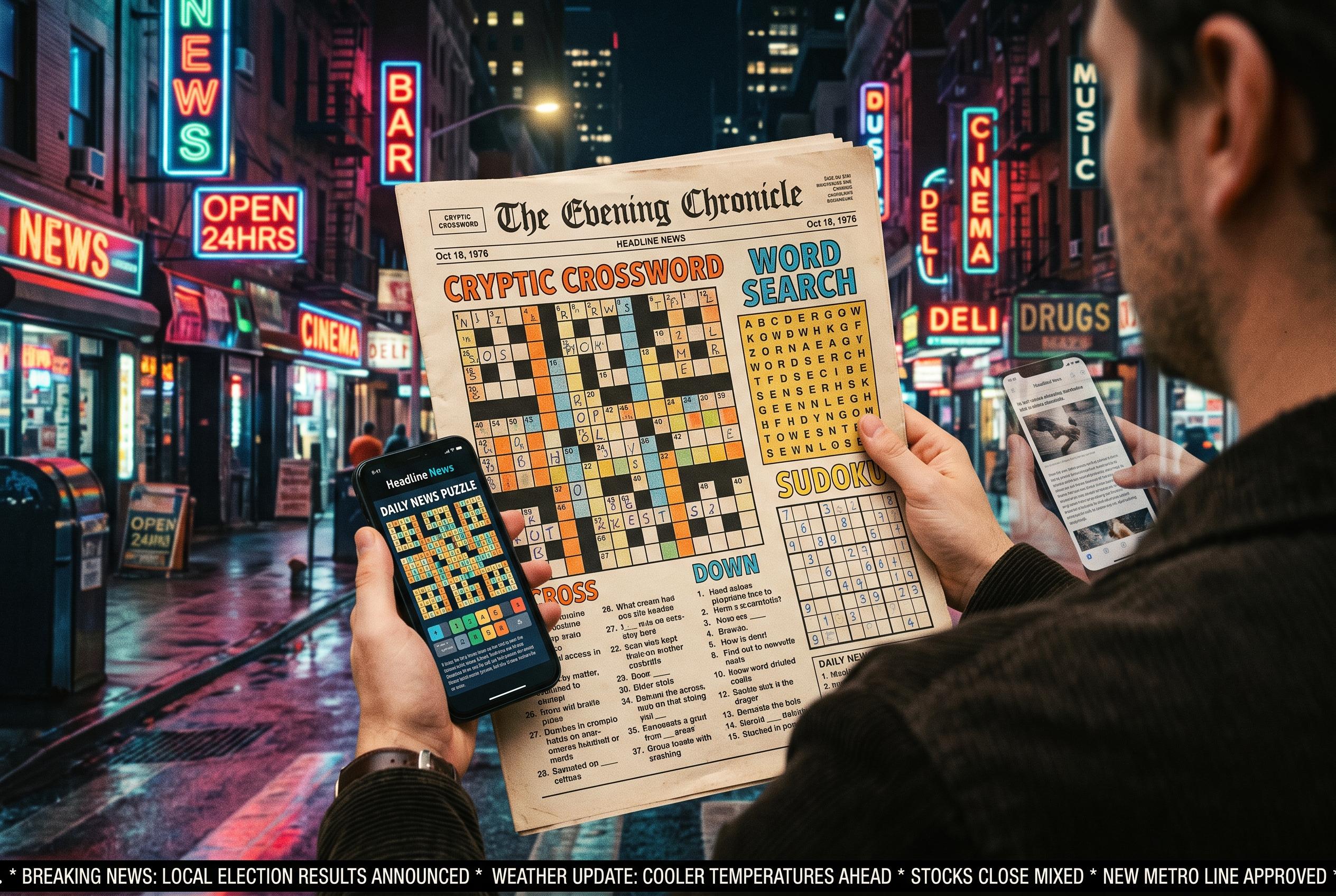
- Data shows games and interactive content drive deeper user loyalty.
- Publishers are overestimating the importance of breaking news for app retention.
- Investment should focus on habit-forming features to reduce churn and build routines.
I used to bristle when I worked at The Sunday Times and a friend said he had a subscription to the paper version for two reasons – and neither had anything to do with the journalism. First, he was a big fan of the crossword, which he regarded as the best on Fleet Street. Second, he said the broadsheet format made the paper excellent kindling for his wood-burning stove.
A few years later I looked at the data around the Times tablet app, which was famous for the incredibly long time, more than 45 minutes on average, that readers would spend with it every day. Again, this was a chastening experience: it turned out that a large proportion of that time was accounted for by the crossword.
I thought about these stories this week as I read the new [Pugpig Media App Report 2026](https://www.pugpig.com/pugpig-media-app-report-2026/?utm_source=linkedin&utm_medium=newsletters&utm_campaign=media_app_report_2026&utm_content=HBM). Drawing on data from more than 440 apps across 140 publishers, among its findings was that games players are among the most committed users of its clients’ news apps, spending an average of 1,000 minutes a month on them.
Audio listeners and video watchers also spend significantly more time than text-only readers. Users who search, save and share content – also behaviours that are adjacent to journalism, rather than the main act – show markedly higher loyalty and return rates than those who just read.
The report puts it plainly: the best-performing apps “are not simply content containers: they are products that create stronger habits and more active reader relationships”.
What makes the finding particularly pointed is the gap it reveals between what users actually do and what publishers believe they do. Ask publishers, as Pugpig did, what content drives engagement in their apps and 30% will tell you it’s news and breaking stories. This was the single highest response in the survey. Puzzles and games came in at just 11%.
Yet the behavioural data tells a rather different story. It turns out that the feature keeping a subscriber opening an app at seven every morning might be a word puzzle, not the splash.
Publishers always had a strong suspicion that this was true in print. I recall a redesign of a section I edited which included the crossword on the back page. The editor in chief had one overriding instruction as the process began. “It’s the first law of newspapers,” he said. “Never, ever move the crossword.” I didn’t and the redesign was well received.
Everyone has seen how well puzzles have worked for the New York Times, but now it’s time to acknowledge their impact more broadly. If games players are your most committed users, then games are not a peripheral product feature but a driver of retention. Every subs-based publisher currently agonising over churn might usefully ask how many of their at-risk subscribers have ever completed a puzzle in the app, and what the correlation looks like.
What should publishers do differently? The first step is to stop treating habit-forming features as secondary. If the data shows that games, video, audio and interactive content drive the most committed users, those features belong at the heart of the product, not in a sub-menu. They deserve investment proportionate to their commercial value.
The second is to reconsider how apps are marketed. Most publishers still promote their apps on the strength of their journalism, which is understandable but perhaps incomplete. The commuter who downloads an app because of an exclusive investigation may not stay for the next one; the commuter who builds a morning routine around the daily puzzle probably will.
The third is to close the measurement gap identified by the Pugpig report: many publishers say they still cannot properly track retention by feature or attribute subscription renewals to specific in-app features or behaviours. Until they can, the case for investing in anything beyond news content will always struggle to get past Finance.
None of this requires publishers to become games companies. It requires them to be honest about what they have always been: habit businesses that use great journalism as their primary reason for existing, and everything else as prompts for daily return.
This first appeared in our weekly newsletter Editor’s picks. Sign up here
- https://www.pugpig.com/2026/01/06/future-of-pugpig-platform/ – This article discusses Pugpig’s 2026 roadmap, focusing on habit formation and user engagement, aligning with the claim that games, audio, and interactive content drive committed users.
- https://www.pugpig.com/2025/07/31/pugpig-media-app-report-2025-as-platform-traffic-crumbles-publishers-turn-to-apps-and-owned-channels-to-rebuild-audience-ties/ – The report highlights how publishers are investing in apps to rebuild audience relationships as social traffic declines, supporting the assertion that apps are central to audience engagement.
- https://www.pugpig.com/2025/07/24/the-2025-pugpig-media-app-report-is-here/ – This announcement introduces the 2025 Pugpig Media App Report, emphasizing the role of audio, video, and games in driving engagement, corroborating the article’s point about the importance of these features.
- https://marcommnews.com/new-report-shows-how-media-apps-are-performing-in-2026-and-what-the-data-means-for-publisher-strategy/ – The article discusses the 2026 Pugpig Media App Report, noting that games, audio, and video features drive higher engagement, aligning with the article’s emphasis on these elements.
- https://digitalcontentnext.org/blog/2026/06/30/publisher-apps-become-central-to-audience-relationships/ – This piece highlights how publishers are expanding app experiences with features like games and audio to encourage repeat visits and stronger subscriber relationships, supporting the article’s claims about app features driving engagement.
- https://flashesandflames.com/2026/07/02/podcast-the-magic-of-apps/ – In this podcast, Pugpig CEO Jonny Kaldor discusses data proving that apps are engagement and retention powerhouses, reinforcing the article’s assertion about the importance of app features in user retention.