












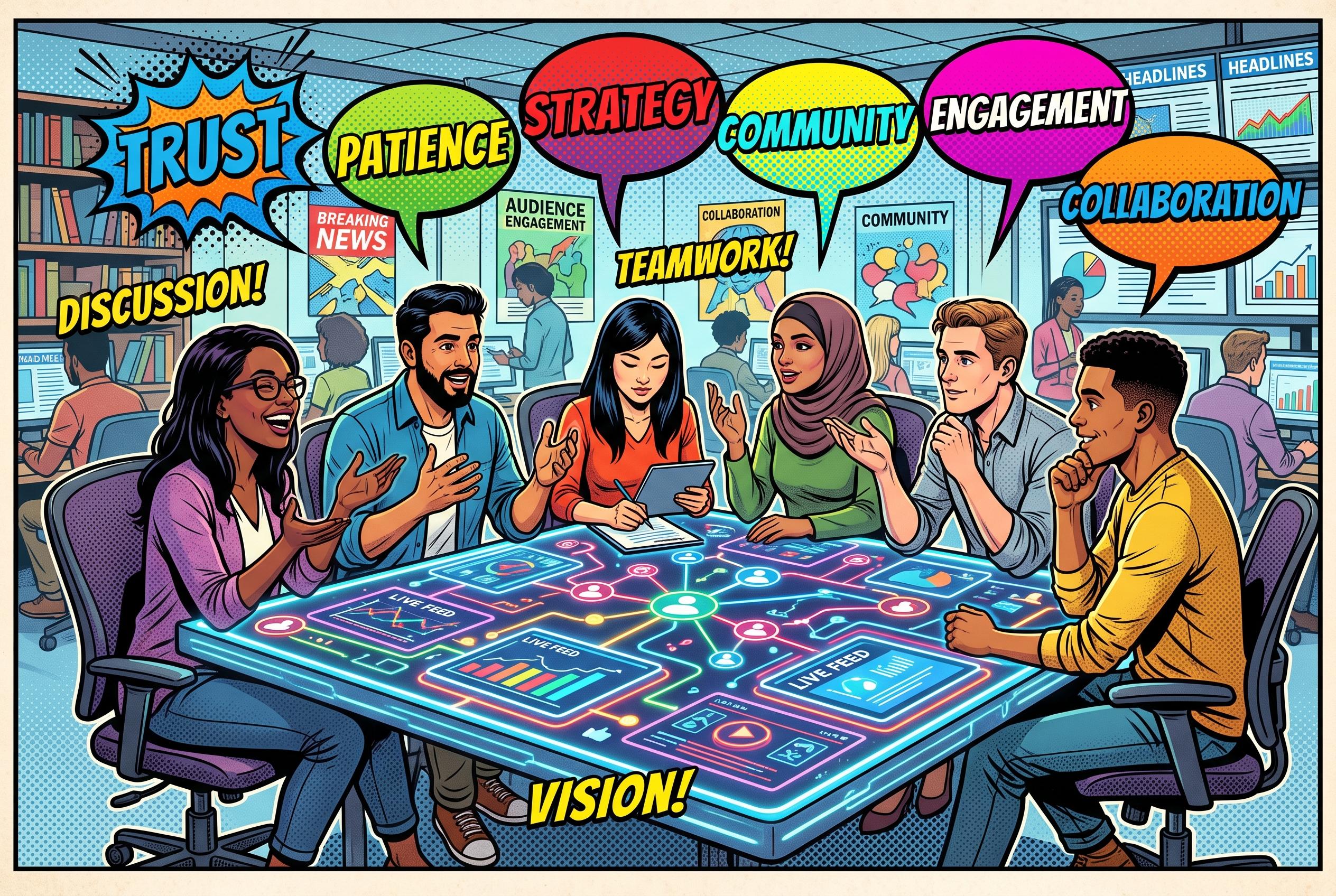
- News organisations are shifting focus towards community-building to reconnect with audiences
- Success varies: B2B publishers excel while general news outlets face challenges
- Building genuine communities requires patience, specialised focus, and long-term strategy
Everyone in the news business is talking about communities.
In its Future Newsrooms Study 2026, FT Strategies suggested that news is entering the “community era”, where “the new advantage shifts towards building trusted networks and communities around specific niche topics, supported by specialised editorial and product teams”.
The goal is primarily expressed through trying to bring “audience participation back in-house rather than relying on off-platform spaces”. Examples quoted included a website that introduced a Reddit-style forum for its audience, another that had structured live debates to discuss issues to be covered, and a third that offered weekly Q&As.
Just this week, Audiencers wrote about SFGATE’s new strategy for paid memberships, which focused on an app experience but also pop-up newsrooms, where members could meet journalists, and other live journalism events in the San Francisco area. Notably, the app is called Friends of SFGATE.
I have also spoken this summer to an editor-in-chief who is thinking about moving on from talking to their newsroom about audiences to emphasising the building of communities.
So, the pivot to communities™ is definitely here. And in principle it’s a really good idea, for all the reasons advanced above. But there is a question nagging at me: can news providers really build genuine communities?
For B2B publishers, the answer is obviously yes. I’ve seen this first hand with clients who as much as anyone else provide the connective tissue of their respective industries, both through their journalism and, of course, their events.
This shouldn’t be a surprise: these publications were built to serve industries and could be said to sit within them, rather than as outsiders looking in. In a recent interview, Tracy De Groose, the ceo of William Reed, said emphatically that the company was not a publishing business but rather an intelligence business that sat within the food and drinks industry.
For general news publications, the situation is a bit different. By their nature, they cover the waterfront, everything from the latest local and international political developments to sports, book reviews, fashion, beauty, business and personal finance. The group that would be interested in all that sounds more like a society than a single community.
And even if you focus your attention building a community around individual areas, does your current newsroom have the expertise and depth of coverage to make yourself the place where people will go to learn more about the subject, discuss it and make connections both with your team and other users? Are you going to beat specialist publications in this respect? It’s going to be tricky.
I also wonder if people see themselves as part of a community when they access a news product or are they happy, mostly, to be just users. For some, especially those who have commented below the line or write to the letters page, clearly it’s something more. But these are not remotely the majority. Most people have traditionally been accustomed to news being a utility, not an experience.
I’ve seen at close hand attempts to engage readers more deeply. At The Times we ran Times+ which then, as now, “offers, competitions and events”. The idea was that we would bring subscribers closer to the title so that they would be less likely to churn.
The events were great: often when we did them with our journalists we’d have queues of dozens of attendees waiting to talk to them. Everyone from the newsroom or business who went to them came away buzzing at how interested the readers were with how we did things.
The problem was that we found that the events tended to attract the same people. Literally. The people who came along were superfans who went to almost every event. We were catering to the people who were the most loyal subscribers and were never going to churn. This was definitely a community, but it was a small one.
It was telling that when we tried to rebrand the subscription as a “membership”, to try to draw people even closer to the brand, it didn’t really work. Surveys suggested that the subscribers didn’t really think that you could be “members” of a newspaper brand.
Where does this leave the pivot to community™?
For general news brands, I think the first thing to do is start thinking about communities plural. Personally, I’d suggest they give up on the idea of building a single community that encompasses the whole brand but instead focus on the areas where it has a particular speciality or loyal following. That’s where you want to bring users into the story ideation and reporting process, as well as traditional features like comments, Q&As and so on.
As ever, you need to accept that it will take time to build a brand. I was talking to a friend who has spent nearly a decade building up a community big enough that it’ll support his side project as a separate business. The work of building communities will not succeed overnight and requires patience and endless iteration. If we are to really pivot to community, it’s going to be a long haul.
This first appeared in our weekly newsletter Editor’s picks. Sign up here
- https://www.ftstrategies.com/en-gb/insights/future-newsrooms-study – This URL links to the ‘Future Newsrooms Study 2026’ by FT Strategies, which discusses the shift towards building trusted networks and communities around specific niche topics in the news industry.
- https://www.sfgate.com/friend/ – This URL directs to SFGATE’s ‘Friend of SFGATE’ membership program, which includes an app experience and live journalism events in the San Francisco area, aligning with the article’s mention of SFGATE’s new strategy for paid memberships.
- https://www.sfgate.com/news/article/friends-of-sfgate-app-22346568.php – This article details SFGATE’s launch of the ‘Friends of SFGATE’ membership program, offering an ad-free app and live events, supporting the article’s reference to SFGATE’s new strategy for paid memberships.
- https://www.ftstrategies.com/en-gb/insights/ft-strategies-and-wan-ifra-study-finds-newsrooms-are-rebuilding-around-ai-audiences-and-community – This study by FT Strategies and WAN-IFRA examines how newsrooms are restructuring around AI, audience engagement, and community, corroborating the article’s discussion on the pivot to communities in the news industry.
- https://www.ftstrategies.com/en-gb/insights/webinar-future-newsrooms-study-2026 – This webinar discusses the findings of the ‘Future Newsrooms Study 2026’, focusing on how news organisations are redefining editorial strategy and audience relationships, supporting the article’s emphasis on the importance of building communities.
- https://www.sfgate.com/bobaevent/ – This page promotes SFGATE’s ‘Friends of SFGATE’ membership program, highlighting live events and interactive features, aligning with the article’s mention of SFGATE’s strategy for paid memberships and live journalism events.


