











- Expert warns news industry is still writing as if it’s 1957
- Discussions highlight challenges of mobile storytelling and atomisation of news
- Questions remain about verification, funding, and brands in an AI-driven news future
“We are still writing like it’s 1957” was the blunt assessment of Mario Garcia, speaking earlier this month at WAN-IFRA World News Media Congress in Marseille.
You might dismiss this as hyperbole from some, but Garcia, the Columbia University journalism school legend, is in a better position than most to judge. At 79 years old, he was one of the few delegates – perhaps he was the only one – who could actually remember 1957.
He got me thinking about what journalism will look like in 2057, or – given the pace of change we are experiencing – rather earlier, and how few pointers we actually have.
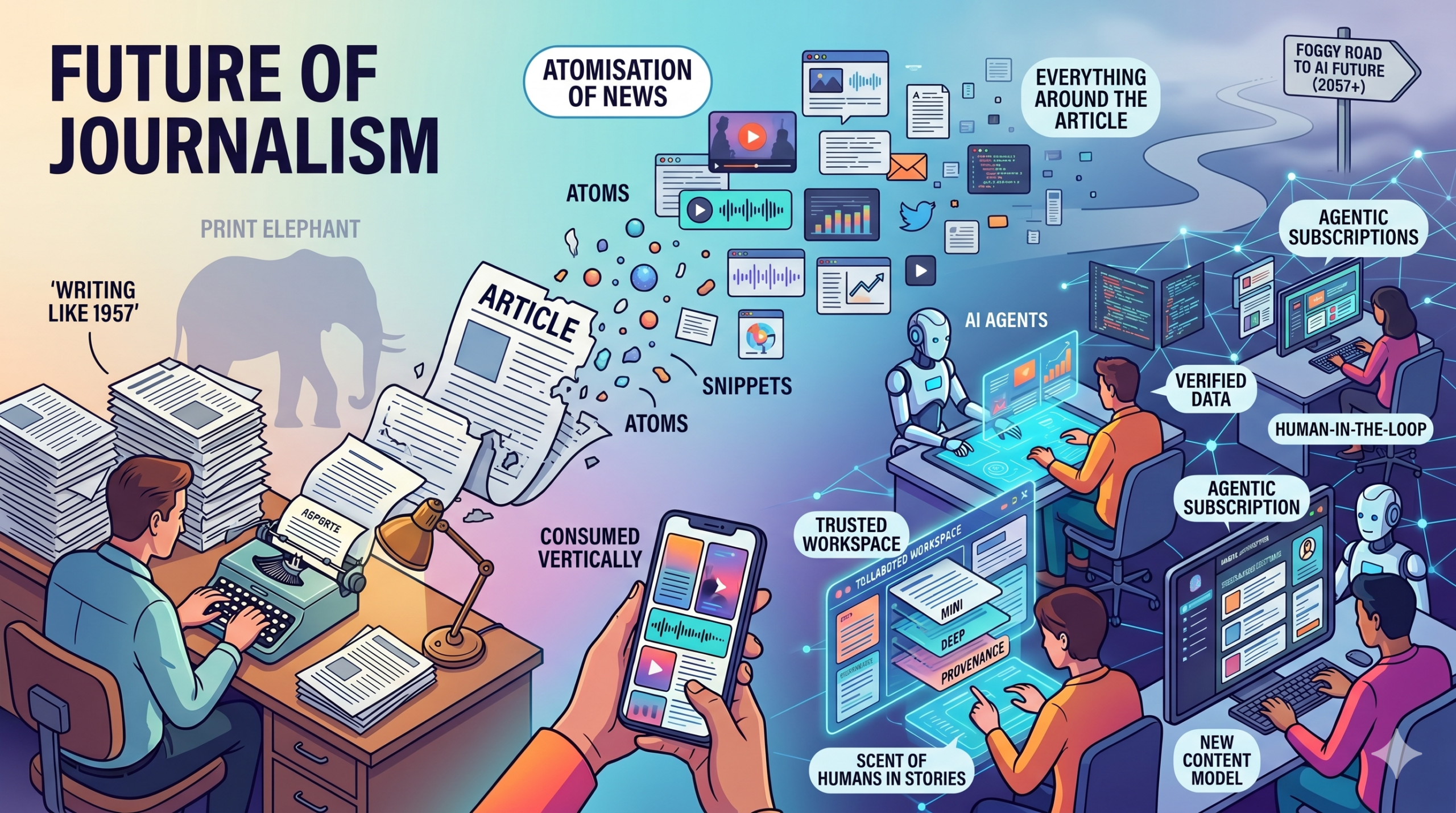
First, though, Garcia’s thesis. He said he had lived through six journalistic revolutions: hot type to cold type; typewriters to computers; black and white to colour; the internet; and now the mobile revolution and AI. Of the present, concurrent ones he said: “The other revolutions never affected how you write a story.”
He went into a long explanation of how newsrooms, with a few honourable exceptions, were failing to meet this challenge. Among other things, he lamented how “everything is produced horizontally, but consumed vertically” on mobile screens. And the various different elements that we can now use alongside text – video, audio, infographics etc – are treated as add-ons rather than an integral, indivisible part of the creative process.
“When I walk into a newspaper and they say, ‘You’ll meet the multimedia team at 2pm”, I think the elephant in the room is a big print elephant,” said Garcia. His point was that we have not truly assimilated the requirements of mobile storytelling and still treat it as something separate from the main form of journalism: writing articles.
This came to mind as speaker after speaker spoke about the atomisation of news and the death of the article. “The future of journalism is not the article, but everything around it,” said Ezra Eeman, who leads WAN-IFRA’s AI in Media initiative. He meant provenance, context and rights, but either way I see little sign of this becoming a reality any time soon.
I’m not saying that it won’t – and you could argue that video is becoming that form as I type this newsletter – but very few have truly broken away from the article.
Sannuta Raghu, from Scroll in India, spoke in Marseille about how they are trying to become a “trusted workspace” for people interested in studying South Asia in depth. The workspace for each subject covered by Scroll comprises different layers of content: Mini – which is headlines, key facts, key players; Core – a traditional article; and Deep – a curated dossier of collected materials and which explains what Scroll does and does not know about a topic. Note that Core is an article.
I thought back to Circa, the ill-fated Silicon Valley atomised news app of 15 years ago. Ultimately, the atoms of news it published would roll up into an article. We seem hardwired to see completion in this form of journalism.
I say this not as criticism but more because I find it really difficult to imagine how an atomised world of news will work in practice, rather than theory. I get that reporters will file snippets of text, or video, or audio, or photographs, or data and that these could be assembled using AI-driven models to provide individualised news experiences.
But how will this content be verified? How will it be paid for – surely a publishers would want to charge more for a 50-word snippet than the fully immersive 10-minute video, graphics and audio version? Will there be a general release version that anyone can access and goes into the historical record? Will there be recognisable news brands at all, or will they all effectively be wire services feeding into the AI giants that own the user relationship?
There are some stirrings on these questions. Jessica Davis of USA Today spoke in Marseille about agentic AI “needs a new model for oversight”. She and her team are working to “protect trust without capping AI-enabled value” by automating evaluations of content produced using AI. In short, remaking the human in the loop in bot form. Others are working on this too.
Eeman said he “wouldn’t disown the idea” of agentic subscriptions, where you’d buy agentic access to the content of, say, the Wall Street Journal, or New York Times, or The Guardian.
At the Signals at Scale workshop in Copenhagen the week before, there was a lot of focus on the need for a payment layer for atomised content, but no answers as yet.
I guess I’m just being impatient for wanting to “see” this future landscape and that it’ll emerge over time. Until then we’re in the world of the vague. Near the end of his talk, Garcia said of the AI revolution that “we need to put the scent of humans into stories”. I smiled at the time but on reflection am not any the wiser about what that really means. As Jane Barrett from Reuters said, the road to our AI future is a little foggy at present.
My closing thought is a simple one: the news industry shouldn’t leave the navigation of that road to AI giants who might not have our best interests at heart.
This first appeared in our weekly newsletter Editor’s picks. Sign up here
Alan Hunter is a co-founder of HBM Advisory, which helps organisations navigate the transformation of their content businesses, from finding the right strategy to producing the right content, and of course everything AI. Contact us for more information at [email protected]
- https://garciamedia.com/ – This is Mario Garcia’s official website, confirming his role as a prominent figure in journalism and his participation in the WAN-IFRA World News Media Congress in Marseille.
- https://www.wan-ifra-aim.org/ – This is the official page for WAN-IFRA’s AI in News Media initiative, led by Ezra Eeman, highlighting the integration of AI technologies in the media industry.
- https://www.businessmole.com/wan-ifras-ai-in-media-initiative-led-by-ezra-eeman/ – This article discusses Ezra Eeman’s appointment as the strategic advisor for WAN-IFRA’s AI initiatives, detailing his role in guiding AI integration in the media sector.
- https://www.theaudiencers.com/inside-wan-ifra-marseille-2026-the-deals-the-data-and-the-fight-for-what-journalism-is-worth/ – This piece provides insights into the discussions at the WAN-IFRA World News Media Congress in Marseille, including topics on AI’s impact on journalism and the future of news consumption.
- https://www.themediaonline.co.za/2026/03/ai-at-work-from-adding-ai-to-media-to-adding-media-to-ai/ – This article explores how newsrooms are redefining production and audience reach by integrating AI, reflecting on the shift from ‘adding AI to media’ to ‘adding media to AI’.
- https://www.ebu.ch/news/2017/02/ebu-welcomes-new-head-of-digital – This announcement details Ezra Eeman’s appointment as Head of Digital for the European Broadcasting Union, underscoring his expertise in digital transformation within media.


