












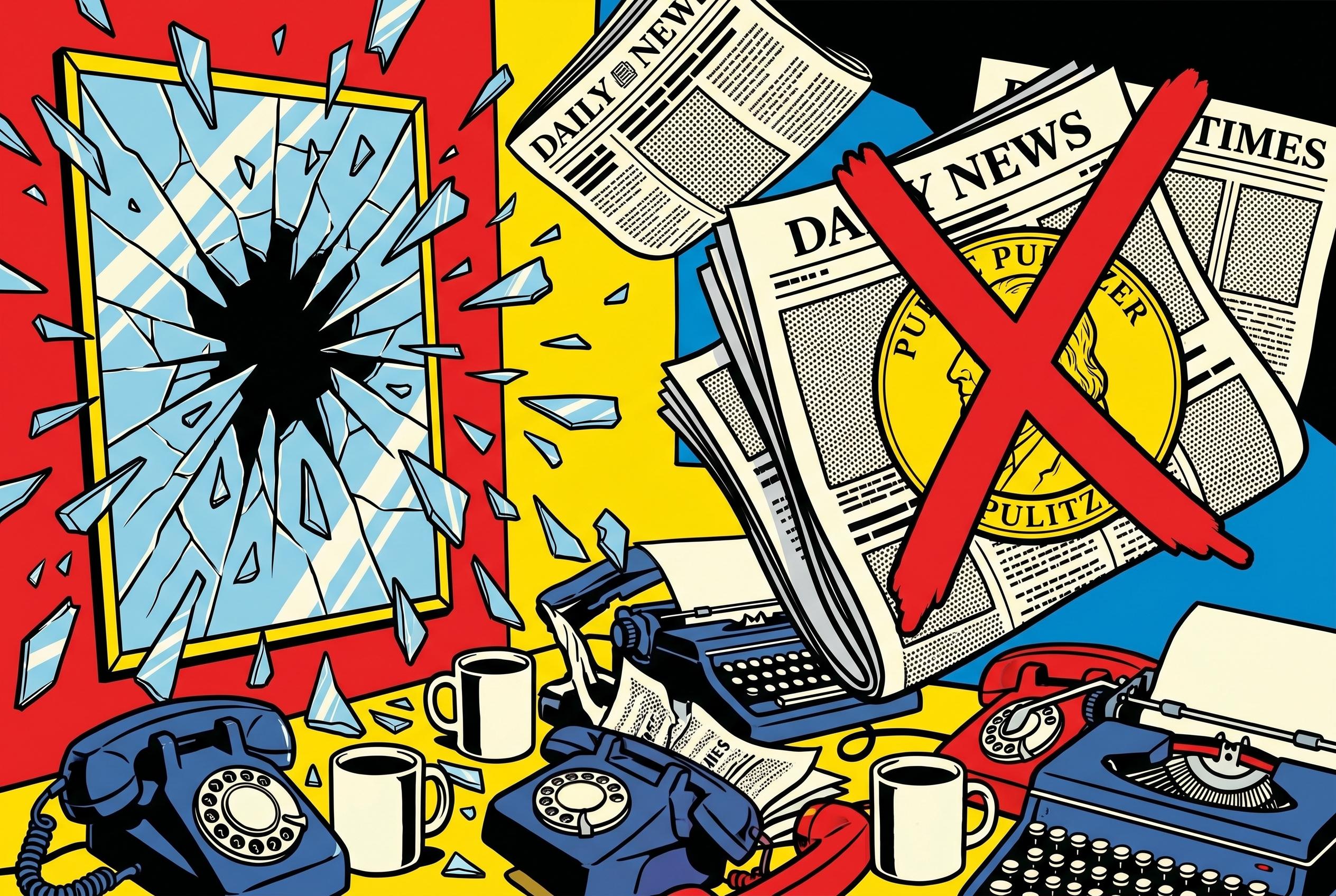
- Examines the American focus on prestigious awards over reader needs
- Critiques the biased and inward-looking nature of the Pulitzers
- Argues that abolition could renew journalism’s relevance to the public
The difference between American and British journalism is clear in what they choose to display in their newsrooms. Visit any large US newspaper’s offices and you will see a “wall of fame” that commemorates its winners of Pulitzers and other journalism awards. Visit any UK newsroom and you’ll see nothing like that.
Indeed, when I worked at The Times the displays on the walls had a slightly different tenor. Among those “celebrated” were Kim Philby, a former sub-editor at the paper whose notorious career as a Russian spy led to many deaths, and Boris Johnson, a former trainee reporter at the paper (fired for making up quotes) whose notorious career as prime minister … I’ll leave it there.
I was thinking about this contrast when the Pulitzers were announced earlier this month. America takes its journalism awards very seriously indeed; Britain doesn’t.
When I was a judge on the British Press Awards back in the early teens, there was an unspoken instruction that my job was to bring home an award for one of my colleagues. Everyone else seemed to be operating on the same principle.
So we don’t take awards too seriously and the focus is less on who wins or loses and more on a fun night out at a London hotel when the prizes are handed out accompanied by mediocre catering but a well-stocked bar.
American journalists do take awards seriously – I would argue much too seriously. So much so that I think it is time to abolish the Pulitzers to liberate the country’s journalism.
First, they should be abolished because they reward a conservative kind of journalism. I am not knocking the stories or reporters they honour. This year’s winners were undeniably worthy stories that were pursued with rigour and fortitude, including investigations into DOGE cuts and President Trump’s enrichment of his social circle, alongside reporting of a horrific school shooting.
But these represent a journalist’s view of what is important journalism, rather than a reader’s – or viewer’s or listener’s. Almost universally – with the exception of the Pablo Torre Finds Out podcast – the award winners were very long screeds of text, which is emphatically not how most people are consuming news content at the moment.
There is a reason why more and more of these stories are accompanied by companion pieces with “Five Key Takeaways From Our Investigation…” in the headline. They are written more for prize juries than for readers, who want something more accessible.
The Pulitzer jury also tacitly admitted this year that they can get things very wrong. Julie Brown of the Miami Herald was awarded a “special citation” for her ground-breaking reporting at the end of the last decade on Jeffrey Epstein’s crimes.
To award Brown a retrospective Pulitzer is basically admitting that you are no great judge of a story. Imagine glossing over the most significant story in American politics in the past decade. And they didn’t do it once, but twice, in 2017 and 2018.
Of course Brown was not writing for one of the big publications that dominate the Pulitzers year after year. This year 27 of the 48 journalism finalist positions went to one or other of these big titles: the New York Times, Wall Street Journal, Washington Post, Bloomberg, Reuters, AP, the New Yorker and the Atlantic.
These are, of course, the organisations that have the most resources to devote to their Pulitzer campaigns. And boy, do they devote time and effort to these awards. Until recently, at least one of them had a member of staff who was devoted entirely to awards entries.
There’s also the December dump of stories aimed squarely at awards. To be eligible articles need to have been published in the relevant calendar year, so to bolster the idea that a paper is running a series of stories on a subject – check the citations: the judges seem to love a “series” – a whole load of stories get published in late December to meet the deadline.
A quick scrutiny of this year’s lists of submissions reveals the last couple of weeks of December to have been an apparent golden period for American journalism. For the public service award, three of the Washington Post’s submitted articles, two of the Chicago Tribune’s and one of the Wall Street Journal’s were published after December 21. In the investigative category, three of ProPublica’s seven submissions were published after December 19 and three of the San Francisco Chronicle’s after December 29!
You will not be surprised to hear that late December is probably the least likely time that any actual reader will see these stories and yet this is the time America’s newsrooms are ramping up their coverage of investigations started months earlier just to meet awards criteria.
More than all this though, the Pulitzers should be abolished because they are fundamentally inward looking – at the practice of journalism, rather than outward looking – at what readers want. And this is a huge problem for journalism, in America and elsewhere.
Will Lewis got into trouble at the Washington Post for saying “people aren’t reading your stuff” but he wouldn’t have said that without a reason. American journalism needs to focus on what it can do for readers every day, rather than what it thinks they should read. The Pulitzers remain an expression of the latter rather than the former.
Before you say it, I believe that the public does want to know about serious and complicated subjects. They just want it in a format and style that makes sense to them. Look at all the research and you’ll see that we are falling short in this respect.
Abolishing the Pulitzers would, I believe, give American news organisations back the time, focus and resources to really mould their work to what the public wants and needs. It would make them look to the future and not to the past. It would help re-establish their role in a society that needs independent media more than ever.
This first appeared in our weekly newsletter Editor’s picks. Sign up here
- https://fpa.org/is-american-journalism-really-better-than-british/ – This article discusses the differences between American and British journalism, highlighting the American emphasis on awards like the Pulitzers and the British preference for a more understated approach.
- https://www.theguardian.com/media/greenslade/2013/jun/24/usa-newspapers – This piece examines the prominence of British journalists in U.S. media, suggesting that British journalists’ approach to journalism is more valued in the U.S. than American journalists’ approach in the UK.
- https://www.theguardian.com/media/2022/jun/08/the-worst-law-on-earth-why-the-rich-love-london-s-reputation-managers – This article highlights the challenges in British media law, including defamation and privacy issues, which can impact investigative journalism.
- https://www.the-independent.com/news/media/the-british-press-awards-the-writers-on-the-wall-299800.html – This article critiques the British Press Awards, noting that they have become less about celebrating merit and more about internal conflicts, contrasting with the American system of journalism awards.
- https://bylinetimes.com/2022/08/25/boris-johnson-completely-obliterated-the-line-between-journalism-and-politics/ – This piece discusses how Boris Johnson’s career blurred the lines between journalism and politics, reflecting on the ethical considerations in British journalism.
- https://www.spectator.co.uk/article/chasing-pulitzers-has-ruined-american-journalists-that-s-why-they-re-edited-by-brits/ – This article argues that the pursuit of Pulitzers has negatively impacted American journalism, leading to British editors taking over U.S. media outlets.


