












News publishers in India are asking the same questions and facing the same issues as those in the US and Europe was the conclusion after two days of discussions and presentations at WAN-IFRA’s Digital Media India conference in Chennai this week.
They may be only just starting to face falling print circulations – another victim of Covid – but otherwise they are still looking at how best to monetise their digital content and utilise artificial intelligence. There were questions about scale and subscriptions, AI and audiences.
“Do you really need 200-300m users to build sustainability? Can you do it with a more engaged audience?” asked Pradeep Gairola, business head, digital at The Hindu. He went on to say that he felt publishers were obsessed with replacing print revenues with digital income when actually smaller online revenues can lead to sustainability because you don’t have the printing and distribution costs of newsprint.
He added that he regularly talks with the paper’s editors about the volume of content they produce, a familiar theme in western newsrooms. “I ask the editors, ‘What will you stop doing?’ But they always want to do more. They see newspapers as a family affair, always adding things for new members.”
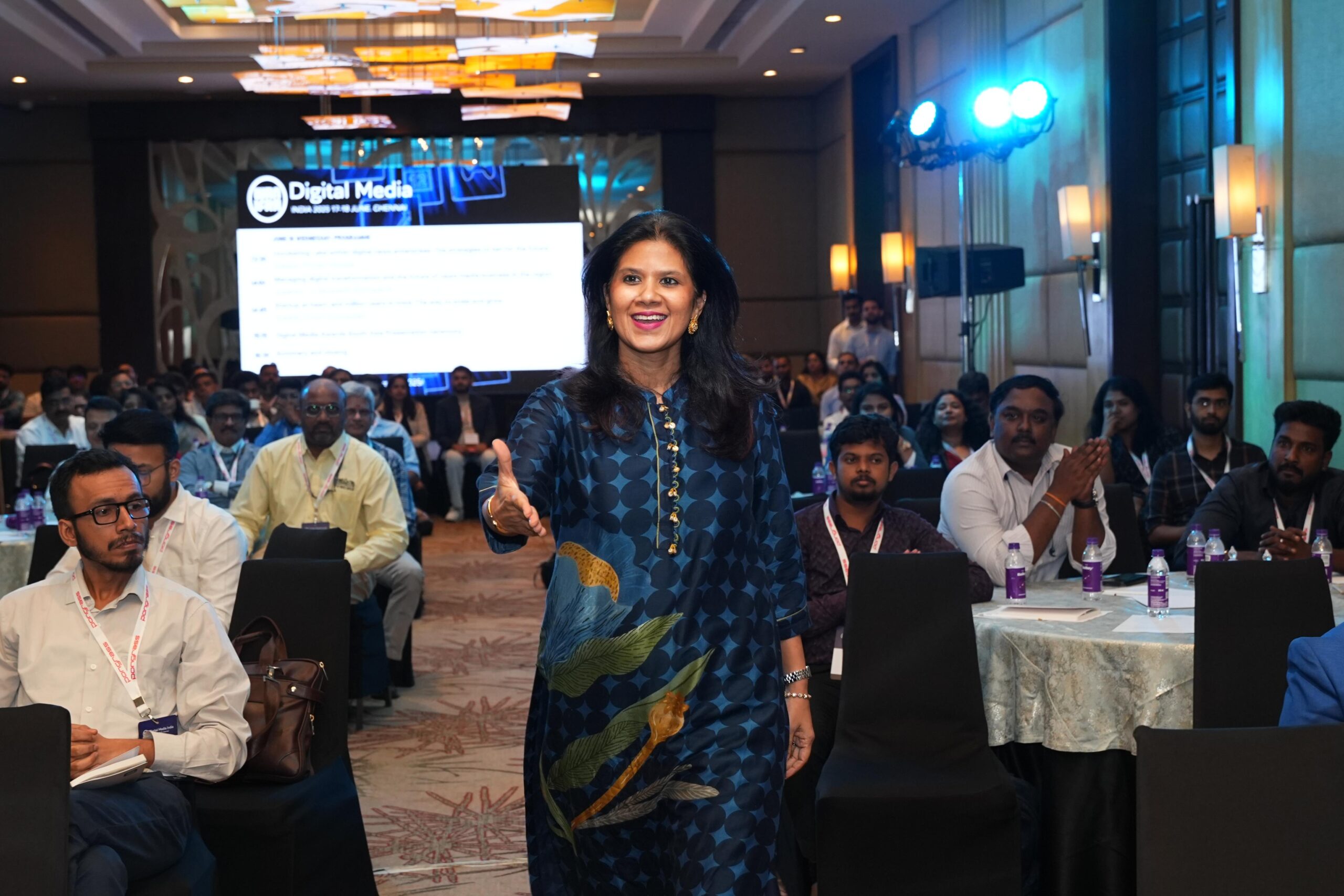
Mariam Mammen Mathew (pictured above), ceo, Manorama Online, also believes that attitudes toward traffic are changing in India: “We have run after the numbers in terms of traffic. But digital can’t work with only ads. We need subs.” She said that required a knowledge about what will bring in individual readers on a daily basis. “We had a one-to-many approach to customers – it needs to become one-to-one.”
Shelly Walia, executive editor of The Quint, suggested that the lesson that subscriptions is a long-term game had been quickly absorbed in India. “It’s a long struggle to get people to pay for news,” she said. “Each click and each sub requires work – and for the whole organisation.”
Indeed, the theme of internal alignment was a common one. Pundi Sriram, chief product officer, at The Hindu, talked about how the product chief in newsrooms should be seen as the equivalent of a restaurateur to the editor’s chef, or a producer to his or her film director.
But more than that he had a telling challenge to the journalists present: “What would it mean if your newsroom thought like a product team?” In other words, thinking of the value their output gives readers and of the overall offering as “news as a service”.
That service isn’t there at the moment, according to many speakers. Siddarth Varadarajan, founder and editor of The Wire and a former editor of The Hindu, lamented “a sameness of content” with the same news and ideas being endlessly resurfaced. “There has been a failure of big media to provide analysis and information to what is clearly a very large audience. In fact, audiences have never been bigger,” he said.
Of course, there was much discussion of AI and its effect on newsrooms. Nishant Sinha, product head at Times Internet, spoke about his AI-first CMS. His team works to the principle that “you can’t dig a well when you’re thirsty” and so have built AI tools into the CMS. The AI tools need to be there when required; journalists won’t take the time to search them out in busy moments.
Among the areas the AI-first CMS covers are content generation and summarisation (offering article drafts, summaries, headline suggestions); content creation and personalisation (tagging, personalised feeds); multimedia generation and optimisation (translation, image generation); research and verification (data analysis); automated publication and distribution (content scheduling).
He said the Times wants to use AI “as an assistant, augmenting human creativity and critical thinking, not replacing it”. But of course it anticipates that reporters’ roles will change. “They are becoming more like editors, strategists and specialised investigators.”
Finally it was left to Suresh Sambandan, a software entrepreneur and investor, to challenge the audience with the last presentation on the second day. He said that we are moving from the information economy to the entertainment economy, driven by AI which should give consumers “a lot more time to indulge ourselves”. This was a great opportunity for news publishers, he said, as “content will continue to be big”.
However, the trap was to assume that today’s publishers will still exist as of right. “Less than 5% of old brands will make it to the new era,” he said, pointing out that in the 1800s there were ice cutters, in the 1900s there were ice factories, but that neither now exist because we get our ice from our refrigerators. “Embrace change or complain? Your choice.”
Ps The guys who presented the keynote were great ;). Here’s a link to an article about our presentation
- https://www.printweek.in/news/25th-edition-wan-ifra-india-begins-chennai-26160 – This article discusses the WAN-IFRA India conference held in Chennai, highlighting topics such as journalism, fake news, artificial intelligence, and readership development, aligning with the conference’s focus on challenges faced by news publishers in India.
- https://www.thehindu.com/sci-tech/technology/digital-india-act-to-address-disbalance-between-digital-news-publishers-and-big-tech-platforms-mos-rajeev-chandrasekhar/article67822466.ece – This piece covers Union Minister Rajeev Chandrasekhar’s statement on the upcoming Digital India Act, aiming to address the revenue-sharing imbalance between digital news publishers and big tech platforms, reflecting the industry’s concerns over monetising digital content.
- https://www.inma.org/blogs/readers-first/post.cfm/news-media-can-maximise-digital-subscription-growth-in-2024 – This article examines the challenges news publishers face in maximising digital subscription growth, including the impact of AI-generated content and changing consumption habits, which are central to discussions at the WAN-IFRA conference.
- https://www.bestmediainfo.com/2024/11/digital-news-publishers-face-ai-threat-over-ad-revenue-and-ip-rights-7609010 – This report highlights the challenges digital news publishers face due to AI tools disrupting the digital news ecosystem, including concerns over copyright, compensation, and diminishing traffic, echoing themes discussed at the WAN-IFRA conference.
- https://www.ringpublishing.com/blog/knowledge/wan-ifra-insights-how-news-media-innovates-to-compete-with-big-tech/qbnv0q9 – This article provides insights from the WAN-IFRA World News Media Congress, focusing on how news media innovates to compete with big tech, including strategies for revenue diversification and AI investment, relevant to the challenges discussed at the conference.
- https://pressinstitute.in/rind-survey/ais-impact-on-journalism-challenges-and-the-road-map/ – This piece explores how AI can enhance newsrooms without compromising journalistic integrity, discussing challenges such as bias, content ownership, and the evolving relationship with big tech, aligning with topics addressed at the WAN-IFRA conference.


