












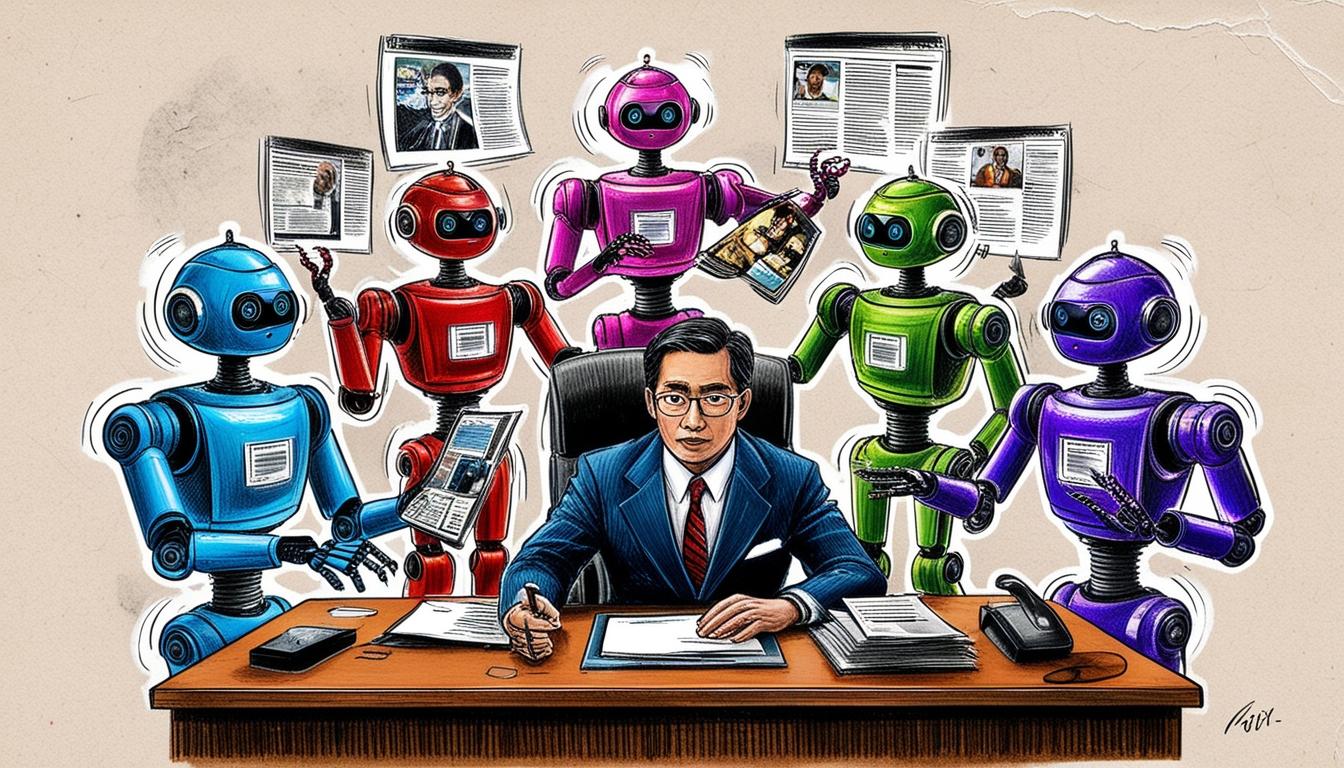
This powerful new technology should be embraced and not feared by journalists.
We have been delighted with the reception that Tomorrow’s Publisher has received on its launch. People have praised its innovation, its content and its design. A particular favourite response was that it was “a real showcase for what’s possible for publishers”.
Inevitably, there have been criticisms, particularly about our use of AI. We didn’t mention it on launch as we wanted the content to stand on its own, regardless of its genesis. But now I want to address how we produce it and why this is a good model for future publishing initiatives. Indeed, it is my belief that AI is not the enemy of journalism – it is its saviour.
In short, Tomorrow’s Publisher uses AI to find stories and then verify them with multiple sources. Next, it will draft an article, if required. Then a human editor will scrutinise the output and decide if it’s ready for publication.
Let’s go into more detail.
NoahWire’s AI-driven system was designed to solve a pressing problem for publishers: finding breaking, relevant content in specific verticals. This is particularly challenging for niche B2B and B2C publishers that often lack the journalistic resources of larger outlets after decades of business model attrition.
Here’s how we do it:
Global reach and connections: we tap into every legitimate RSS feed from government agencies, police reports, planning departments, news websites, blogs, social media and press release wires across the globe. This ensures we source content directly from its origin.
Supporting story verification: our system doesn’t just pull stories; it verifies and reassembles them using publisher-grade search tools. In doing so, it mimics the core journalistic practices of validating facts, cross-referencing sources and building context.
Intelligent matching: our AI bridges the gap between breaking stories and journalists seeking niche insights. Small publications can now deliver robust, subscription-worthy content to their readers, offering in-depth coverage that was previously unattainable.
Critics often argue that AI “stealing” stories from one publication to publish on another undermines journalism. Let’s unpack this: it is how news has always worked. Journalism has always thrived on the spread and evolution of stories.
Those who claim that we are undermining original reporting are being naive or tendentious. And indeed blind to how the industry has always operated. How do they think today’s leading websites fill their space with thousands of articles a day? Is it all the result of original reporting? Of course not. Nobody even pretends that it is.
When a journalist spots a compelling story, they investigate, verify and retell it, often with added context or insight. Stories “grow legs” precisely because they resonate. Newsrooms usually regard it as a badge of honour when their story is picked up by a rival.
Stories spread, not out of malice or theft, but because they’re essential to societal discourse. Whether told around a campfire, whispered in gossip or amplified by a publication, storytelling is how we survive and thrive as a species.
AI can mirror this process. It identifies stories of interest, connects them with relevant supporting content and enables the creation of informed, value-added narratives.
Think about it from the view of the subject too. If you were to give an interview to one publication, would you like it to be picked up by others, or just sit on a single site?
Having spent years interacting with journalism as an entrepreneur and activist — writing for major newspapers, disrupting norms and championing causes — I’ve always dreamt of my stories “growing legs”. When I fought against Section 28 or shifted attitudes towards AIDS, it was the media’s ability to spread, evolve and amplify those narratives that made change possible. As head of the Institute of Contemporary Arts, I saw how ideas could shape culture when they reached a wider audience.
AI breathes new life into this process. It helps stories grow legs in a digital age where platforms like TikTok and YouTube often overshadow written content. By empowering niche publications, AI can help these vital stories reach their audience, fostering informed communities and strengthening journalism’s role as a cornerstone of democracy.
Rather than fear AI, we must embrace its potential to save the written word. Niche publishers, in particular, stand to benefit enormously. By leveraging AI to provide relevant content, they can thrive in an era dominated by video platforms and ad-driven clickbait. Rather than put journalists’ jobs at risk, AI will free up their time to write the scoops, interviews and analysis that readers will pay for.
AI is not replacing journalism; it’s enriching it. It’s enabling journalists to do what they do best: tell stories that matter. And as a society, we should celebrate any tool that helps the written word compete, survive and grow.
So to any sceptics I say: let’s not waste time fighting tools designed to help us. Instead, let’s focus on the real goal — ensuring journalism remains relevant, impactful and indispensable in a rapidly changing world.
- https://petermball.com/whats-really-going-on-at-a-successful-book-launch-event/ – Discusses the role of social and professional capital in book launches, which is relevant to understanding how content and stories can spread and gain traction.
- https://shorthand.com/the-craft/investigative-journalism-examples/ – Provides examples of investigative journalism, highlighting the importance of verifying stories and using multiple sources, similar to the AI-driven verification process described.
- https://publishingcrawl.com/p/what-is-launch – Explains the launch process in publishing, which involves introducing books to the sales, marketing, and publicity teams, and how this initial introduction sets the tone for a book’s success.
- https://libguides.lib.cwu.edu/c.php?g=625394&p=4391900 – Details methods for verifying the truthfulness of stories and identifying fake news, which aligns with the AI system’s process of verifying and reassembling stories using multiple sources.
- https://www.bbc.com/news/av/technology-62173741 – Although not directly linked, this BBC article on AI in journalism can corroborate the concept of AI being used to identify and verify stories, similar to the system described in the article.
- https://www.poynter.org/fact-checking/2020/how-to-spot-misinformation/ – Provides guidelines on spotting misinformation, which is relevant to the AI system’s role in verifying and cross-referencing sources to build context.
- https://www.cjr.org/tow_center_reports/the-future-of-journalism.php – Discusses the future of journalism and how technology, including AI, can enhance journalistic practices and help stories reach a wider audience.
- https://www.niemanlab.org/2020/02/how-ai-is-changing-the-news-industry/ – Explains how AI is being used in the news industry to find, verify, and distribute stories, aligning with the AI-driven system described in the article.
- https://www.journalism.co.uk/news/how-ai-can-help-journalists/s2/a756230/ – Details how AI can assist journalists in their work, such as identifying stories and providing supporting content, which is in line with the AI system’s functions.
- https://www.reuters.com/article/us-media-ai-idUSKBN1XK1Z6 – Reports on the use of AI in media and journalism, including its role in content creation and verification, supporting the article’s claims about AI’s benefits.


